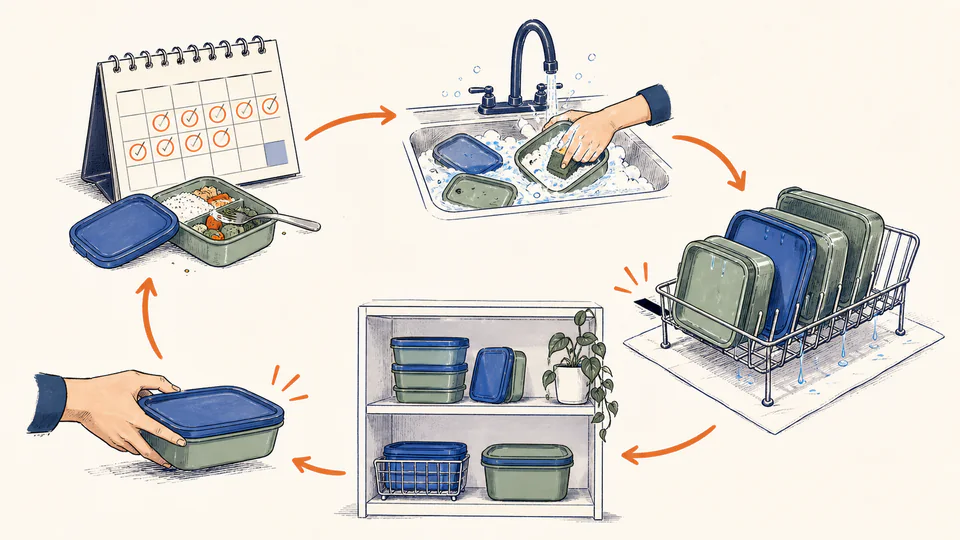
Drying can be the longest stage
A quick wash does not matter if air drying or inspection extends return time. Measure the complete unavailable interval.
Practical household planning
Plan a reusable-item rotation from daily demand, turnaround time, reserve inventory, batch capacity, cleaning frequency, and processing hours.
REUSABLE ROTATION SCHEDULE
Running out of clean items is a flow problem, not a shopping-price problem. This calculator tests two constraints: how often owned inventory can turn through a declared cleaning delay, and how many items the available batches can process. It supports a household scheduling decision; it does not certify a sanitation procedure or product-specific drying time.
REUSABLE ROTATION SCHEDULE
A negative capacity margin means demand exceeds at least one entered constraint. Identify whether the limiting value is inventory cycling or cleaning throughput before buying more items; extra inventory alone cannot repair inadequate processing capacity.
| Flow stage | Demand / quantity | Rate / time | Weekly capacity |
|---|
CURRENT CALCULATION PROCESS
D = ud; Irec = ceil(ut)+R; Ci = q·max(1,floor(7/t)); Cw = ba; C = min(Ci,Cw)
Convert daily use u and active days d into weekly demand D. Recommend inventory from demand during turnaround t plus reserve R. Compare inventory cycling capacity Ci with cleaning capacity Cw; the smaller is the operational bottleneck.
| Symbol | Meaning | Unit | Default |
|---|---|---|---|
| D | Weekly demand | uses/week | calculated |
| u | Uses per active day | uses/day | 3 |
| d | Active days | days/week | 6 |
| t | Turnaround duration | days | 2 |
| R | Protected reserve | items | 2 |
| q | Owned inventory | items | 8 |
| b | Batch capacity | items/batch | 6 |
| a | Available batches | batches/week | 3 |
Conversions and rounding: Convert turnaround into whole weekly turns with floor(7/t), but allow at least one planning turn. Round recommended inventory and batches upward; preserve hours as decimal time.
HOW TO USE
SUBJECT FUNDAMENTALS
MODEL AND FORMULA
Convert daily use u and active days d into weekly demand D. Recommend inventory from demand during turnaround t plus reserve R. Compare inventory cycling capacity Ci with cleaning capacity Cw; the smaller is the operational bottleneck.
DEEPER DECISION ANALYSIS
A quick wash does not matter if air drying or inspection extends return time. Measure the complete unavailable interval.
Weekly averages can pass while one high-demand day empties the shelf. Run the busiest credible pattern before setting reserve.
A theoretical machine capacity is not an available batch. Calendar access, labor, and prohibited mixed loads determine usable throughput.
WORKED DECISION CASES
A household alternates containers while two days of wash-and-dry time are covered. Reserve protects an unexpected late return without inflating every daily allocation.
Weekly capacity looks generous, but all demand occurs in one evening and items cannot be washed during service. A peak inventory plan is required outside this steady-flow model.
TECHNICAL LANGUAGE
EVIDENCE AND DATA LINEAGE
Use a dated demand log, item count, wash start and finish times, drying and inspection completion, batch occupancy, and missed-cycle record. Product care instructions define allowable cleaning and drying procedures. Record special loads separately when they cannot share a batch.
LIMITS AND EXCLUSIONS
RELIABLE SOURCES
FREQUENTLY ASKED QUESTIONS
Reserve is protected disruption capacity; embedding it in normal demand would make it unavailable when a delay occurs.
Enter the measured fraction, but verify peak concurrency because the weekly-turn approximation may overstate same-day availability.
No. When cleaning capacity is the bottleneck, additional items delay failure but do not raise sustainable weekly throughput.
Batches required are rounded upward because any remaining items still need a cycle, even when the final load is not full.
Only if their care method, capacity consumption, turnaround, and hygiene rules are compatible. Otherwise model separate streams.
Entered capacity exactly equals average weekly demand, leaving no throughput protection beyond the separately entered reserve inventory.
IMPORTANT NOTE
Use manufacturer instructions and relevant health or safety guidance for actual cleaning. This calculator only organizes entered demand and turnaround assumptions.