Sequential dependencies
If the ring choice must be final before travel or photography can be booked, the maximum-lead assumption is too optimistic. Use a dependency schedule instead.
Love and relationship planning
Test a planned proposal date against remaining preparation tasks, ring and permit lead times, weekly capacity, and a protected final buffer.
PROPOSAL READINESS
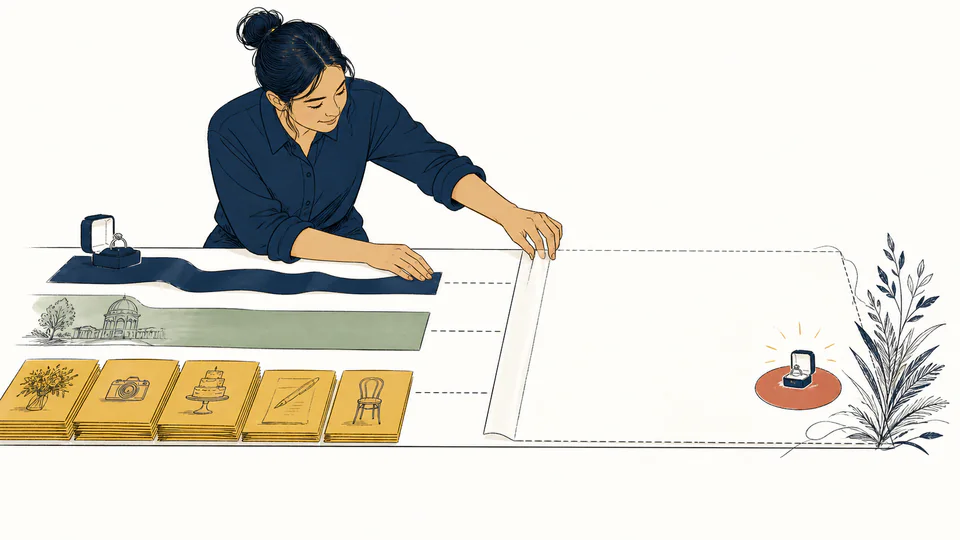
A date on the calendar is not a readiness milestone when a ring, permit, or location confirmation is still on a longer external clock. This model separates parallel external lead from couple-owned preparation and protects the final buffer before declaring the milestone supported.
PROPOSAL READINESS
A nonnegative capacity gap means the declared task backlog fits after the longest parallel lead and protected buffer. It does not guarantee vendor delivery, privacy, weather, or the other person’s preferred timing.
| Layer | Calendar or tasks | Lead/buffer/rate | Capacity or duration | Gap/slack |
|---|
CURRENT CALCULATION
Lext = max(Lring, Lpermit); Dwork = D - Lext - B; C = Dwork/7 x W; gap = C - T
The model treats confirmed ring and site leads as parallel, subtracts the longer lead and final buffer from the calendar, then compares the remaining task capacity with the defined backlog.
HOW TO USE THIS DECISION TOOL
SUBJECT FOUNDATIONS
MODEL BOUNDARY
The model treats confirmed ring and site leads as parallel, subtracts the longer lead and final buffer from the calendar, then compares the remaining task capacity with the defined backlog.
DECISION DEPTH
If the ring choice must be final before travel or photography can be booked, the maximum-lead assumption is too optimistic. Use a dependency schedule instead.
A public location may require crowd, access, security, or staff coordination that does not appear in a simple task count.
Operational completion cannot establish that the relationship is ready for marriage or that a surprise format is welcome. Those decisions require direct knowledge and communication.
REAL USE CASES
The longest external lead consumes most of the calendar. The planner either moves the date or chooses an available alternative instead of spending the final buffer.
Site authorization, not task throughput, becomes the limiting evidence. The planner keeps a confirmed backup that respects the same privacy and accessibility needs.
TERMS USED ON THIS PAGE
EVIDENCE TO RETAIN
Keep dated ring estimates, resizing or shipping terms, permit or reservation confirmation, task register, owner assignments, completed-week history, backup location, accessibility notes, weather trigger, and the explicit decision that protects the final buffer.
LIMITS AND EXCLUSIONS
RELIABLE SOURCES
QUESTIONS SPECIFIC TO THIS DECISION
The default assumes ring and site work can happen in parallel. Add them only when one truly must finish before the other begins.
Only if its done condition is comparable with the rest. Split research, sizing, purchase, insurance, and pickup when they create separate dependencies.
The arithmetic fits exactly with no calendar recovery room. Any rework or slower week consumes the planned date.
It can, but doing so changes the risk posture. Recalculate with the reduced buffer rather than silently treating it as ordinary work time.
No. The page checks preparation resources only and cannot assess consent, commitment, relationship health, or personal preference.
Rerun after a vendor change, missed weekly target, location restriction, travel change, or scope decision that changes the task backlog.
IMPORTANT BOUNDARY
This calculator is a deterministic event-planning aid. It does not provide relationship counseling, legal, financial, safety, jewelry, insurance, medical, or venue advice.
RELATED CALCULATORS