More visits can coincide with a lower unit cost
The ambitious case may assume early booking or shared lodging, but the discount must be entered rather than presumed.
Practical relationship planning
Price three independently entered meeting-frequency scenarios with scenario-specific cost changes and select the highest-frequency case inside an annual budget.
THREE MEETING SCENARIOS
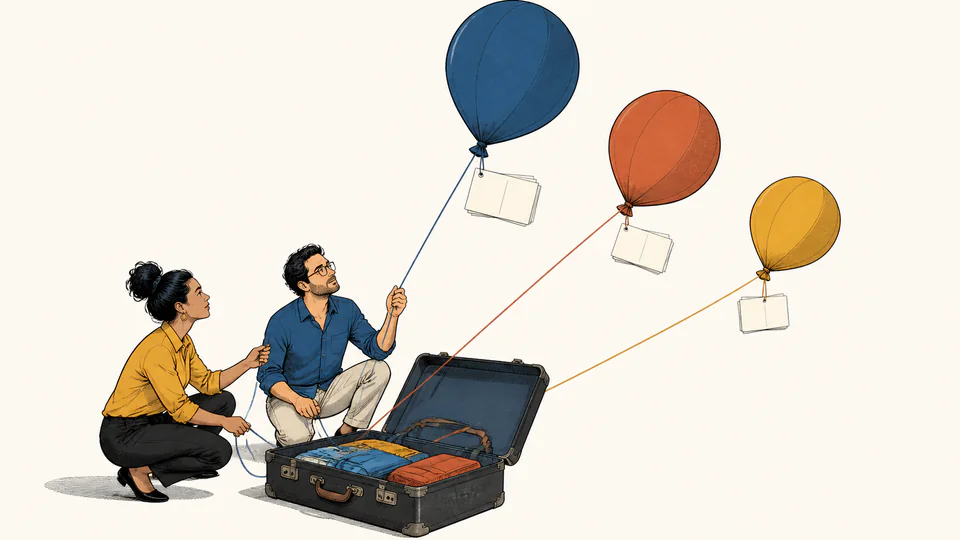
A travel plan changes on two axes: how often people meet and what each meeting costs. This calculator prices cautious, expected, and ambitious visit counts with separate cost-change assumptions, then recommends the highest-frequency scenario that fits the entered annual budget. It does not assign probabilities to the scenarios.
THREE MEETING SCENARIOS
The preferred label follows the entered budget rule only. A lower-frequency plan may still be preferable for health, work, safety, or relationship reasons.
| Scenario | Visit count | Adjusted cost / visit | Annual cost |
|---|
CURRENT CALCULATION PROCESS
Cj=nj(B+L)(1+qj); choose max nj subject to Cj≤A
Add the common base travel and local amounts, apply each scenario’s own percentage change, multiply by that scenario’s visit count, then choose the affordable case with the greatest frequency.
| Symbol | Meaning | Unit | Default |
|---|---|---|---|
| j | Scenario index | cautious/expected/ambitious | three cases |
| nj | Visits in scenario j | visits/year | 4; 6; 9 |
| B | Base travel cost | USD/visit | 500 |
| L | Base local cost | USD/visit | 120 |
| qj | Scenario cost change | decimal | 0.10; 0; −0.05 |
| Cj | Scenario annual total | USD/year | calculated |
| A | Annual budget | USD/year | 4000 |
Conversions and rounding: Convert each cost-change percentage independently. Negative changes must remain above −100%. Preserve scenario totals at full precision and display currency to cents.
HOW TO USE
SUBJECT FUNDAMENTALS
MODEL AND FORMULA
Add the common base travel and local amounts, apply each scenario’s own percentage change, multiply by that scenario’s visit count, then choose the affordable case with the greatest frequency.
DEEPER DECISION ANALYSIS
The ambitious case may assume early booking or shared lodging, but the discount must be entered rather than presumed.
Late or inflexible bookings can raise the unit cost even when annual frequency falls.
The names organize decisions; they are not statistical confidence levels or outcome odds.
WORKED DECISION CASES
The expected case fits with a positive margin while the ambitious case exceeds the envelope.
The model falls back to the least expensive total, signaling that frequency or unit cost needs redesign.
TECHNICAL LANGUAGE
EVIDENCE AND DATA LINEAGE
Keep current fare and lodging quotes, booking windows, expected discount conditions, visit-count rationale, and the annual budget source. Record which assumption changed when comparing later runs.
LIMITS AND EXCLUSIONS
RELIABLE SOURCES
FREQUENTLY ASKED QUESTIONS
The labels cautious, expected, and ambitious describe increasing frequency in this model.
Yes, when supported by a discount or lower-cost design; it must remain above −100%.
Its total is zero but it is excluded from the highest-frequency affordable recommendation.
The page is a transparent case comparison and does not collect defensible probabilities.
Represent that difference in the scenario percentage or run separate models when category-level detail matters.
No. It only compares arithmetic with the entered budget.
IMPORTANT NOTE
Discuss uncertainty openly and avoid using an ambitious case as a commitment. Confirm bookings, safety conditions, and each person’s capacity before acting.