Rates have different purposes
Tax, employer-reimbursement, fleet, and personal cash-cost rates may include different items. Label the source and date instead of treating one published rate as universal.
Love and relationship planning
Convert one-way distance and visit frequency into annual round-trip distance, distance-based travel cost, alternate fares, and a break-even rate.
LONG-DISTANCE VISIT ROUTE
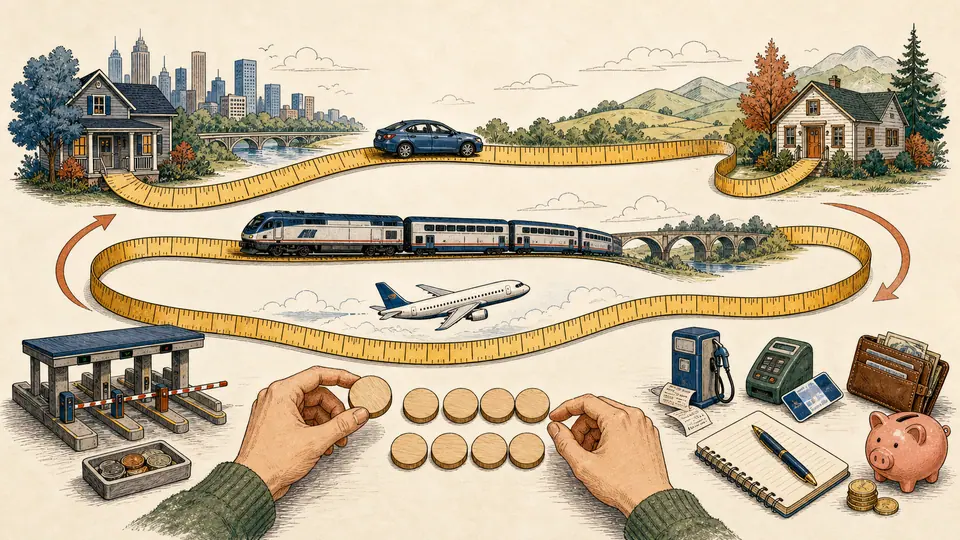
A visit plan repeats a round trip across the year. This calculator keeps distance-based operating cost, tolls, passenger count, and an alternate round-trip fare visible so the cost comparison uses the same trips and travelers.
LONG-DISTANCE VISIT ROUTE
The lower-cost label reflects only entered money costs for the same trip count. It does not price fatigue, safety, reliability, emissions, schedule access, or vehicle availability.
| Mode | Distance per trip | Annual trips | Cost per trip | Annual recorded cost |
|---|
CURRENT CALCULATION
Dround = 2Doneway; Dannual = Dround x N; Cdrive = N(Dround r + toll); Calt = N fare travelers
The model doubles the one-way route, repeats it for the planned number of visits, applies a user-entered distance cost and per-trip tolls, and compares the annual total with passenger fares for an alternate mode.
HOW TO USE THIS DECISION TOOL
SUBJECT FOUNDATIONS
MODEL BOUNDARY
The model doubles the one-way route, repeats it for the planned number of visits, applies a user-entered distance cost and per-trip tolls, and compares the annual total with passenger fares for an alternate mode.
DECISION DEPTH
Tax, employer-reimbursement, fleet, and personal cash-cost rates may include different items. Label the source and date instead of treating one published rate as universal.
Refundability, baggage, transfers, seat selection, and rebooking rights can change the comparable alternate fare. Preserve the actual fare conditions.
Driving, rail, and air routes do not share one physical path. The distance result describes the distance-based option; alternate modes remain fare-based unless separately modeled.
REAL USE CASES
Use a documented vehicle planning rate plus tolls for the car and a fee-inclusive return fare for each rail traveler. Parking at either station belongs in the selected boundary.
A flight fare alone is incomplete when airport transfers recur. Add those costs to the alternate fare before comparing it with the repeated road plan.
TERMS USED ON THIS PAGE
EVIDENCE TO RETAIN
Keep the route date, source and unit, planned trip count, traveler count, distance-rate source and included costs, toll and parking evidence, alternate fare quote, mandatory fees, fare restrictions, and calculation date. Published rates should be recorded with their effective period.
LIMITS AND EXCLUSIONS
RELIABLE SOURCES
QUESTIONS SPECIFIC TO THIS DECISION
Either works if the one-way distance and cost rate use the same unit. State the unit in the saved record.
Not necessarily. It serves specific tax purposes and changes over time. Use a rate appropriate to your planning boundary and document its source.
Passenger modes usually charge each traveler, while the distance-based vehicle cost may be shared by occupants. The comparison must reflect how many fares are needed.
It can when tolls alone exceed the alternate total fare. In that case no nonnegative distance rate makes the distance-based option cheaper under the entered boundary.
Only if it is included in the entered one-way route. Add destination travel explicitly in a broader trip budget if it applies differently by mode.
The label reports recorded money cost only. Consider time, reliability, personal safety, weather, accessibility, flexibility, and relationship preferences separately.
IMPORTANT BOUNDARY
This calculator does not establish deductible mileage, reimbursement rights, safe routing, insurance coverage, vehicle fitness, entry eligibility, or carrier obligations. Verify current rates and obtain appropriate professional guidance.