Physics and mechanics
Electric Field Trajectory Calculator
Calculate the two-dimensional nonrelativistic trajectory of a charged particle in a uniform static electric field, including acceleration, final velocity, electric work, and kinetic-energy reconciliation.
CURRENT MODEL
Enter the declared electric-field case
Physics students and laboratory planners screening low-speed charged-particle motion over a short interval before using a numerical field or relativistic model.
Decision supportedEstimate displacement and final velocity under the declared uniform field and determine whether the low-speed, collision-free approximation remains admissible.
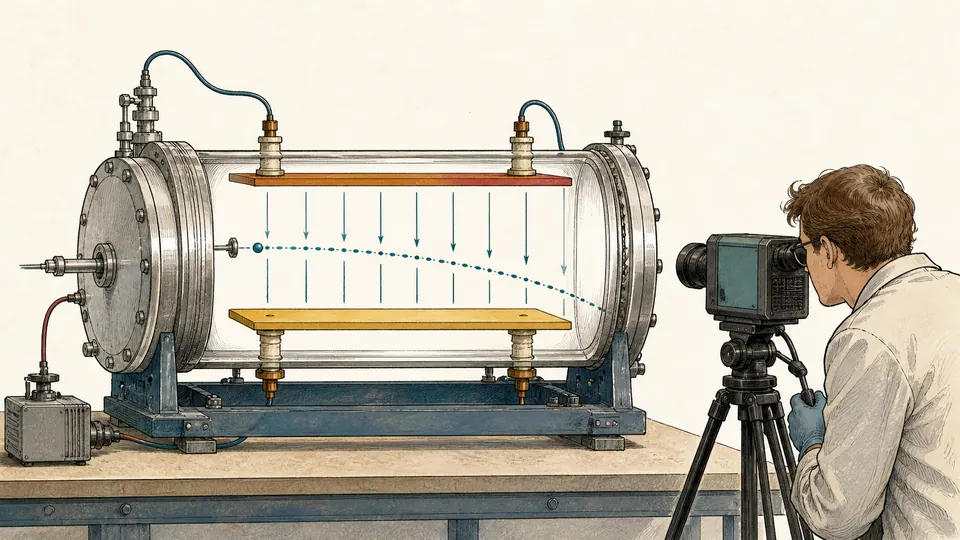
SUBJECT DECISION ILLUSTRATION
A charged bead crossing a controlled uniform field
The static scene communicates the physical assumptions without becoming a fake trajectory chart; current motion values stay in the exact ledger.
| Quantity | Expression | Current value | Unit | Interpretation |
|---|
How to use
Screen a charged particle's uniform-field flight
- Confirm that one constant electric-field vector is a reasonable approximation over the full path and time interval.
- Enter signed particle charge and positive mass from the same particle or bead specification.
- Resolve electric field and initial velocity into one x-y coordinate frame before entering their components.
- Choose a nonnegative flight time short enough that boundaries, collisions, and field changes remain negligible.
- Read acceleration, position, and velocity together; charge sign controls the direction of acceleration relative to E.
- Inspect the 0.1c screening and work-energy residual before using the result as an initial condition for a higher-fidelity model.
Trajectory fundamentals
Five layers of uniform electric-force motion
- Electric force
- The uniform force vector is qE, so negative charge reverses acceleration relative to the field.
- Charge-to-mass ratio
- Acceleration scales with q/m; small mass or large charge makes the path far more sensitive.
- Component independence
- Constant x and y accelerations can be solved separately and recombined into one trajectory.
- Ballistic boundary
- Zero charge or zero field gives constant-velocity motion rather than an invalid calculation.
- Work-energy audit
- For the modeled electric force, qE dot displacement must equal the kinetic-energy change.
Calculation method
Convert to SI, apply qE/m, and integrate constant acceleration
Nanocoulombs become coulombs, milligrams become kilograms, and milliseconds become seconds. The calculator obtains two acceleration components from qE/m, then applies the constant-acceleration displacement and velocity equations to each axis.
Finally, electric work is computed from the field-displacement dot product and compared with the kinetic-energy change. A speed check occurs before the page presents the Newtonian result as admissible.
Path curvature depends on relative directions
If acceleration is parallel to initial velocity, the particle stays on a line while speeding up or slowing down. A transverse acceleration creates the visible parabolic deflection.
Negative charge reverses the bend
The electric field keeps its declared direction, but qE changes sign. This is why positive and negative particles launched identically diverge to opposite sides.
Uniform-field and low-speed gates are independent
A particle may remain slow while crossing a strongly nonuniform fringe field, or stay in a uniform field long enough to become relativistic. Either failure requires another model.
Detailed calculation process
Symbols, current substitution, intermediate quantities, and reconciliation
a=qE/m; Delta r=v_0t+0.5at^2; v_f=v_0+atThe SI trajectory and energy audit use unrounded values; displayed positions, speeds, and joules are formatted afterward.
| Symbol | Meaning | Default | Unit |
|---|---|---|---|
| q | Signed particle charge | 1 nC = 1e-9 C | C |
| m | Particle mass | 1 mg = 1e-6 kg | kg |
| E_x, E_y | Uniform field components | 1000, 500 | V/m |
| v_0x, v_0y | Initial velocity components | 0.2, 0 | m/s |
| t | Elapsed flight time | 100 ms = 0.1 s | s |
| a_x, a_y | Electric acceleration components | calculated | m/s2 |
| Delta r | Displacement from the origin | calculated | m |
| W_E, Delta K | Electric work and kinetic change | calculated | J |
Waiting for valid inputs.
Result interpretation
Use the signed components before reducing motion to speed
Final speed alone hides which side of the axis the particle reaches. Position and velocity components preserve that direction. Zero elapsed time returns the origin and initial velocity, while zero charge produces a straight ballistic path and zero electric work.
Evidence to retain
Record particle, field, and timing provenance
Keep particle identity, charge-state method, mass and uncertainty, field-map evidence, electrode geometry, coordinate axes, launch position and velocity, timing trigger, vacuum or gas conditions, collision mean free path, magnetic field estimate, boundary distances, and the reason 0.1c is an acceptable screening threshold.
Scope and limitations
What the constant-acceleration path excludes
- No spatial or temporal field variation, electrode fringe, or space-charge feedback
- No magnetic Lorentz force, gravity, drag, collisions, scattering, or radiation loss
- No relativistic momentum or kinetic energy at/above the screening boundary
- No particle size, rotation, polarization, charge leakage, or image-charge force
- No impact, aperture, chamber wall, or detector interception check
- No quantum behavior, beam distribution, or stochastic uncertainty
Point particle, constant mass and charge, spatially and temporally uniform electric field, no magnetic field, gravity, drag, collisions, radiation, boundaries, or space-charge feedback; initial and final speed below 0.1c.
Key terminology
Charged-particle trajectory glossary
- Uniform field
- A field vector assumed constant across the modeled position and time interval.
- Charge-to-mass ratio
- The signed factor q/m that converts electric field into acceleration.
- Ballistic motion
- Constant-velocity travel when the modeled net force is zero.
- Transverse deflection
- Displacement perpendicular to the initial velocity caused by a field component.
- Work-energy theorem
- The equality between net work and change in kinetic energy.
- Relativistic screening
- A speed threshold used to reject cases where Newtonian formulas are no longer appropriate.
Practical cases
Two trajectories that call for different next steps
Charged calibration bead
A milligram bead in a modest plate field remains far below the speed gate and travels only millimetres. The team uses the result to size a camera field of view, then checks drag and actual plate uniformity.
Electron-device model rejection
An electron-scale mass with a long flight interval reaches the low-speed gate almost immediately. The page rejects the result, directing the designer to relativistic particle tracking and a numerical electrode field map.
Important note
An energy residual near zero validates arithmetic, not apparatus fidelity
Before using the trajectory for equipment design, confirm field uniformity, collisions, magnetic fields, boundaries, charge stability and whether relativistic or stochastic effects are negligible.
Frequently asked questions
Why is the path curved in a uniform electric field?
A constant electric force gives constant acceleration. Unless acceleration is exactly parallel to the initial velocity, the two component motions combine into a parabolic path.
What does a negative particle charge change?
It reverses both acceleration components relative to the electric-field vector. The entered initial velocity is unaffected.
Why is zero charge allowed?
A neutral particle experiences no electric force in this model, so it continues at constant initial velocity. That ballistic boundary is physically meaningful.
Why impose a 0.1c screening limit?
The equations use Newtonian momentum and kinetic energy. The conservative screening limit prevents the page from presenting a clearly relativistic result as valid.
Does the energy check prove the real apparatus is lossless?
No. It proves only that the implemented uniform electric-force model reconciles work and kinetic-energy change. Collisions, radiation, drag, and boundaries are excluded.
Can this model electrons between real electrodes?
Only when the field is adequately uniform, the travel remains low-speed, and collisions and quantum effects are negligible. Many electron devices need relativistic or numerical particle tracking.
Authority and follow-on work
Reliable sources and related calculators
- OpenStax University Physics - Electric FieldProvides F=qE and electric-field vector conventions.
- OpenStax University Physics - Constant AccelerationConstant-acceleration velocity and displacement equations.
- OpenStax University Physics - Electric Potential EnergyElectric work and kinetic/potential-energy relationship.
- NIST Fundamental Physical ConstantsExact speed of light used for the low-speed screening ratio.
Related calculators
Continue with a genuinely different electric-field question without silently changing this page's assumptions.