Physics and engineering
Magnetic Force Equilibrium Calculator
Compare upward magnetic force on a straight conductor with supported weight and downward preload, then solve the equilibrium current.
CURRENT MODEL
Balance magnetic lift against weight and preload
Teaching laboratories and preliminary actuator teams checking an ideal magnetic lift balance before mechanical and thermal design.
Decision supportedDetermine whether the entered current produces upward excess, downward deficit, or force balance, and find the finite equilibrium current when geometry permits.
PHYSICAL CONTEXT
The modeled decision in context
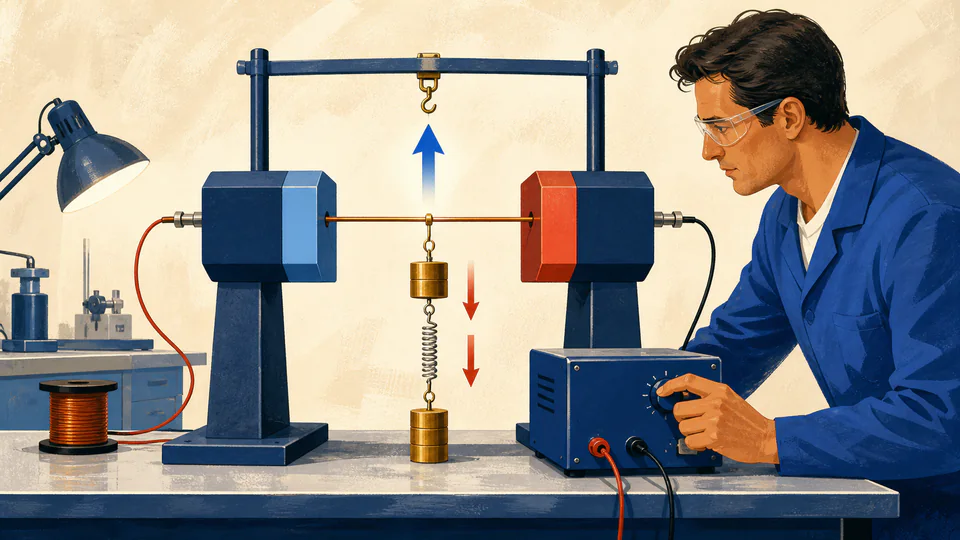
This static editorial scene clarifies the apparatus and evidence boundary; all current numeric detail remains in the exact ledger below.
| Quantity | Symbol or equation | Current value | Unit |
|---|
How to use
Establish a vertical force balance
- Enter supported mass separately from force preload.
- Measure field over the active straight segment.
- Enter the current being tested.
- Convert physical active length from the fixture drawing.
- Confirm right-hand direction is upward and enter the current-field angle.
- Compare net force and required current before energizing hardware.
Equilibrium fundamentals
Six layers of the balance
- Weight
- Mass becomes downward force through standard gravity.
- Preload
- Additional fixed downward force is added, not converted as mass.
- Magnetic lift
- Upward force follows B I L sin(theta).
- Net force
- Positive means upward excess under the declared axis.
- Equilibrium current
- Current that makes ideal net force zero.
- Feasibility
- Positive load cannot be balanced by zero magnetic geometry.
Calculation method
Build the load before solving current
The model converts grams to kilograms, calculates weight, adds preload, and independently calculates force per ampere. Their ratio yields equilibrium current only when magnetic geometry is nonzero.
Direction discipline
The scalar equation cannot prove lift direction; reverse current or field and the physical force reverses.
Stability question
Zero net force at one position does not establish stable equilibrium when field or preload changes with displacement.
Current heating
The required current may violate conductor temperature or supply limits even when magnetic arithmetic is feasible.
Detailed calculation process
Symbols, conversions, substitution, intermediate results, and reconciliation
F_B=B I L sin(theta); F_load=mg+F_pre; I_eq=F_load/[B L sin(theta)]Mass and length convert to SI before force balance. Balance tolerance and infeasible geometry are resolved before display rounding.
| Symbol | Meaning | Default | Unit |
|---|---|---|---|
| m | Supported mass | 10 | g |
| B | Uniform field | 0.5 | T |
| I | Entered current | 0.5 | A |
| L | Active length | 50 | cm |
| theta | Current-field angle | 90 | deg |
| F_pre | Downward preload | 0.02 | N |
Waiting for valid inputs.
Interpretation
Separate force balance from motion
Upward excess predicts initial acceleration only if supports permit motion. A balanced label means ideal force equality, not stable levitation or structural acceptance.
Evidence and measurement
Document both sides of the balance
Retain mass calibration, local gravity choice, preload source, field map, current measurement and polarity, active-length datum, angle, support friction, temperature, supply limit, and uncertainty.
Scope and limitations
Excluded balance effects
- Friction and guide reactions
- Spring force varying with position
- Field gradients and saturation
- Dynamic acceleration and damping
- Conductor heating and resistance
- Levitation stability and safety
A rigid straight conductor experiences uniform upward magnetic force; gravity and preload act downward. Dynamic motion, suspension stiffness, and field gradients are excluded.
Key terminology
Balance glossary
- Supported mass
- Mass whose weight enters the load.
- Preload
- Declared additional downward force.
- Net force
- Signed upward force minus total load.
- Force per ampere
- Geometry coefficient B L sin(theta).
- Equilibrium current
- Current producing ideal force equality.
- Infeasible geometry
- Zero magnetic coefficient with positive load.
Practical cases
Two balance outcomes
Slight upward excess
The default 0.5 A produces 0.125 N against 0.1180665 N load, giving a small upward excess.
Parallel conductor
A positive load with zero angle has no finite equilibrium current, so geometry must change before current is specified.
Important note
Force equality is not stable levitation
Verify polarity, constraints, temperature, dynamics, and fail-safe support on the real assembly.
Frequently asked questions
What does equilibrium mean here?
Upward ideal magnetic force equals supported weight plus the entered downward preload, leaving zero net vertical force.
Why can equilibrium be infeasible?
A positive load cannot be balanced when field, active length, or sin(theta) makes force per ampere zero.
Why use standard gravity?
The page converts mass to nominal weight with 9.80665 m/s squared. Precision local balances may require local gravitational acceleration.
Does a positive current margin guarantee lift?
Only in the declared direction and ideal geometry. Friction, stiffness, field nonuniformity, heating, and structure can change actual motion.
Can the preload represent a spring?
Only as a fixed force at the assessed position. A displacement-dependent spring needs a coupled force-position equilibrium model.
Is exact numerical balance stable?
Not necessarily. Stability depends on how magnetic, gravitational, spring, and control forces change with displacement.
Authority and follow-on work
Reliable sources and related calculators
- OpenStax — Magnetic Force on a Current-Carrying ConductorIncludes the straight-wire force law and a magnetic-force/weight balance example.
- NIST Guide to the SISupports SI force and length conventions.
- NIST — Standard Acceleration of GravitySupports the standard gravity value used for nominal weight.