p

Physics and electromagnetism

Magnetic Force Solver Calculator

Solve all three components of the magnetic Lorentz force from signed charge, velocity, and magnetic-field vectors with SI conversions and orthogonality checks.

Three-dimensional Lorentz force

Solve magnetic force as a vector, not a magnitude shortcut

Enter velocity and magnetic-field components in one right-handed Cartesian frame. The calculator evaluates the cross product before applying the signed charge, exposing direction reversals that a scalar |q|vB sin(theta) calculation cannot show.

Force magnitude-
Force Fx-
Force Fy-
Force Fz-

Current model evidence

Vector cross-product ledger

Use component signs for direction and the norm for magnitude; preserve the same coordinate frame for v and B.
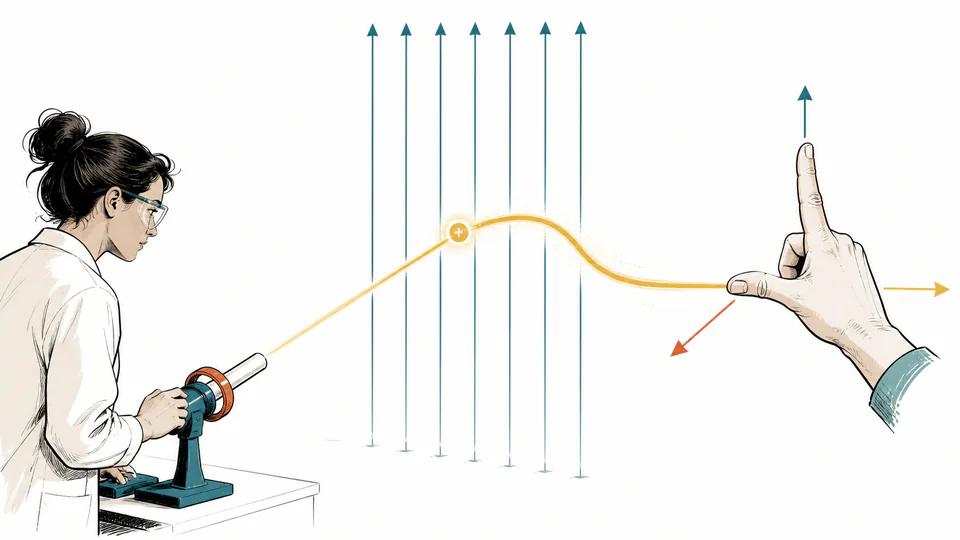
Editorial charged-particle experiment with perpendicular velocity, magnetic field, and force directions arranged in a right-handed frame
The magnetic force is perpendicular to both velocity and field; reversing charge reverses the force vector without changing its magnitude.
Vector cross-product ledgerCurrent unrounded calculation path
Use component signs for direction and the norm for magnitude; preserve the same coordinate frame for v and B.
Vector stageDisplayed inputConversion / ruleCurrent valueScope / unit

DETAILED CALCULATION PROCESS

Formula, units, default substitution, and reconciliation

1. Governing relation

F = q(v x B); Fx = q(vy Bz - vz By), Fy = q(vz Bx - vx Bz), Fz = q(vx By - vy Bx)

Normalize microcoulombs, kilometres per second, and millitesla to SI units; compute v x B in a right-handed basis; multiply every component by the signed charge; then verify F dot v and F dot B.

2. Symbols and default basis

SymbolMeaningUnitDefault basis
qSigned particle chargeC+1.6 microC
vParticle velocity vectorm/s(3, 4, 0) km/s
BMagnetic flux-density vectorT(0, 0, 250) mT
FMagnetic Lorentz-force vectorNSolved
thetaSmaller angle between v and BdegDerived
dotScalar product used for orthogonalitymixedF dot v and F dot B

3. Unit and sign normalization

  • Multiply each velocity component by 1000 to convert km/s to m/s.
  • Multiply each field component by 1e-3 to convert mT to T.
  • Multiply charge in microcoulombs by 1e-6; its sign is retained after the cross product.

4. Current numerical substitution

    5. Independent reconciliation

    HOW TO USE THIS CALCULATOR

    Five steps from measured inputs to a defensible result

    1. Define a right-handed x-y-z frame and record it with the measurement.
    2. Resolve the velocity into signed x, y, and z components in km/s.
    3. Resolve the magnetic field into components in the identical frame and enter the signed charge.
    4. Use the force components for direction-sensitive work; use the magnitude only for scalar comparisons.
    5. Check both dot products before exporting because a nonzero value signals a wiring, frame, or arithmetic error.

    ELECTROMAGNETIC FOUNDATIONS

    Concepts that control this specific model

    The cross product carries direction
    v x B follows the right-hand rule and changes sign when its operand order is reversed.
    Charge sign flips the force
    A negative charge moves opposite the right-hand-rule direction obtained for a positive charge.
    Parallel motion has zero magnetic force
    When v is parallel or antiparallel to B, the cross product vanishes.
    Magnetic force does no instantaneous work
    Because F is perpendicular to v, the power F dot v is zero in this model.
    Components require one coordinate frame
    Mixing laboratory and sensor axes creates a plausible magnitude with an incorrect direction.

    DEEP ANALYSIS 1

    Why the determinant matters

    Each component depends on a different pair of velocity and field components. A single angle loses the directional information needed for steering, detector placement, or sign diagnosis.

    DEEP ANALYSIS 2

    Orthogonality is a strong independent audit

    The computed force must be perpendicular to both v and B. Dot products test this property without repeating the original component formulas.

    DEEP ANALYSIS 3

    Zero force has several distinct causes

    q = 0, v = 0, B = 0, and v parallel to B all return zero, but they represent different experimental states and should not be conflated.

    RESULT INTERPRETATION

    What the current output does and does not decide

    A positive Fx, Fy, or Fz points along the positive coordinate axis selected by the user; the page cannot infer a physical compass direction without that frame definition.

    The result is instantaneous. A particle trajectory also needs mass, initial position, electric fields, and time integration.

    REAL USE CASES

    Two decisions with different boundary conditions

    Beam steering in a transverse field

    For q = +1.6 microC, v = (3,4,0) km/s, and B = (0,0,250) mT, the force is (0.0016,-0.0012,0) N with magnitude 0.002 N.

    Negative carrier diagnosis

    Keeping v and B fixed while changing q from positive to negative reverses all force components. That sign change distinguishes carrier polarity without altering |F|.

    EVIDENCE AND DATA QUALITY

    What to retain with the exported result

    Retain the axis drawing, sensor sign conventions, calibration records, charge state, component inputs before unit conversion, timestamp, and exported dot-product checks. A magnitude-only record cannot reconstruct force direction.

    LIMITS AND EXCLUSIONS

    Where this physical model stops

    • Includes only the magnetic term q(v x B), not electric force qE.
    • Treats q, v, and B as instantaneous classical quantities at one location.
    • Does not integrate motion or account for field gradients and radiation.
    • Assumes all vector components use the same orthonormal right-handed frame.
    • Does not propagate instrument uncertainty or covariance between components.

    TERMS USED HERE

    Six terms that keep the calculation unambiguous

    Lorentz force
    Force on a charge due to electric and magnetic fields; this page uses only the magnetic term.
    Cross product
    Vector product perpendicular to both input vectors.
    Right-handed frame
    Coordinate basis whose positive axes obey the right-hand orientation rule.
    Component
    Signed projection of a vector along one axis.
    Orthogonality
    Perpendicular relation verified here by a zero dot product.
    Magnetic flux density
    Vector B measured in tesla.

    RELIABLE SOURCES

    References supporting the equation and units

    FREQUENTLY ASKED QUESTIONS

    Questions specific to this calculation

    Why can the charge be negative?

    The signed charge determines whether the magnetic force follows or opposes v x B.

    Can all three velocity components be zero?

    Yes. A stationary charge has zero magnetic force, although an electric field could still accelerate it.

    Why does a parallel field return zero?

    The sine of the angle between v and B is zero, so their cross product vanishes.

    Is F dot v exactly zero numerically?

    It should be zero within floating-point roundoff; the exported value exposes any small residual.

    Can I enter field strength in gauss?

    Convert first: 1 gauss = 0.1 mT. This page accepts mT components.

    Does this calculate the circular radius?

    No. Radius requires particle mass and the perpendicular speed; use the energy page for that model.

    IMPORTANT BOUNDARY

    Use the result as analysis, not certification

    This classical instantaneous-force calculation is not a charged-particle trajectory, magnet safety assessment, accelerator design certification, or relativistic analysis.