p

Physics and electromagnetism

Magnetic Force Energy Calculator

Partition a nonrelativistic charged particle’s kinetic energy into parallel and perpendicular components and calculate its Larmor radius in a uniform magnetic field.

Uniform-field energy partition

Separate magnetic turning from actual energy transfer

A static magnetic field bends the velocity component perpendicular to B but does no work. This page quantifies total, perpendicular, and parallel kinetic energy and connects the perpendicular share to the Larmor radius.

Total kinetic energy-
Perpendicular energy-
Parallel energy-
Larmor radius-

Current model evidence

Kinetic-energy and gyroradius ledger

Use the energy closure to audit the pitch-angle split and the radius only for the perpendicular motion.
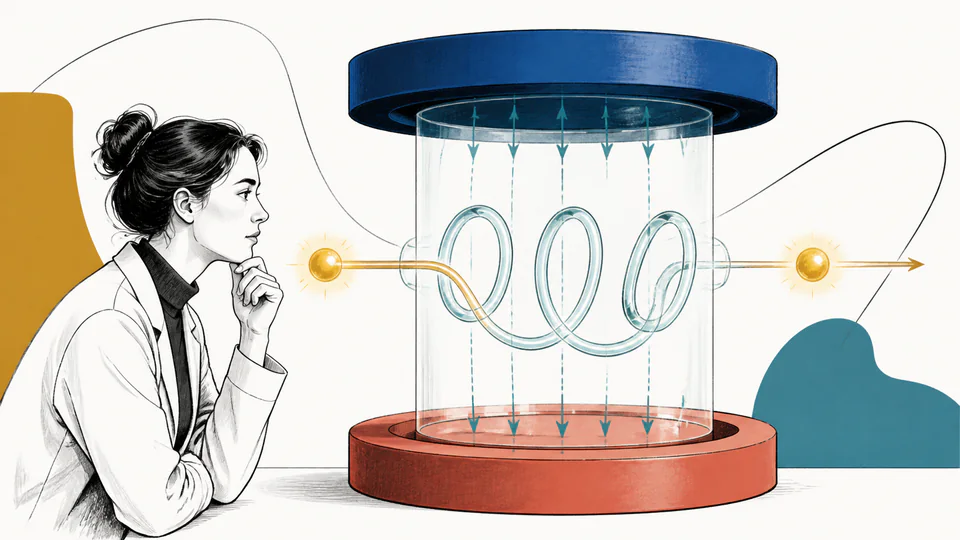
Editorial charged particle following a helix through a magnetic field while its parallel and perpendicular motion remain visibly distinct
The field redirects the perpendicular velocity into gyromotion while the parallel component advances along B; total kinetic energy stays constant.
Kinetic-energy and gyroradius ledgerCurrent unrounded calculation path
Use the energy closure to audit the pitch-angle split and the radius only for the perpendicular motion.
Energy stagePrimary basisSecondary basisCurrent valueScope / unit

DETAILED CALCULATION PROCESS

Formula, units, default substitution, and reconciliation

1. Governing relation

K = mv^2/2; K_perp = K sin^2(theta); K_parallel = K cos^2(theta); rL = m v_perp/(|q|B)

Convert mass, charge, speed, and field to SI; resolve velocity by pitch angle; compute kinetic-energy shares; derive the Larmor radius from perpendicular momentum; verify that the shares close to total energy.

2. Symbols and default basis

SymbolMeaningUnitDefault basis
mParticle rest masskg1 u
qSigned particle chargeC+1 e
vParticle speedm/s500 km/s
thetaPitch angle from Bdeg60 deg
K_perpKinetic energy in perpendicular motionJSolved
rLLarmor radiusmSolved

3. Unit and sign normalization

  • Mass in u is multiplied by the CODATA atomic mass constant.
  • Charge number is multiplied by the exact elementary charge; radius uses its absolute value.
  • Speed is multiplied by 1000 and B by 1e-3 before energy and radius calculations.

4. Current numerical substitution

    5. Independent reconciliation

    HOW TO USE THIS CALCULATOR

    Five steps from measured inputs to a defensible result

    1. Select a particle mass in atomic mass units and preserve the actual ionization state.
    2. Enter the signed charge number; the magnitude controls radius while the sign controls rotation direction outside this page.
    3. Enter speed below 0.1c and a nonzero uniform B magnitude.
    4. Measure pitch angle from the field direction, not from a plane perpendicular to B.
    5. Use the closure residual and stated limits before transferring the radius to aperture or confinement decisions.

    ELECTROMAGNETIC FOUNDATIONS

    Concepts that control this specific model

    Magnetic work is zero
    For F = q(v x B), F is perpendicular to v, so instantaneous power F dot v vanishes.
    Pitch angle partitions velocity
    v_perp = v sin(theta) gyrates; v_parallel = v cos(theta) advances along the field.
    Energy shares use squared components
    The sin^2 and cos^2 terms ensure K_perp + K_parallel = K.
    Radius follows perpendicular momentum
    Only m v_perp enters rL because parallel motion does not bend around the field line.
    Charge sign does not change radius magnitude
    Replacing q by -q reverses the rotation sense but leaves |q| and rL unchanged.

    DEEP ANALYSIS 1

    A helical path can have constant energy

    Direction changes continuously even when speed and kinetic energy do not. Force and energy transfer should therefore be reported separately.

    DEEP ANALYSIS 2

    Pitch-angle endpoints are meaningful boundaries

    At 0 or 180 degrees, v_perp and rL are zero; at 90 degrees all kinetic energy is perpendicular and the guiding center does not advance along B.

    DEEP ANALYSIS 3

    The 0.1c limit protects the classical approximation

    At higher speeds relativistic momentum increases the radius and changes frequency. Rejecting those values is safer than silently applying mv.

    RESULT INTERPRETATION

    What the current output does and does not decide

    Total energy is the classical translational kinetic energy before and during ideal uniform-field motion, not energy stored in the magnet.

    Larmor radius is a local uniform-field scale; it is not a full orbit radius when electric fields, gradients, collisions, or changing B are important.

    REAL USE CASES

    Two decisions with different boundary conditions

    Proton-like ion at 60 degrees

    A 1 u, +1 e particle at 500 km/s in 200 mT has 75% of its kinetic energy perpendicular to B and 25% parallel, producing finite helical radius.

    Field-aligned injection

    At pitch angle 0 degrees the particle keeps all kinetic energy in parallel motion and the ideal Larmor radius is zero because magnetic force vanishes.

    EVIDENCE AND DATA QUALITY

    What to retain with the exported result

    Retain particle species and charge state, speed-estimation method, pitch-angle definition, local field calibration, time and location, and the exported energy closure. State explicitly whether relativistic or electric-field effects were screened out.

    LIMITS AND EXCLUSIONS

    Where this physical model stops

    • Uses nonrelativistic kinetic energy and rejects speed at or above 0.1c.
    • Assumes a uniform static magnetic field and no electric field.
    • Excludes radiation, collisions, magnetic moments, field gradients, and adiabatic invariants.
    • Treats mass and charge state as fixed and exactly known.
    • Does not calculate orbit phase, guiding-center drift, or confinement lifetime.

    TERMS USED HERE

    Six terms that keep the calculation unambiguous

    Pitch angle
    Angle between particle velocity and magnetic-field direction.
    Perpendicular energy
    Kinetic energy associated with velocity transverse to B.
    Parallel energy
    Kinetic energy associated with velocity along B.
    Larmor radius
    Radius of ideal circular gyromotion about a field line.
    Guiding center
    Center around which the perpendicular velocity gyrates.
    Magnetic work
    Energy-transfer rate F dot v, equal to zero for the ideal magnetic force.

    RELIABLE SOURCES

    References supporting the equation and units

    FREQUENTLY ASKED QUESTIONS

    Questions specific to this calculation

    Why does the field not appear in total kinetic energy?

    A static magnetic field changes velocity direction, not speed, so K depends on mass and speed only.

    Why does B affect the radius?

    A stronger field supplies greater transverse force at the same speed, bending the path more tightly.

    What happens at a 90-degree pitch angle?

    All motion is perpendicular, K_perp equals K, K_parallel is zero, and the ideal path is circular.

    Does negative charge produce negative energy?

    No. Energy and radius are nonnegative; charge sign only reverses gyromotion direction.

    Why is zero charge rejected?

    An uncharged particle has no magnetic gyromotion, making the Larmor-radius denominator and this model inapplicable.

    Can I use an electron mass in u?

    Yes, if entered accurately, but the same nonrelativistic speed limit and fixed-mass assumptions apply.

    IMPORTANT BOUNDARY

    Use the result as analysis, not certification

    This ideal single-particle model is not a plasma-confinement design, radiation analysis, accelerator acceptance study, or relativistic orbit calculation.