Microsecond proton-like timing
A 1 u, +1 e particle in 200 mT cycles at about 3.07 MHz, completing roughly 30.7 turns in a 10 microsecond gate.
Physics and electromagnetism
Calculate nonrelativistic cyclotron angular rate, frequency, period, and turns during an observation interval from particle mass, charge state, and magnetic field.
Charged-particle turning rate
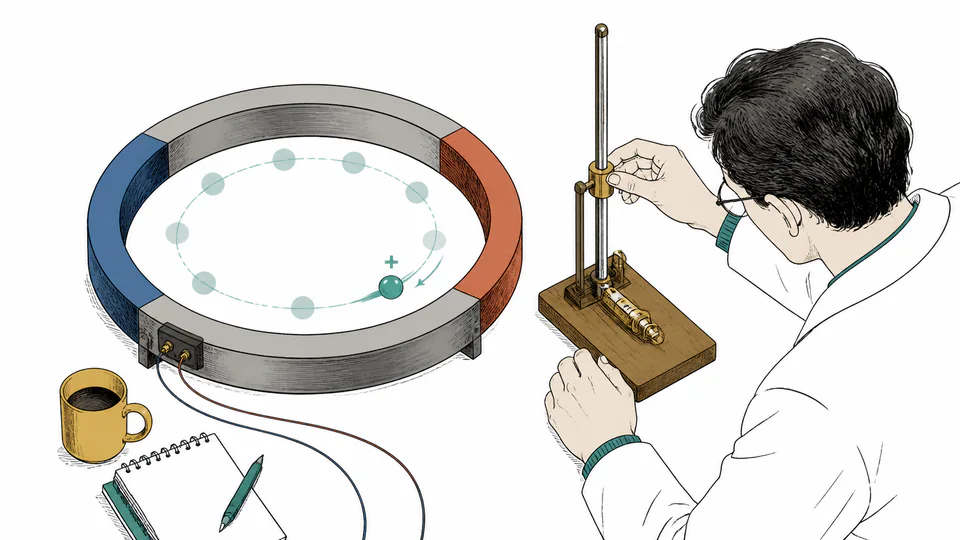
Here rate means the angular and cyclic rate of ideal nonrelativistic gyromotion in a uniform magnetic field. It is not force per time or changing field strength; the frequency follows the particle charge-to-mass ratio and B.
Current model evidence
Compare period with instrument timing and use turns only within the entered observation window.
| Rate stage | Numerator / input | Denominator / conversion | Current value | Scope / unit |
|---|
DETAILED CALCULATION PROCESS
omega_c = |q|B/m; f_c = omega_c/(2 pi); T_c = 1/f_c; N = f_c t_obs
Normalize mass, charge, B, and observation time to SI; evaluate angular frequency; convert radians per second to cycles per second; invert for period; then count cycles in the window.
| Symbol | Meaning | Unit | Default basis |
|---|---|---|---|
| m | Particle mass | kg | 1 u |
| q | Signed charge | C | +1 e |
| B | Uniform magnetic-field magnitude | T | 200 mT |
| omega_c | Cyclotron angular rate | rad/s | Solved |
| f_c | Cyclotron cycle frequency | Hz | Solved |
| t_obs | Observation interval | s | 10 microseconds |
HOW TO USE THIS CALCULATOR
ELECTROMAGNETIC FOUNDATIONS
DEEP ANALYSIS 1
Equating magnetic force |q|vB with centripetal force mv^2/r gives r = mv/(|q|B); dividing circumference by speed removes v from the period.
DEEP ANALYSIS 2
A detector gate can end partway through a cycle. The decimal turn count is phase advance divided by 2 pi, not a count of completed events.
DEEP ANALYSIS 3
At high speed the momentum factor gamma raises the effective orbital inertia and lowers the observed cyclotron rate. This page intentionally stops at the classical formula.
RESULT INTERPRETATION
Frequency and period characterize ideal local gyromotion, not collision rate, detector count rate, or magnetic-field switching rate.
Turns estimate accumulated phase only if mass, charge state, and B remain constant throughout the observation interval.
REAL USE CASES
A 1 u, +1 e particle in 200 mT cycles at about 3.07 MHz, completing roughly 30.7 turns in a 10 microsecond gate.
At the same B and charge magnitude, a 40 u ion rotates forty times more slowly, which may move its period outside an instrument’s sampling window.
EVIDENCE AND DATA QUALITY
Retain species and charge-state assignment, local B calibration and polarity, observation-window clock source, nonrelativistic justification, and exported reciprocal check. Document any field nonuniformity across the expected orbit.
LIMITS AND EXCLUSIONS
TERMS USED HERE
RELIABLE SOURCES
FREQUENTLY ASKED QUESTIONS
It cancels from the classical uniform-field period derivation; speed changes radius instead.
Frequency is a nonnegative rate magnitude; the sign is reported separately as rotation sense.
No. An uncharged particle has no cyclotron motion, so frequency and period are not defined by this model.
Hz counts cycles per second; rad/s counts angular phase, with omega = 2 pi f.
No. It describes one particle’s phase accumulation, not an event count.
No. Relativistic momentum changes the rate and requires a different equation.
IMPORTANT BOUNDARY
This ideal cyclotron timing estimate is not a detector calibration, accelerator synchronization design, plasma collision model, or relativistic frequency calculation.