Launch angle
Angle changes both components at once. Near vertical launch, a small angle change can create a large relative change in horizontal range even when speed barely changes.
Physics and mechanics
Convert projectile launch speed and calculated range between SI and US customary units while preserving vector components, launch height, gravity, and unrounded flight time.
PROJECTILE UNIT BRIDGE
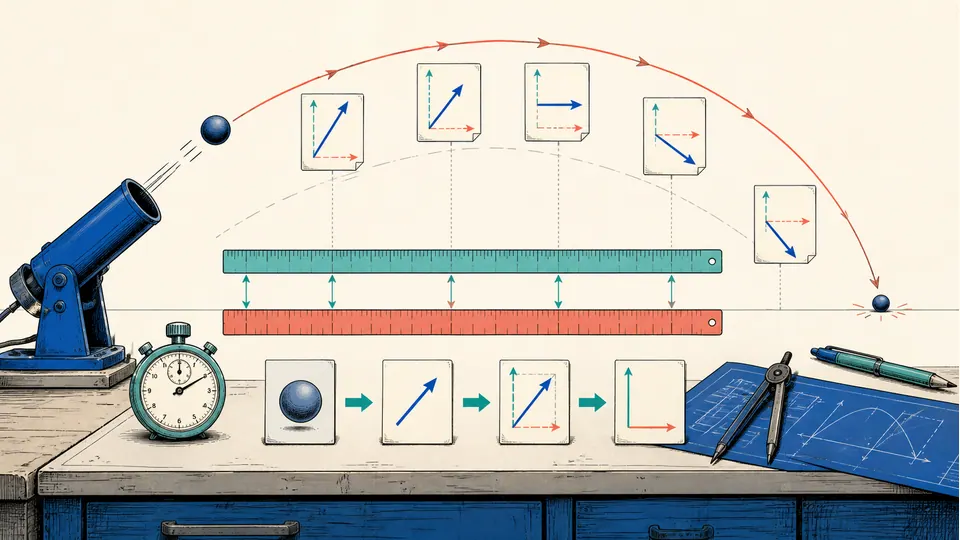
Unit conversion is not a cosmetic step in projectile work. This calculator converts the entered launch speed to a single SI basis, resolves horizontal and vertical components, solves the positive landing-time root, and then reports range in metres and feet.
PROJECTILE UNIT BRIDGE
All trajectory calculations use metres, seconds, and the entered SI gravity. US customary outputs are converted only after the unrounded SI solution is complete.
| Quantity | Source unit | Source value | Target unit | Target value |
|---|
DETAILED CALCULATION PROCESS
v = vkm/h / 3.6; vx = v cos(theta); vy = v sin(theta); t = (vy + sqrt(vy² + 2gh0))/g; R = vx t
Convert speed to m/s, resolve components using degrees converted to radians, solve y(t)=h0+vyt-gt²/2 for the positive time, and convert the resulting range with 1 m = 3.280839895 ft.
| Symbol | Meaning | Unit | Default-page basis |
|---|---|---|---|
| v | Launch speed after conversion | m/s | km/h ÷ 3.6 |
| theta | Launch angle above horizontal | degrees | entered angle |
| vx | Horizontal velocity component | m/s | v cos(theta) |
| vy | Vertical velocity component | m/s | v sin(theta) |
| t | Positive flight time | s | positive quadratic root |
| R | Horizontal range | m | vx × t |
RESULT INTERPRETATION
The horizontal and vertical velocity components show how the entered speed and angle are divided at launch. Flight time is controlled by the vertical component, initial height, and gravity; horizontal range then uses the unchanged horizontal component under the no-drag assumption. A correct unit conversion does not validate that assumption.
Zero launch angle can still produce range when the initial height is positive. A negative or nonphysical flight-time branch is discarded by the model, while an angle near 90 degrees makes horizontal range highly sensitive to rounding. Use the component ledger to distinguish conversion effects from trajectory assumptions.
DECISION BOUNDARY
All trajectory calculations use metres, seconds, and the entered SI gravity. US customary outputs are converted only after the unrounded SI solution is complete.
Angle changes both components at once. Near vertical launch, a small angle change can create a large relative change in horizontal range even when speed barely changes.
SENSITIVITY AND STRESS TESTING
Height extends flight time without increasing horizontal velocity. Measure it from the modeled release point to the landing datum, not from an unrelated site benchmark.
The closed-form range omits aerodynamic force. For large, light, fast, or irregular projectiles, a numerical drag model can matter more than additional conversion precision.
HOW TO USE THIS CALCULATOR
SUBJECT FOUNDATIONS
MODEL BOUNDARY
Convert speed to m/s, resolve components using degrees converted to radians, solve y(t)=h0+vyt-gt²/2 for the positive time, and convert the resulting range with 1 m = 3.280839895 ft.
DECISION DEPTH
Programming functions usually require radians. Entered degrees must be converted once; converting twice changes both components.
The familiar v²sin(2theta)/g expression applies only when launch and landing heights are equal. This page solves the general positive root.
If vx and vy are rounded before the time calculation, the final range may not agree with the speed and angle. Use the unrounded internal values.
REAL USE CASES
A launch monitor reports speed in km/h while a coaching report needs ft/s and feet. One SI calculation prevents mixing unit systems inside the trajectory.
A student measures a nonzero release height. The positive-root ledger shows why equal-height range shortcuts do not apply.
TERMS USED ON THIS PAGE
EVIDENCE TO RETAIN
Record instrument model, calibration or stated accuracy, speed unit, angle convention, launch and landing reference points, gravitational value, environmental conditions, and unrounded converted values. Store the original readings rather than only the final feet or metres.
LIMITS AND EXCLUSIONS
RELIABLE SOURCES
QUESTIONS SPECIFIC TO THIS CALCULATION
A single coherent basis keeps gravity, height, time, and distance compatible and makes the final reconciliation auditable.
That shortcut assumes equal launch and landing elevations. The entered launch height requires the general vertical quadratic.
No. Correct conversion represents the same physical speed. Any changed result indicates inconsistent units or premature rounding.
Not in this page. It is scoped to launches initially above horizontal; a downward-launch tool needs a different input boundary.
They support comparison and reporting, while the underlying trajectory remains an SI calculation.
Match the least precise measured input or the governing reporting standard; retain unrounded values for internal checks.
When initial height is above the landing datum, gravity still requires time to bring the projectile down even though initial vertical velocity is zero.
Horizontal velocity approaches zero, so the ideal range approaches zero while flight time can remain substantial. Display rounding can hide the small component.
Avoid it when drag, wind, lift, spin, terrain, thrust, or a moving launch platform materially affects the path; use an appropriate numerical or measured model instead.
The components are the quantities used by the equations and provide a direct inverse check when the converted angle or magnitude appears suspicious.
IMPORTANT BOUNDARY
This calculator is an idealized mechanics and unit-conversion aid. It must not be used to set weapon ranges, public safety zones, structural clearances, or certified sports measurements without an appropriate validated model and qualified review.