Speed squared
Aerodynamic drag scales with relative speed squared. A modest speed change can dominate density or area adjustments and rapidly move the state away from balance.
Physics and mechanics
Resolve projectile weight and aerodynamic drag into net force and acceleration, and show why zero vertical velocity at the apex is not force equilibrium.
IN-FLIGHT FORCE RECONCILIATION
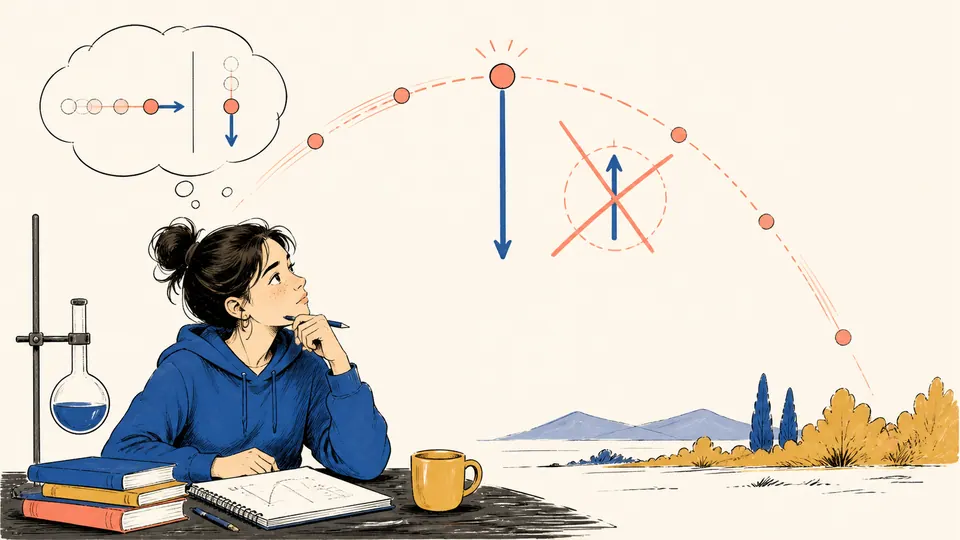
A projectile can have zero vertical velocity at the top of its arc while still accelerating downward. This calculator resolves weight and quadratic drag at an entered instant, reports net-force components, and quantifies the mismatch from force equilibrium.
IN-FLIGHT FORCE RECONCILIATION
Equilibrium requires both net-force components to be zero. A velocity component equal to zero does not satisfy that condition.
| Vector | Horizontal component | Vertical component | Magnitude | Direction or role |
|---|
DETAILED CALCULATION PROCESS
D = 0.5 rho Cd A v²; Fx = -D cos(phi); Fy = -mg - D sin(phi); a = Fnet/m
Compute weight from mass and gravity, compute drag from the declared aerodynamic inputs, direct drag opposite the instantaneous velocity, then divide the vector sum by mass.
| Symbol | Meaning | Unit | Default-page basis |
|---|---|---|---|
| D | Aerodynamic drag magnitude | N | 0.5 rho Cd A v² |
| rho | Fluid density | kg/m³ | entered condition |
| Cd | Drag coefficient | dimensionless | entered regime value |
| A | Reference area | m² | entered projected area |
| Fx, Fy | Net force components | N | drag components plus weight |
| a | Immediate acceleration magnitude | m/s² | net force ÷ mass |
RESULT INTERPRETATION
The drag magnitude is resolved opposite the entered relative-flow direction, then combined with weight. A small net-force magnitude means the two-dimensional force ledger nearly closes under the entered state; it does not prove the projectile will remain at that state as speed or orientation changes.
Read horizontal and vertical residuals separately. A near-zero total can conceal component sign mistakes if rounded values are used, while a large vertical residual usually reflects weight or the vertical drag component. Acceleration reports the immediate response from the current force state, not a complete future trajectory.
DECISION BOUNDARY
Equilibrium requires both net-force components to be zero. A velocity component equal to zero does not satisfy that condition.
Aerodynamic drag scales with relative speed squared. A modest speed change can dominate density or area adjustments and rapidly move the state away from balance.
SENSITIVITY AND STRESS TESTING
The angle determines how drag is divided between horizontal and vertical components. Confirm the sign convention before interpreting upward or downward assistance.
A single drag coefficient assumes a compatible shape, orientation, Reynolds-number regime, and reference area. A value from another regime can invalidate the force closure.
HOW TO USE THIS CALCULATOR
SUBJECT FOUNDATIONS
MODEL BOUNDARY
Compute weight from mass and gravity, compute drag from the declared aerodynamic inputs, direct drag opposite the instantaneous velocity, then divide the vector sum by mass.
DECISION DEPTH
Vertical velocity changes sign there because downward acceleration persists. Treating vy=0 as ay=0 confuses a state variable with its rate of change.
During ascent drag has a downward component; during descent it has an upward component. The force must be resolved at the entered angle.
Cd can vary with Reynolds number, Mach number, surface roughness, and orientation. A screening value is not a complete aerodynamic model.
REAL USE CASES
Enter a near-horizontal velocity angle. The ledger still shows weight and horizontal drag, demonstrating that the projectile is not in equilibrium.
Change density while keeping the instantaneous state fixed. The altered drag changes both net-force magnitude and acceleration without changing weight.
TERMS USED ON THIS PAGE
EVIDENCE TO RETAIN
Retain mass measurement, instantaneous speed and direction, coordinate convention, drag coefficient source, reference-area definition, air-density basis, gravity value, omitted forces, and unrounded component calculations.
LIMITS AND EXCLUSIONS
RELIABLE SOURCES
QUESTIONS SPECIFIC TO THIS CALCULATION
No. Its vertical velocity is momentarily zero, but gravity remains and usually drag also remains because horizontal speed is nonzero.
Every represented force component must sum to zero. A freely moving projectile under weight and drag does not normally meet that condition.
Drag opposes the full velocity vector. If the projectile is climbing or descending, that direction includes a vertical component.
No. Weight still produces downward acceleration unless another force cancels it.
Drag depends on the current relative airflow. Launch speed generally differs from speed later in flight.
It is a diagnostic ratio only. Any acceptance threshold must come from the governing experiment or engineering requirement.
Only for the declared one-dimensional or two-dimensional force state and coefficient regime. Stability, orientation, lift, wind variation, and changing density can still alter the motion.
Drag opposes relative motion through the fluid. The component signs follow the declared flow-angle convention, not a universally positive magnitude.
Use a tolerance tied to measurement uncertainty and the decision purpose. A convenient display rounding threshold is not an engineering acceptance criterion.
No. Translational force balance does not establish moment balance or stability. Include application points and moments in a model designed for that question.
IMPORTANT BOUNDARY
This instantaneous mechanics calculator is for education and preliminary analysis. It does not certify trajectories, aircraft, sporting equipment, safety zones, weapons, or aerodynamic designs.