Cash and tax compounding
Cash-option conversion and estimated tax are multiplicative. Applying the tax rate to the annuity headline and then comparing it with a cash payout mixes two different bases.
Probability
Estimate after-tax lottery expected value per ticket and for a ticket batch, including cash-option conversion, prize odds, ticket cost, return rate, break-even jackpot, and jackpot probability.
LOTTERY PAYOFF ECONOMICS
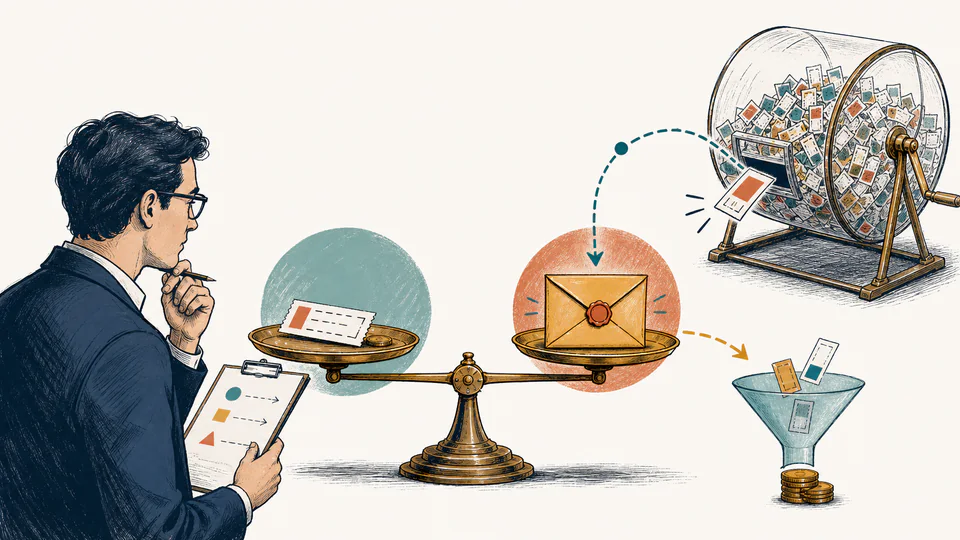
This model converts an advertised annuity headline into an estimated after-tax cash value, probability-weights the jackpot and one secondary prize tier, adds any documented ancillary expected return, and subtracts the certain ticket cost. It is a long-run average model—not a prediction that any ticket will win.
LOTTERY PAYOFF ECONOMICS
Use the sign and magnitude of EV to compare the modeled payout schedule with ticket cost. A positive estimate does not make a purchase prudent: jackpot splitting, sales volume, pari-mutuel treatment, cash-option timing, taxes, and human spending limits can materially change the economics.
| Calculation line | Starting amount | Probability or factor | Result | Interpretation |
|---|
CURRENT CALCULATION PROCESS
EVticket = [J × c × (1 − t)] / Oj + [S × (1 − t)] / Os + Eother − C; EVbatch = N × EVticket
J is the advertised annuity jackpot, c is the lump-sum share, t is the estimated tax rate, Oj and Os are odds denominators, S is the secondary prize, Eother is the per-ticket expected return from remaining tiers, C is ticket cost, and N is ticket count. Every payoff is probability-weighted before the certain cost is deducted.
Intermediate values remain unrounded until display formatting.
HOW TO USE THIS MODEL
LOTTERY PAYOFF ECONOMICS FUNDAMENTALS
MODEL AND FORMULA
J is the advertised annuity jackpot, c is the lump-sum share, t is the estimated tax rate, Oj and Os are odds denominators, S is the secondary prize, Eother is the per-ticket expected return from remaining tiers, C is ticket cost, and N is ticket count. Every payoff is probability-weighted before the certain cost is deducted.
DEEP PROBABILITY ANALYSIS
Cash-option conversion and estimated tax are multiplicative. Applying the tax rate to the annuity headline and then comparing it with a cash payout mixes two different bases.
Large jackpots attract more ticket sales, which can increase the chance that any winning jackpot is shared. A full expected-value study would model the distribution of co-winners.
The other-prize field should come from the official prize table and probabilities. A convenient allowance with no source can move a near-break-even result across zero.
WORKED DECISION CASES
An analyst can enter each drawing’s cash option, odds, and ticket price, then compare net EV per ticket without confusing the larger advertised annuity with the larger cash-adjusted expectation.
A group can multiply per-ticket EV by the number of purchased plays and retain the ticket count, price, and published odds used. The result does not allocate winnings among members or replace a written pool agreement.
PROBABILITY GLOSSARY
EVIDENCE AND DATA LINEAGE
Keep the game name, drawing date, official prize-and-odds table, ticket price and add-ons, advertised annuity amount, quoted cash option, tax assumption and jurisdiction, number of plays, lower-tier EV worksheet, and whether the jackpot can be split. The result is not reproducible if only the final EV is saved.
LIMITS AND EXCLUSIONS
RELIABLE SOURCES
FREQUENTLY ASKED QUESTIONS
The advertised jackpot usually describes an annuity total. Expected value must use the payoff basis the modeled winner would actually elect, so the cash share is applied before tax and probability weighting.
No. EV is a mathematical mean, not financial advice or a guarantee. Variance is extreme, the chance of a jackpot remains tiny, and co-winner and personal-budget effects may be omitted.
The calculator uses one explicit planning rate for modeled taxable prizes so the tiers share a consistent after-tax basis. Actual withholding and final liability can differ by prize and jurisdiction.
Only the sum of payout times probability for lower tiers not entered separately. Use an official prize table and keep the worksheet; do not enter the total advertised prize pool.
No, if tickets have the same price and probability. It multiplies both total expected payoff and total cost, while the at-least-one-jackpot probability rises from a very small base.
A jackpot payoff is divided by a very large odds denominator and then reduced by cash-option and tax factors. Those adjustments require a much larger headline amount to offset a certain ticket price.
IMPORTANT PROBABILITY NOTE
This calculator is educational and does not provide gambling, tax, legal, or financial advice. Lottery rules, odds, cash values, taxes, prize sharing, and eligibility vary. Verify the current official game terms, set a strict entertainment budget, and seek qualified help if gambling is causing harm.