Chemistry and reaction planning
Stoichiometry Conversion Calculator
Use amount of substance as the explicit bridge among mass, moles, specified entities, solution volume and ideal-gas volume at entered conditions.
CURRENT STOICHIOMETRIC MODEL
Enter the chemical assumptions
For chemistry work that needs a traceable conversion chain rather than a fixed molar-volume shortcut.
LIVE DECISION VIEW
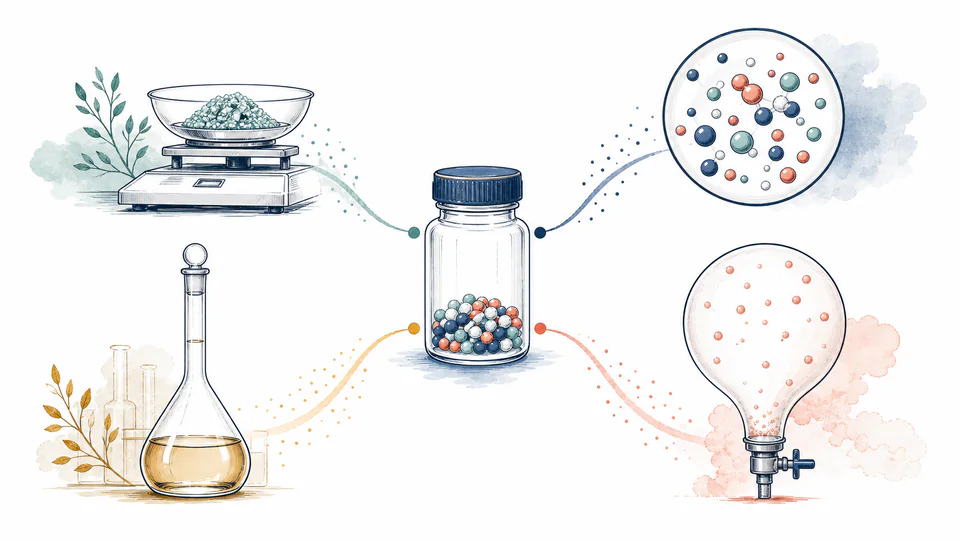
One amount of substance, four measurable forms
The live hub keeps moles at the center and redraws mass, entity count, solution volume and ideal-gas volume from the current assumptions.
| Quantity | Formula path | Current value | Interpretation |
|---|
HOW TO USE
Use Stoichiometry Conversion Calculator without hiding assumptions
- Choose the type and unit of the known quantity.
- Enter a molar mass and, when useful, solution concentration and gas conditions.
- Read the central mole amount before using any equivalent form.
- Keep the identity of the specified entity explicit when reporting particle count.
CURRENT CALCULATION PROCESS
Formula, substitution, intermediate steps and final check
n=m/M=N/N_A=CV=PV/(RT); derive every requested equivalent from n.
Convert the selected source to moles first, then use independent mass, entity, concentration and ideal-gas relationships.
Waiting for valid inputs.
MODEL EXPLANATION
The mole is the bridge, not a shortcut
Mass depends on molar mass, entity count uses the exact Avogadro constant, solution volume depends on amount concentration, and gas volume depends on temperature and absolute pressure.
A fixed 22.4 L/mol value applies only near particular standard conditions. This page uses PV=nRT with the entered state instead.
SYMBOLS AND VARIABLES
Read the formula before relying on the result
| Symbol | Unit or range | Meaning |
|---|---|---|
| n | mol | amount of substance |
| M | g mol^-1 | molar mass |
| N_A | 6.02214076 x 10^23 mol^-1 | exact Avogadro constant |
| C | mol L^-1 | amount concentration |
| R | 8.314462618 L kPa mol^-1 K^-1 | molar gas constant used here |
| P, V, T | kPa, L, K | ideal-gas state variables |
WORKED EXAMPLE
Default 18 g example
- Known mass 18 g divided by 18.01528 g/mol gives about 0.99915 mol.
- Multiplying by the exact Avogadro constant gives the specified-entity count; dividing by 1 mol/L gives solution volume.
- PV=nRT at 25 deg C and 101.325 kPa gives the ideal-gas equivalent rather than assuming 22.4 L/mol.
CHEMISTRY FOUNDATIONS
Unit discipline for stoichiometric conversions
- Entity identity must be specified: molecules, atoms, ions or formula units are not interchangeable labels.
- Gas pressure must be absolute, not gauge pressure.
- Solution volume is final solution volume under the stated concentration.
- Molar mass must match isotope, hydrate, solvate or formula-unit conventions used.
DEEPER ANALYSIS
Where real systems depart from the bridge
- Nonideal gases require a compressibility factor or equation of state.
- Concentrated solutions may need density and activity-based treatment.
- Dissociation changes particle count but not formula-unit amount unless the entity is redefined.
- Measurement uncertainty should be carried with significant figures and calibration data.
REAL-WORLD CASE
Case: translating a reagent certificate into lab quantities
A laboratory has a certified mass and needs equivalent moles, formula units and a target solution volume.
The mole ledger separates identity-dependent molar mass from concentration-dependent volume.
The gas equivalent is clearly conditional and should not be mistaken for an actual gas phase of the substance.
TERMS
Page-specific chemistry vocabulary
- Amount of substance
- SI quantity measured in moles.
- Specified entity
- Named atom, molecule, ion, electron or group counted by the mole.
- Molar mass
- Mass per mole of the specified substance.
- Amount concentration
- Moles of solute per final solution volume.
- Ideal gas
- Model obeying PV=nRT under the entered state.
LIMITS AND DISCLAIMER
Where this model stops
- Ideal-gas volume neglects nonideality and phase behavior.
- Solution conversion assumes the entered amount concentration is valid.
- Does not infer molar mass or chemical identity.
- Entity count depends on the explicitly specified entity.
- Zero amount is valid, but conversion assumptions must remain positive and physical.
Educational conversion aid; verify substance identity, phase, concentration certificate, pressure basis and applicable thermodynamic model.
Frequently asked questions
Why not always use 22.4 L per mole?
Molar gas volume changes with temperature and pressure, and real gases may be nonideal.
Is Avogadro's constant exact?
Yes. The SI fixes it at exactly 6.02214076 x 10^23 mol^-1.
What does specified entity mean?
It identifies what is counted, such as molecules, atoms, ions or formula units.
Does one mole of solute make one liter of 1 M solution?
Yes in the ideal amount-concentration definition: prepare a final solution volume of one liter.
Can the known quantity be zero?
Yes. All equivalent amounts are then zero while assumptions such as molar mass stay positive.
Why use absolute pressure?
The ideal gas equation relates thermodynamic absolute pressure to volume and temperature.
SOURCES