Long countertop lead
The cabinet crew finishes quickly, but fabrication controls completion. Early selections and prompt template approval matter more than another installer.
Home & Construction
Separate productive crew time from countertop fabrication and other elapsed waits so extra installers are not credited with shortening a supplier lead time.
CABINET CRITICAL-PATH PLAN
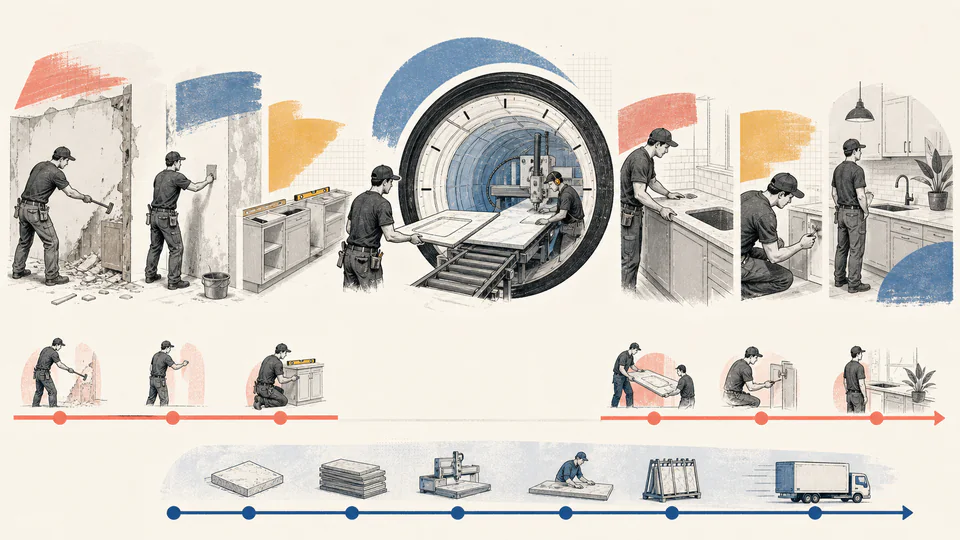
Demolition, preparation, and cabinet setting precede countertop templating. Fabrication lead time then runs as elapsed time before countertop installation, punch work, cure, and inspection release.
EDITORIAL FIELD GUIDE
The sequence illustration highlights the template release that controls countertop fabrication. The ledger distinguishes crew-days from supplier lead time, cure, and inspection so added labor does not falsely erase elapsed waits.
| Phase | Release condition | Labor-hours | Crew-days | Elapsed wait | Critical-path position |
|---|
How to use
Schedule fundamentals
Calculation method
Cabinet count divided by installation productivity gives cabinet-setting labor. Demolition and preparation join that pre-template labor. Countertop and punch labor form the post-template block. Each labor block divides by crew-day capacity; fabrication lead, cure, and inspection remain elapsed days.
Template release
Base cabinets normally need final level, fastening, appliance coordination, and field dimensions before templating. If the entered lead starts earlier than the actual release, the calculated completion date is optimistic.
Trade coordination
Disconnects, rough-ins, wall repair, finished flooring strategy, appliance clearances, sinks, and owner selections may create prerequisites or return visits. Add them to the project schedule rather than hiding them in cabinet productivity.
Crew-size boundary
Crew size changes only productive labor in this model. It does not compress supplier fabrication, adhesive cure, inspection, delivery windows, missing approvals, or rework. Unrealistically large crews can also lose productivity in a constrained room.
Detailed calculation process
The current result cards and phase ledger above provide the final reconciliation.
Result interpretation
The result is elapsed planning time, not a promised completion date. It assumes the declared phases occur sequentially on one critical path and that crew productivity remains available. Procurement before demolition and activities performed in parallel are outside the arithmetic unless reflected in entered lead time.
Decision analysis
If countertop lead dominates, adding cabinet labor has limited effect. If preparation dominates, resolve wall and floor conditions earlier. If repeated punch work dominates, improve submittals, measurements, installation quality, and trade coordination rather than simply increasing crew size.
Evidence and data lineage
Keep approved cabinet and appliance drawings, cabinet count, demolition survey, wall and floor tolerances, blocking confirmation, delivery date, crew records, setting productivity basis, template release checklist, countertop approval and fabrication promise, sink and appliance availability, cure requirements, punch list, inspection or owner signoff, delays, rework, and actual completion timestamps.
Limits and exclusions
Key terminology
Worked decision cases
The cabinet crew finishes quickly, but fabrication controls completion. Early selections and prompt template approval matter more than another installer.
Preparation expands before cabinet setting and delays the template release. A site survey and repair allowance are more useful than optimistic productivity.
Professional basis
Convert elapsed duration to dates using the real work calendar, approved procurement dates, trade commitments, and inspection availability. Do not promise a completion date from default assumptions.
Field templating generally depends on installed and verified base cabinet geometry.
Only when the fabricator accepts a documented release condition for the specific project.
No. It divides productive labor only, not supplier lead, cure, or inspection time.
Confirm delivery before field start or add it as an external predecessor to the modeled sequence.
The output is elapsed days; map it to a project calendar that reflects working and nonworking days.
Enter zero lead and installation hours only when the modeled completion boundary truly ends before countertop work.