Live calculation visualCurrent entered assumptions
Home & Construction
Gutter Cost Estimate Calculator
Keep measured length, purchasable run allowance, fittings, accessories, and labor on auditable cost bases.
AUDITABLE GUTTER PRICE BUILD-UP
Price straight runs, fittings, guards, labor, and mobilization on their own bases
Homeowners, contractors, and estimators can convert a measured gutter layout into a transparent planning subtotal without hiding downspouts or fittings inside one linear-foot rate.
Modeled project subtotal—
Cost per measured run—
Gutter material—
Run labor—
Fittings/downspouts—
Guard scope—
GUTTER COST ASSEMBLY
See which measured component actually drives the estimate
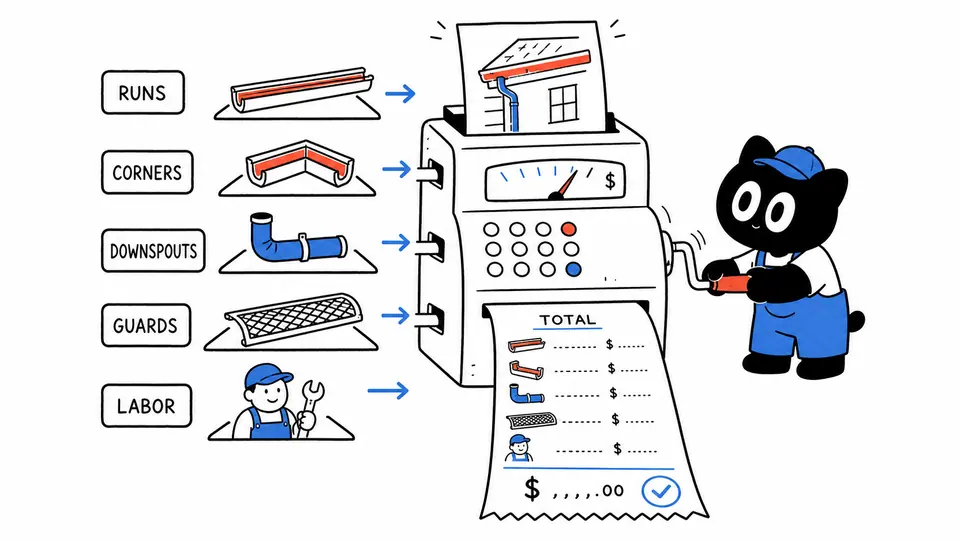
A live roof-edge bill of materials feeds separate cost buckets, so linear runs cannot conceal corner, outlet, downspout, or guard costs.
| Cost family | Quantity basis | Unit rate | Subtotal | Scope check |
|---|
How to use
Price straight runs, fittings, guards, labor, and mobilization on their own bases
- Measure every eave run on one drawing revision.
- Count corners, end caps, outlets, and downspouts from the proposed drainage layout.
- Apply run waste only to purchasable gutter material.
- Enter labor against measured installed run and price each fitting consistently.
- Enter guards only where included, then add mobilization once.
- Compare the subtotal with quote exclusions, taxes, disposal, fascia work, access, and coating specification.
GUTTER ESTIMATE FUNDAMENTALS
Separate measured run, order run, fittings, guards, labor, and mobilization
- Measured run
- Installed gutter centerline length.
- Order run
- Measured run plus entered material allowance.
- Outlet
- Transition from gutter trough to downspout.
- Fitting count
- Discrete corners, caps, outlets, and downspouts.
- Mobilization
- Project-level setup cost not proportional to length.
CALCULATION METHOD
Price each component on the quantity that drives it
Apply order allowance only to gutter run, price fittings and downspouts by count, price guards by covered length, and keep labor and mobilization visible instead of hiding them in one rate.
QUOTE SCOPE
A linear-foot quote may bundle scope
Confirm whether outlets, elbows, extensions, sealants, hangers, removal, disposal, and access are already included before comparing.
HIDDEN SUBSTRATE
Fascia condition is a separate uncertainty
Rot, alignment, paint, flashing, and substrate repairs can exceed the trough cost and should not be buried in waste.
SYSTEM SPECIFICATION
Material specification changes rates
Profile, width, gauge, alloy, coating, seamless fabrication, hanger type, and color affect both material and labor.
Detailed calculation process
Gutter cost reconciliation
Material uses order length, labor uses measured length, discrete pieces use counts, guards use covered length, and mobilization is added once. This prevents a single blended rate from changing meaning when geometry changes.
order run = measured run×(1+waste%)run cost = order run×material rate + measured run×labor ratefittings = downspouts + corners + caps + outlets at entered ratestotal = run cost + fittings + guards + mobilization
| Symbol | Meaning | Unit |
|---|---|---|
| L | Measured run | ft |
| waste% | Material allowance | dimensionless |
| N | Discrete fitting count | each |
| r | Entered unit rate | $/ft or $/each |
| G | Guard length | ft |
| M | Mobilization | $ |
- Order run: 160×1.05 = 168 ft.
- Material: 168×$8 = $1,344; labor: 160×$7 = $1,120.
- Downspouts $380; corners $168; caps $48; outlets $72.
- Guards: 140×$9 = $1,260.
- Add $350 mobilization.
- All buckets reconcile to the $4,742 default subtotal.
The live result cards and exact ledger above provide the final reconciliation for the current inputs.
Result interpretation
Use the subtotal to reconcile scope, not select a contractor
Total cost is the primary modeled subtotal; cost per measured foot is a normalization, not a market quote. A high fitting share is reasonable on short segmented roofs. A zero guard value means no guard scope, not free protection.
Visual interpretation
See which measured component actually drives the estimate
Bucket area follows current subtotal and the sketch preserves physical counts. Changing a corner affects fittings without changing straight run. Relative bucket size can hide unpriced exclusions, so use the exact ledger for reconciliation.
EVIDENCE FOR THIS MODEL
Retain run segments, fitting counts, specification, local rates, and quote inclusions
Keep field dimensions, layout sketch, outlet/downspout locations, metal/profile specification, hanger spacing, guard product, demolition and disposal scope, fascia condition, story/access conditions, labor inclusions, supplier date, tax, permit, and contractor quote.
SCOPE AND LIMITATIONS
Work and risk not contained in the modeled subtotal
- No tax, permit, disposal, fascia repair, paint, heat cable, drainage extension, lift, or contingency unless embedded in rates.
- Waste applies only to trough material.
- Guard length cannot exceed measured run.
- Entered prices are not validated against a market.
KEY TERMINOLOGY
Gutter estimating and scope terms
- Inside corner
- Concave gutter direction change.
- Outside corner
- Convex direction change.
- End cap
- Closure at a trough termination.
- Drop outlet
- Opening that feeds a downspout.
- Guard
- Accessory limiting debris entry.
- Mobilization
- One-time project setup cost.
PRACTICAL DECISIONS
Long simple eave versus Many roof returns
Long simple eave
Run material and labor may dominate; verify downspout spacing and discharge before relying on low fitting cost.
Many roof returns
Corners and short fabrication pieces can dominate even at modest total length.
AUTHORITATIVE BASIS
References for auditable gutter price build-up
Important note
Do not award work from this subtotal alone. Reconcile specifications, quantities, exclusions, tax, repair risk, drainage design, access, and contractor terms.
Frequently asked questions
Why is labor not multiplied by waste?
Labor is tied to measured installed run; waste represents purchased material.
Are elbows included with downspouts?
Only if the entered per-downspout rate includes them.
Can guard length exceed run length?
No; the model rejects that inconsistent scope.
Does total include fascia repair?
No. Price verified repair scope separately.
Why count outlets separately?
An outlet can have its own fabrication and installation cost even when paired with a downspout.
Is cost per foot a contractor rate?
No. It is total modeled scope divided by measured run.