Live calculation visualCurrent entered assumptions
Home & Construction
Gutter Scenario Comparison Calculator
Apply the same catchment and storm to two independently specified gutter and downspout systems before comparing cost.
TWO-SYSTEM RAIN TEST
Require hydraulic eligibility before comparing gutter life-cycle assumptions
Owners and designers can apply one catchment and storm to two systems, expose each trough/downspout bottleneck, and compare first cost and undiscounted annualized planning cost only after capacity status is visible.
Eligible lower-cost screen—
Common peak flow—
Option A status—
Option B status—
B − A capacity—
B − A cost/year—
EQUAL-STORM SYSTEM TEST
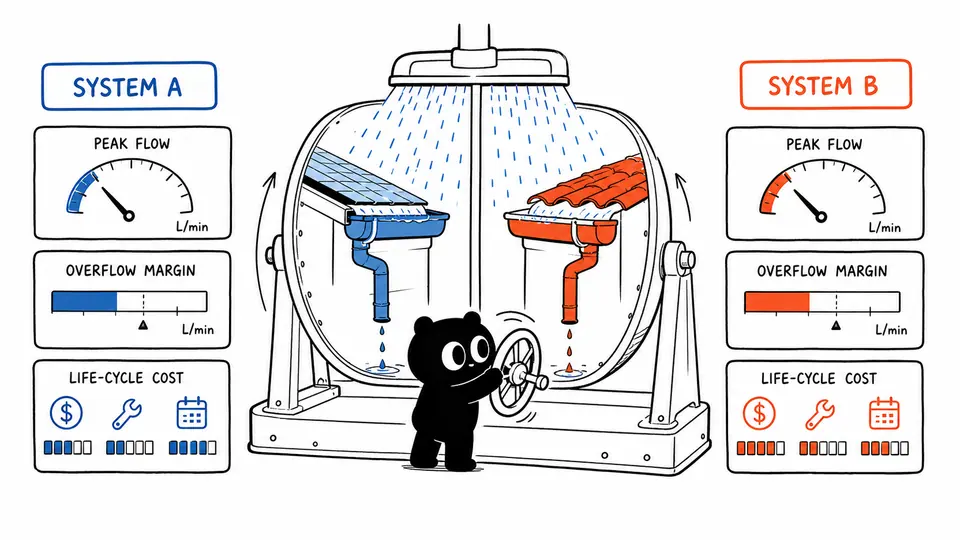
Test both systems against the same rain before considering cost
The rain drum fixes hydraulic demand; each option has independent trough and leader gates plus separate cost and service-life rails.
| Metric | System A | System B | B − A | Decision rule |
|---|
How to use
Require hydraulic eligibility before comparing gutter life-cycle assumptions
- Freeze the same catchment, rainfall method, and coefficient.
- Enter each system’s verified gutter and per-downspout capacities.
- Enter downspout counts and inspect the bottleneck for each option.
- Use complete installed-cost scopes.
- Support maintenance and service-life assumptions with project evidence.
- Exclude any shortfall option before comparing the undiscounted cost/year screen; use present value for capital decisions.
GUTTER OPTION FUNDAMENTALS
Test equal-storm eligibility before comparing cost and assumed life
- Equal storm
- Same hydraulic demand applied to both options.
- Eligible option
- System whose entered capacity meets entered peak flow.
- Bottleneck capacity
- Minimum of trough and combined leaders.
- First cost
- Entered installed expenditure.
- Undiscounted planning cost
- Installed plus nominal maintenance divided by assumed years.
CALCULATION METHOD
Reject ineligible options before economic screening
Apply the same catchment and storm demand to both systems, resolve each limiting component, then compare installed cost and undiscounted cost per year only among options that meet demand.
ELIGIBILITY FIRST
Capacity first, economics second
A cheaper shortfall is not an equivalent alternative. Reconfigure it or remove it from economic ranking.
COMPONENT BALANCE
Component balance matters
An oversized trough with undersized leaders wastes nominal capacity; compare both stages.
ECONOMIC SCREEN
Cost/year is not NPV
Discount rate, escalation, replacement timing, residual value, financing, tax, and risk require present-value life-cycle costing.
Detailed calculation process
Gutter system A versus B ledger
Peak demand is calculated once. Each system develops its own minimum capacity and margin. Recommendation can name only a capacity-eligible option; when both pass, the lower undiscounted annualized screen is reported.
Q = 0.0103896CiAcapacityj = min(gutterj, downspout countj×capacity eachj)eligible iff capacityj−Q ≥ 0planning cost/yearj = (installedj + maintenancej×yearsj)/yearsj
| Symbol | Meaning | Unit |
|---|---|---|
| Q | Common peak runoff | gpm |
| capacityj | Option j limiting flow | gpm |
| margin | Capacity minus demand | gpm |
| installed | Entered first cost | $ |
| maintenance | Nominal annual amount | $/year |
| years | Planning service assumption | years |
- Common peak: 0.0103896×1×4×2,500 = 103.896 gpm.
- A capacity = min(90,3×25) = 75 gpm: shortfall.
- B capacity = min(130,4×35) = 130 gpm: meets entered storm.
- A life total = $2,800 + $120×20 = $5,200; $5,200/20 = $260/year.
- B life total = $3,900 + $80×30 = $6,300; $6,300/30 = $210/year.
- B is the only eligible default option; cost screening cannot rescue A.
The live result cards and exact ledger above provide the final reconciliation for the current inputs.
Result interpretation
Recommendation is conditional on eligibility and life assumptions
Recommended means eligible under entered demand and lower undiscounted cost/year among eligible options. “Neither” means both entered capacities fall short. It does not rank appearance, warranty, corrosion resistance, installation quality, overflow path, or code compliance.
Visual interpretation
Test both systems against the same rain before considering cost
Both options receive the same demand line. The narrower component gate determines each capacity, while cost rails use separate units. A normalized bar cannot prove hydraulic or economic equivalence.
EVIDENCE FOR THIS MODEL
Keep storm, catchment, capacities, cost scope, and service-life support aligned
Retain common rainfall source, catchment plan, capacity method, gutter profile/slope/length, outlet positions, leader route and elbows, product test data, installed-scope bids, guard and maintenance plans, corrosion environment, service-life basis, discount-rate decision, overflow path, and reviewer approval.
SCOPE AND LIMITATIONS
What the recommended option label does not approve
- Entered component capacities are not independently derived.
- No transient storage, blockage, splash, underground drainage, or overflow damage model.
- Economic screen is undiscounted and excludes replacement interruption and residual value.
- Only complete, permitted systems with matched scope should be compared.
KEY TERMINOLOGY
Drainage eligibility and cost-screen terms
- Hydraulic demand
- Peak runoff applied to both systems.
- Leader
- Downspout conveying flow from an outlet.
- Bottleneck
- Lower-capacity stage in the path.
- Eligibility
- Meets the entered capacity rule.
- Undiscounted
- No time value of money.
- Present value
- Equivalent current value of dated cash flows.
PRACTICAL DECISIONS
Cheap undersized option versus Both options pass
Cheap undersized option
Do not select it because of price; revise outlets or leaders and rerun the equal-storm test.
Both options pass
Compare present-value cost, maintenance access, corrosion, overflow, warranty, and installer scope before selection.
AUTHORITATIVE BASIS
References for two-system rain test
Important note
Do not treat the recommended label as design approval. Verify rainfall, hydraulics, overflow, support, discharge, product data, code, and economic method.
Frequently asked questions
Why can a cheaper option be rejected?
It fails the entered hydraulic demand, so it is not an eligible equivalent.
What if both fail?
The recommendation is Neither; redesign component capacities.
What if both pass?
The screen compares undiscounted cost/year, but project selection still needs full technical and economic review.
Does more downspouts always help?
Only until the trough or another component becomes the bottleneck.
Is service life a warranty term?
No. It is a supported planning assumption.
Can I call this life-cycle cost?
Only as an undiscounted screen; use a present-value method for formal LCC.