Open straight corridor
Long stock may reduce joints and use surplus efficiently when delivery, handling, and approved joint spacing allow it.
Home & Construction
Preserve each route as a separate cutting problem so leftovers are not silently assumed reusable across incompatible sizes or systems.
PIPE STOCK TAKEOFF
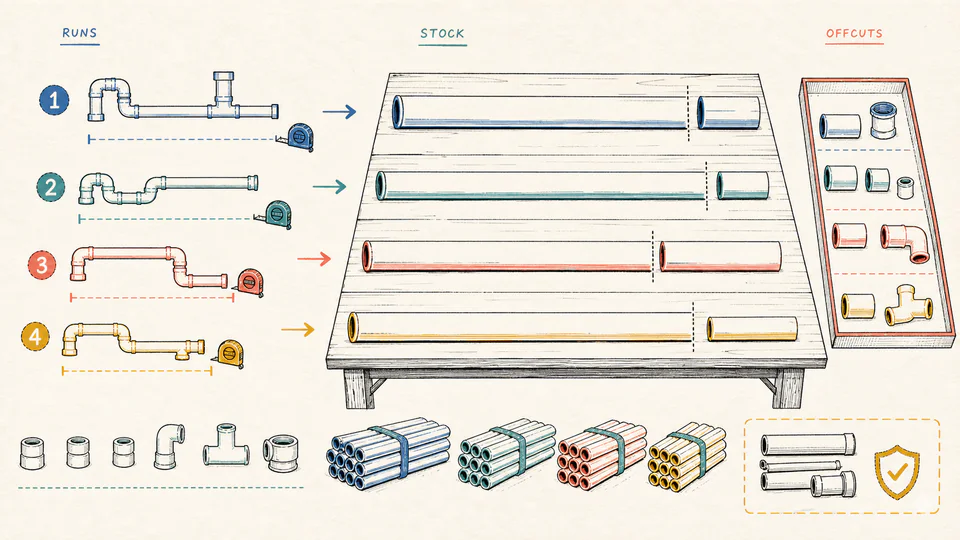
Each route is rounded independently against usable stock length. Bundle rounding is applied only after run-by-run piece counts and the declared order allowance.
SUBJECT DECISION ILLUSTRATION
The illustration explains the professional setting without pretending to be a data chart. The ledger below preserves the entered values and calculation path.
| Run / step | Developed length | Usable stock basis | Unrounded demand | Order result | Interpretation |
|---|
How to use
Takeoff fundamentals
Calculation method
Usable stock length is the nominal piece length less the entered loss at both ends. Each route requires the ceiling of route length divided by usable stock. Route piece counts are summed, the order allowance is applied to pieces, and vendor bundle rounding creates purchased quantity. Couplings count only joints between pieces within each run.
Reuse boundary
Offcuts may be too short, contaminated, damaged, unapproved for a location, or incompatible with the next run. Do not subtract theoretical surplus from another size, material, system, or certification class.
Fitting boundary
The page counts only internal joints created when a listed run needs multiple stock pieces. Elbows, tees, reducers, adapters, unions, valves, cleanouts, terminations, and equipment connections require a drawing takeoff.
Installation depth
Some systems measure cut length between fitting stops; others use center-to-center dimensions with fitting takeoff deductions. Use the manufacturer and trade method appropriate to the joint system rather than treating end trim as a universal rule.
Detailed calculation process
The current run rows and result cards provide the final reconciliation.
Result interpretation
More pieces can increase joints, labor, leak points, supports, and inspection effort even when purchased footage changes little. Review the route-level ledger before choosing stock length.
Decision analysis
Long stock can reduce joints but may be difficult to transport or maneuver. Short stock can improve handling but add couplings. Select stock using material limits, access, approved joints, labor, delivery, and safe handling.
Evidence and data lineage
Keep drawing revision, route identifiers, developed lengths, material, size, schedule or dimension ratio, service class, stock length, cut and insertion rules, allowance basis, bundle contents, fitting schedule, offcut-reuse rule, supplier, estimator, date, and exact run ledger.
Limits and exclusions
Key terminology
Worked decision cases
Long stock may reduce joints and use surplus efficiently when delivery, handling, and approved joint spacing allow it.
Access openings and frequent offsets can force shorter cuts; theoretical long offcuts may not match the remaining routes.
Authoritative basis
Verify the drawing and manufacturer installation method before ordering. This page is a single-family stock takeoff and cannot approve pipe selection, joints, layout, or installation.
Each run must be buildable; leftover length from one route cannot erase the minimum pieces required for another.
The model assumes an entered trim or fit loss on both ends of each stock piece.
Only for internal straight-piece joints; all other fittings require a layout takeoff.
No. Run one calculation for each compatible material, size, schedule, and service class.
This model applies it to the route-rounded piece count before bundle rounding.
Separate route ceilings and whole-bundle purchasing can create real nominal overage.