Live calculation visualCurrent entered assumptions
Unit Converters
Sound Level Comparison Calculator
Translate a decibel difference into the distinct linear ratios required for pressure, energy, exposure, and independent-source addition.
ACOUSTIC RATIO COMPARISON
Translate one decibel difference into the right pressure, energy, and exposure comparisons
Compare two compatible sound measurements without treating dB as a linear quantity. Duration is retained so level ratio and accumulated exposure ratio are not confused.
B − A level—
B/A pressure ratio—
B/A energy-rate ratio—
B/A exposure ratio—
Independent combined level—
Higher exposure—
TWO-SOUND RATIO MAP
Keep amplitude, power, time, and source addition on separate tracks
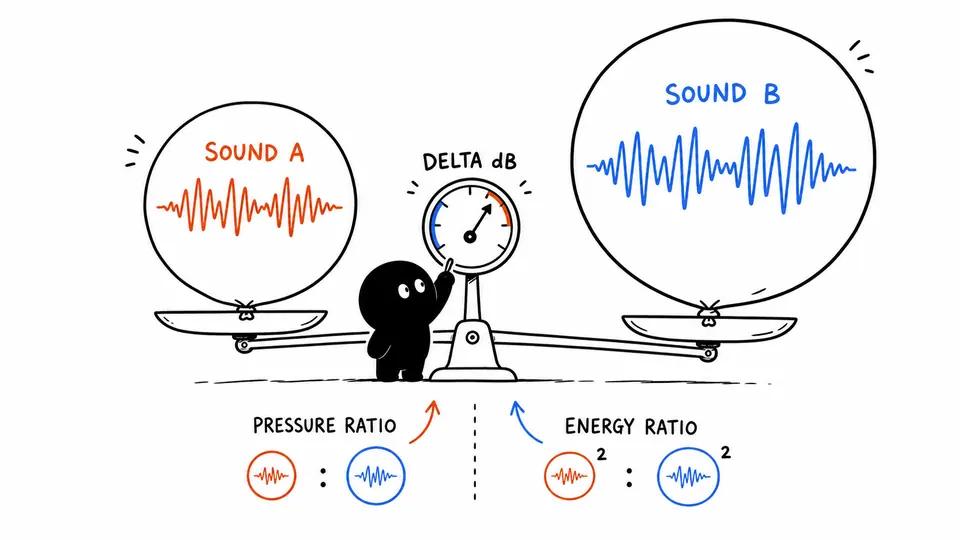
The comparison graphic uses different axes for pressure amplitude and energy rate, then applies duration only to exposure. A separate vector shows independent-source combination.
| Quantity | Sound A | Sound B | B / A | Decision use |
|---|
How to use
Translate one decibel difference into the right pressure, energy, and exposure comparisons
- Enter Sound A level (dB), Sound B level (dB), Sound A duration (min).
- Confirm the remaining assumptions use the same project, measurement, or product basis.
- Read B − A level together with B/A pressure ratio and B/A energy-rate ratio.
- Use a-versus-b reconciliation to reconcile the result before exporting it.
- Confirm that A and B use the same weighting, reference, and operating basis before interpreting any ratio.
DECIBEL COMPARISON FUNDAMENTALS
Choose pressure, intensity, exposure, or source addition before comparing
Required inputs
- Sound A level (dB)
- Default: 82
- Sound B level (dB)
- Default: 88
- Sound A duration (min)
- Default: 120
- Sound B duration (min)
- Default: 45
Reported outputs
- B − A level
- B/A pressure ratio
- B/A energy-rate ratio
- B/A exposure ratio
- Independent combined level
- Higher exposure
CALCULATION METHOD
Translate one dB difference through the correct logarithmic relation
Use 20 log for pressure-amplitude ratios and 10 log for power-like intensity ratios. Apply duration only to accumulated exposure, and combine simultaneous independent sources by summing linear energies.
LOGARITHMIC DIFFERENCE
Signed decibel difference B minus A.
Confirm A and B describe the same acoustic quantity, reference, weighting, bandwidth, and averaging convention.
TIME EXPOSURE
Field-amplitude ratio from the 20-log relation.
Subtract A from B while retaining the sign.
INDEPENDENT SOURCES
Power-like ratio from the 10-log relation.
Use the 20-log inverse for pressure amplitude ratio.
Detailed calculation process
A-versus-B reconciliation
ΔL = LB − LApB/pA = 10^(ΔL/20)IB/IA = 10^(ΔL/10)EB/EA = (tB/tA)10^(ΔL/10)Lcombined = 10 log10(10^(LA/10)+10^(LB/10))
The signed dB difference and duration ratio remain unrounded through every exponential conversion; pressure, intensity, exposure, and combined level are formatted afterward.
| Input | Default substitution | Requirement |
|---|---|---|
| Sound A level (dB) | 82 | Required; use one consistent unit and basis |
| Sound B level (dB) | 88 | Required; use one consistent unit and basis |
| Sound A duration (min) | 120 | Required; use one consistent unit and basis |
| Sound B duration (min) | 45 | Required; use one consistent unit and basis |
- Use the 10-log inverse for intensity or power ratio.
- Multiply intensity ratio by the duration ratio for relative exposure.
- For simultaneous independent sources, add linear energies rather than exposure durations.
- State which comparison answers the decision; the ratios are not synonyms.
Current comparison reconciliation will keep pressure, intensity, duration exposure, and independent-source addition on separate tracks.
Result interpretation
Choose the result that matches amplitude, power, time, or source addition
A +6 dB difference is roughly twice the pressure amplitude but about four times the intensity. If B lasts much less time, its total exposure can still be below A. The combined-source result assumes compatible, independent contributions and does not model phase-coherent addition.
Visual interpretation
Keep amplitude, power, time, and source addition on separate tracks
The comparison graphic uses different axes for pressure amplitude and energy rate, then applies duration only to exposure. A separate vector shows independent-source combination. Read the graphic with the exact ledger: geometry and color show relationships, while the table remains the numerical record.
EVIDENCE FOR THIS MODEL
Document why sound A and sound B are genuinely comparable
Retain both raw measurements, reference, weighting, time weighting, bandwidth, duration boundaries, microphone geometry, source operating state, background correction, uncertainty, and whether sources are simultaneous or sequential.
SCOPE AND LIMITATIONS
Claims the ratio calculation does not support
- Pressure ratio assumes comparable acoustic impedance conditions.
- Combined level uses independent energy addition, not coherent waveform addition.
- No loudness or annoyance judgment is inferred.
- Duration-adjusted exposure is only meaningful for compatible measurements.
KEY TERMINOLOGY
Acoustic comparison terminology
- Level difference
- Signed decibel difference B minus A.
- Pressure ratio
- Field-amplitude ratio from the 20-log relation.
- Intensity ratio
- Power-like ratio from the 10-log relation.
- Exposure ratio
- Intensity ratio adjusted for duration.
- Combined level
- Energy sum of compatible independent sources.
- Coherence
- Stable phase relationship not modeled here.
PRACTICAL DECISIONS
Machine modification versus Two work tasks
Machine modification
Use intensity ratio to describe energy-rate reduction while retaining uncertainty and operating state. Do not call a 3 dB reduction “half as loud.”
Two work tasks
A louder short task can have less total exposure than a quieter long task. Use the exposure ratio, not the level ranking alone.
AUTHORITATIVE BASIS
References for acoustic ratio comparison
Important note
Pressure ratio assumes comparable acoustic impedance conditions. Preserve the entered assumptions, exact ledger, and named source before using b − a level in a decision.
Frequently asked questions
Is +3 dB twice the pressure?
No. It is about 1.413 times pressure and twice intensity.
Is +6 dB four times louder?
The page makes no loudness claim.
Why enter duration?
Exposure depends on both energy rate and time.
Can A and B use different weighting?
No. The comparison would not identify one consistent quantity.
Does combined level mean sequential exposure?
No. It represents simultaneous independent-source addition.
Can delta be negative?
Yes; ratios then fall below one.
Which output is final?
Choose the quantity that matches the decision: amplitude, rate, accumulated exposure, or simultaneous combination.
Does this prove control effectiveness?
Only if measurement conditions, operating state, and uncertainty support the comparison.