Live calculation visualCurrent entered assumptions
Unit Converters
Sound Level Batch Conversion Calculator
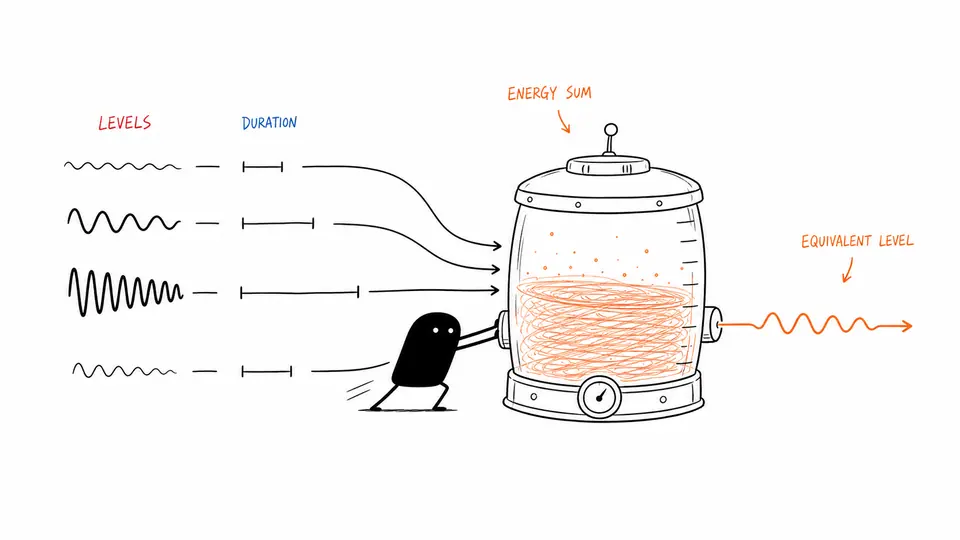
Preserve each level-duration pair and sum linear energy before returning to decibels.
TIME-WEIGHTED SOUND ENERGY
Combine variable sound segments in the energy domain, not by averaging decibels
Pair each compatible level with its duration. The calculator derives LAeq for the entered period, an eight-hour normalized level, sound exposure level, a NIOSH-reference dose estimate, and the energy share of every segment.
Period LAeq—
8-hour normalized level—
Sound exposure level—
NIOSH-reference dose—
Total duration—
Largest energy segment—
ENERGY CONTRIBUTION JOURNEY
See which segment dominates the total exposure
Bar width follows time while fill intensity follows linear energy. The cumulative trace shows why a short high-level segment can outweigh hours at a lower level.
| Segment | Level (dBA) | Duration (min) | Energy share | NIOSH allowable (min) |
|---|
How to use
Combine variable sound segments in the energy domain, not by averaging decibels
- Enter Levels (dBA, commas or lines), Matching durations (minutes).
- Confirm the remaining assumptions use the same project, measurement, or product basis.
- Read Period LAeq together with 8-hour normalized level and Sound exposure level.
- Use level-duration energy ledger to reconcile the result before exporting it.
- Confirm that the durations share one time unit and cover the intended analysis period without gaps or overlap.
SOUND-EXPOSURE FUNDAMENTALS
Keep level, duration, equivalent level, and criterion dose distinct
Required inputs
- Levels (dBA, commas or lines)
- Default: 82, 88, 91, 85
- Matching durations (minutes)
- Default: 120, 60, 30, 270
Reported outputs
- Period LAeq
- 8-hour normalized level
- Sound exposure level
- NIOSH-reference dose
- Total duration
- Largest energy segment
CALCULATION METHOD
Integrate sound energy across time
Pair every A-weighted level with its duration, convert levels to linear relative energy, sum level-duration contributions, and only then return to decibels. Eight-hour normalization and criterion dose remain separate downstream interpretations.
SEGMENT ENERGY
A-weighted equivalent continuous level over T.
Use levels measured with the same frequency weighting, detector response, calibration basis, and representative location.
EIGHT-HOUR NORMALIZATION
Sound exposure level normalized to eight hours.
Align each duration with exactly one level; record order is retained.
CRITERION DOSE
Level increase that halves allowable duration.
Convert every level to linear relative energy and multiply by its duration.
Detailed calculation process
Level-duration energy ledger
Erelative = Σ ti10^(Li/10)LAeq,T = 10 log10(Erelative/Σti)LEX,8h = 10 log10(Erelative/480 min)DoseNIOSH = 100Σ[ti/(480×2^((85−Li)/3))]
Every level-duration energy contribution remains unrounded through summation; LAeq, LEX,8h, and dose are formatted only after the shared energy total reconciles.
| Input | Default substitution | Requirement |
|---|---|---|
| Levels (dBA, commas or lines) | 82, 88, 91, 85 | Required; use one consistent unit and basis |
| Matching durations (minutes) | 120, 60, 30, 270 | Required; use one consistent unit and basis |
- Sum energy contributions, then divide by total duration for the period LAeq.
- Normalize the same energy sum to 480 minutes for LEX,8h.
- For the displayed NIOSH reference, calculate allowable time at each level using 85 dBA and a 3 dB exchange rate.
- Review the energy-share column before acting on the aggregate result.
Current exposure reconciliation will preserve every level-duration contribution before LAeq, eight-hour normalization, and criterion dose are reported.
Result interpretation
Read the period equivalent level before normalized and policy outputs
Period LAeq describes the entered window. LEX,8h answers a different normalization question and can be lower or higher depending on total energy relative to eight hours. Dose is tied to the displayed NIOSH reference assumptions and is not interchangeable with an OSHA 5 dB exchange-rate calculation.
Visual interpretation
See which segment dominates the total exposure
Bar width follows time while fill intensity follows linear energy. The cumulative trace shows why a short high-level segment can outweigh hours at a lower level. Read the graphic with the exact ledger: geometry and color show relationships, while the table remains the numerical record.
EVIDENCE FOR THIS MODEL
Preserve every level-duration pair and its measurement basis
Keep each timestamped segment, duration source, A-weighting, time weighting, dosimeter threshold, exchange-rate convention, microphone position, work task, hearing protection condition, calibration checks, excluded intervals, shift length, and unrounded energy contribution.
SCOPE AND LIMITATIONS
What the entered exposure history cannot establish
- No task-duration estimate can repair nonrepresentative level measurements.
- The NIOSH-reference dose uses 85 dBA, 3 dB exchange, and an eight-hour criterion.
- Impulse, peak, octave-band, protector attenuation, background correction, and uncertainty need separate treatment.
- Do not mix OSHA and NIOSH dose percentages without naming the rule.
KEY TERMINOLOGY
Sound-exposure terms used by this calculator
- LAeq,T
- A-weighted equivalent continuous level over T.
- LEX,8h
- Sound exposure level normalized to eight hours.
- Exchange rate
- Level increase that halves allowable duration.
- Dose
- Sum of actual-to-allowable duration fractions.
- Energy share
- Segment contribution divided by total linear energy.
- SEL
- Exposure expressed relative to one second.
PRACTICAL DECISIONS
Short loud task versus Partial-shift survey
Short loud task
The 91 dBA segment may dominate despite its short duration. Control effort should follow energy contribution rather than clock time alone.
Partial-shift survey
LAeq describes the surveyed period; LEX,8h normalizes only the captured energy. Verify that unobserved work is represented before drawing a shift conclusion.
AUTHORITATIVE BASIS
References for time-weighted sound energy
Important note
No task-duration estimate can repair nonrepresentative level measurements. Preserve the entered assumptions, exact ledger, and named source before using period laeq in a decision.
Frequently asked questions
Why must counts align?
Each level needs the duration over which it applies.
Can I enter one number?
Yes; it becomes a single constant-level segment.
Why does the highest level dominate?
Each +10 dB multiplies linear energy by ten.
Is LAeq the same as dose?
No. Dose also applies a criterion level and exchange rule.
Can I use dBC?
Only if the intended calculation and rule use the same compatible quantity; this page labels the dose reference as dBA.
What if a duration is zero?
Remove that record; every retained segment must have positive duration.
Does 100% prove legal noncompliance?
No. It identifies the entered NIOSH-reference criterion, not a legal finding.
Should hearing protection change the input?
Use a separately justified protected-exposure method; do not subtract an arbitrary rating.