Live calculation visualCurrent entered assumptions
Unit Converters
Sound Level Tolerance Calculator
Keep the central reading, entered limits, and uncertainty interval visible in one decision record.
UNCERTAINTY-GUARDED SOUND LIMITS
Test the complete measurement interval against asymmetric decibel limits
Define the target, lower and upper tolerances, measured level, and expanded uncertainty. The decision distinguishes a guarded pass from a nominally in-band result that still overlaps a limit.
Decision—
Acceptance limits—
Measurement interval—
Guarded lower margin—
Guarded upper margin—
Nearest boundary—
DECISION INTERVAL
See central value and uncertainty before accepting the result
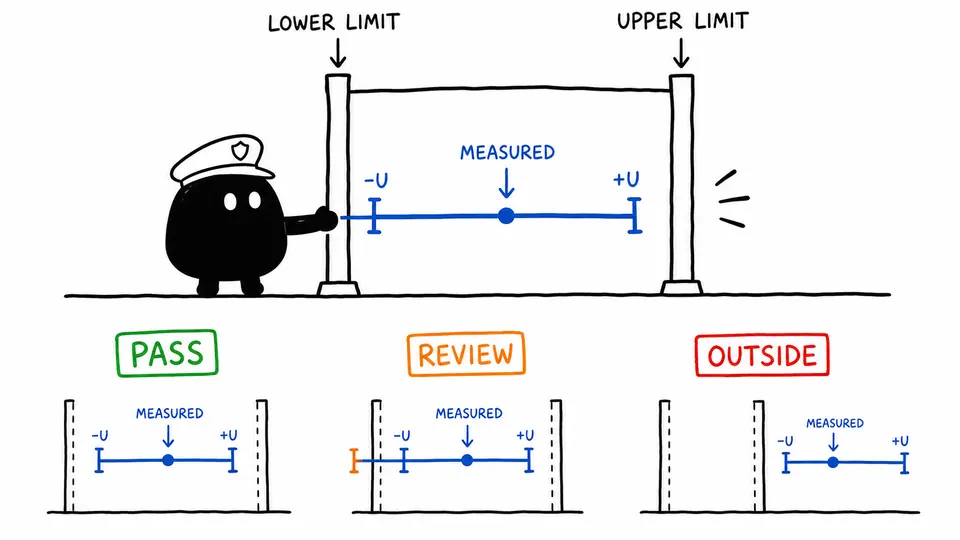
The measured interval moves against asymmetric boundaries. Color encodes guarded pass, review overlap, or central value outside—without hiding negative margins.
| Element | Low (dB) | Center (dB) | High (dB) | Status |
|---|
How to use
Test the complete measurement interval against asymmetric decibel limits
- Enter Target level (dB), Lower tolerance (dB), Upper tolerance (dB).
- Confirm the remaining assumptions use the same project, measurement, or product basis.
- Read Decision together with Acceptance limits and Measurement interval.
- Use tolerance and guard-band ledger to reconcile the result before exporting it.
- Record the source of the target, both tolerances, and the uncertainty coverage basis before accepting the decision.
CONFORMITY FUNDAMENTALS
Separate target, asymmetric limits, uncertainty, and decision rule
Required inputs
- Target level (dB)
- Default: 85
- Lower tolerance (dB)
- Default: 2
- Upper tolerance (dB)
- Default: 3
- Measured level (dB)
- Default: 84.2
- Expanded uncertainty ±U (dB)
- Default: 0.8
Reported outputs
- Decision
- Acceptance limits
- Measurement interval
- Guarded lower margin
- Guarded upper margin
- Nearest boundary
CALCULATION METHOD
Test the complete supported interval against the specification
Build lower and upper limits from the target and independent allowances. Compare the unrounded measurement interval with both limits before assigning Pass, Review, or Outside.
SPECIFICATION BAND
Declared nominal sound level.
Obtain the target and asymmetric tolerances from the governing specification.
MEASUREMENT INTERVAL
Allowed departure from target.
Enter an expanded uncertainty that applies to this measurement and reported result.
DECISION RULE
Reported interval half-width under a stated coverage basis.
Construct the acceptance interval around the target.
Detailed calculation process
Tolerance and guard-band ledger
Llow = Ltarget − tolerance−Lhigh = Ltarget + tolerance+Imeasurement = [Lmeasured − U, Lmeasured + U]Guarded pass iff Imeasurement ⊆ [Llow,Lhigh]
The conformity decision uses unrounded limits and interval endpoints; displayed margins cannot move an observation across a boundary.
| Input | Default substitution | Requirement |
|---|---|---|
| Target level (dB) | 85 | Required; use one consistent unit and basis |
| Lower tolerance (dB) | 2 | Required; use one consistent unit and basis |
| Upper tolerance (dB) | 3 | Required; use one consistent unit and basis |
| Measured level (dB) | 84.2 | Required; use one consistent unit and basis |
| Expanded uncertainty ±U (dB) | 0.8 | Required; use one consistent unit and basis |
- Construct the measurement interval around the central value.
- Report outside when the central value itself is outside.
- Report review when the center is inside but the uncertainty interval crosses a boundary.
- Report guarded pass only when the complete interval is contained.
Current conformity reconciliation will compare the complete unrounded measurement interval with both asymmetric limits.
Result interpretation
A central value inside the band can still require review
Positive guarded margins show clearance after uncertainty. A review result is not an automatic failure; it says the entered evidence does not support the guarded-pass rule. An outside result identifies the central value outside the entered specification before uncertainty is considered.
Visual interpretation
See central value and uncertainty before accepting the result
The measured interval moves against asymmetric boundaries. Color encodes guarded pass, review overlap, or central value outside—without hiding negative margins. Read the graphic with the exact ledger: geometry and color show relationships, while the table remains the numerical record.
EVIDENCE FOR THIS MODEL
Keep the tolerance clause and uncertainty statement together
Retain the specification revision, target quantity, weighting, averaging, tolerances, decision rule, measured result, uncertainty source and coverage, calibration evidence, rounding policy, reviewer, and disposition of review cases.
SCOPE AND LIMITATIONS
What this guarded comparison cannot certify
- This page applies rather than invents a specification.
- The uncertainty interval is treated symmetrically as entered.
- No producer/consumer risk model or statistical acceptance sampling is included.
- Rounding is for display only; decisions use unrounded values.
KEY TERMINOLOGY
Tolerance and conformity terms
- Target
- Declared nominal sound level.
- Tolerance
- Allowed departure from target.
- Expanded uncertainty
- Reported interval half-width under a stated coverage basis.
- Guard band
- Margin reserved for uncertainty or decision risk.
- Review
- Evidence overlaps a boundary under this rule.
- Outside
- Central result lies beyond a limit.
PRACTICAL DECISIONS
Nominally inside, interval crosses versus Guarded clearance
Nominally inside, interval crosses
The central value may look acceptable while its upper uncertainty bound exceeds the limit. Route the result to the documented review process.
Guarded clearance
Both interval endpoints remain within the limits. Record the positive margins together with the uncertainty basis.
AUTHORITATIVE BASIS
References for uncertainty-guarded sound limits
Important note
This page applies rather than invents a specification. Preserve the entered assumptions, exact ledger, and named source before using decision in a decision.
Frequently asked questions
Why allow asymmetric limits?
Real specifications can permit different low and high departures.
Is review the same as fail?
No. The governing procedure must define review disposition.
Can U be zero?
Yes mathematically, but only when justified by the measurement record.
Are dB margins linear percentages?
No. dB is logarithmic.
Does rounding affect the result?
No. The decision uses unrounded values.
Can this decide OSHA compliance?
Not without the applicable measurement protocol, exposure rule, and legal interpretation.
Where do limits come from?
A specification, approved criterion, or governing procedure.
What if target quantity changes?
Rebuild the decision with compatible weighting, averaging, and reference.