Live calculation visualCurrent entered assumptions
Unit Converters
Sound Level Precision Calculator
Keep energetic averaging separate from repeatability and combine only the stated uncertainty components.
REPEAT MEASUREMENT PRECISION
Separate sound-energy averaging from repeat scatter and stated uncertainty
Enter repeated, compatible sound-level readings from one measurement condition. The page preserves every record, calculates both the arithmetic and energetic means, estimates repeatability, and combines standard error with an entered meter standard uncertainty.
Energetic mean—
Arithmetic mean—
Sample SD—
Standard error—
Expanded uncertainty—
Observed range—
REPEATABILITY STRIP
See every repeat, the mean, and the uncertainty interval
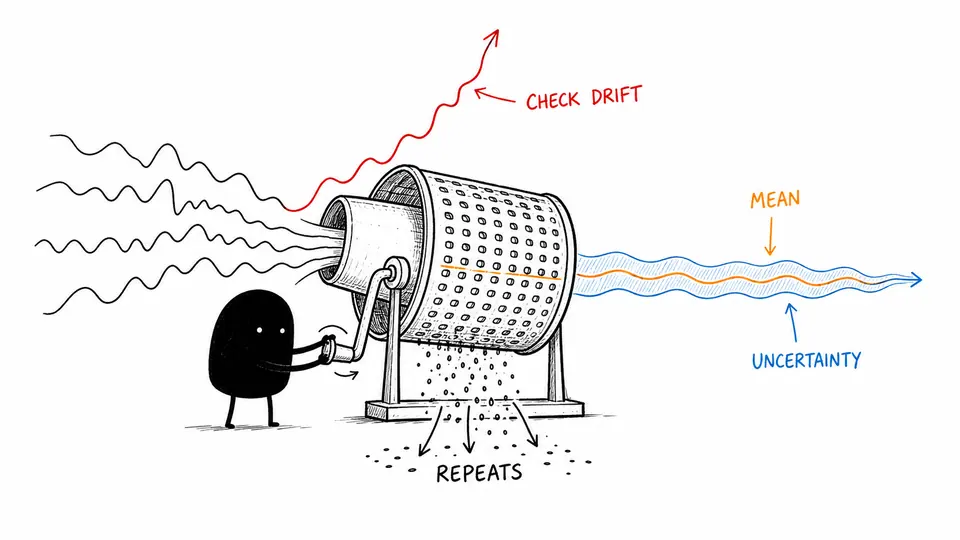
The ordered strip shows acquisition sequence rather than hiding it in one statistic. The contribution bars keep repeat scatter and meter uncertainty separate before combination.
| Reading | Level (dB) | Residual (dB) | Energy share | Within expanded interval |
|---|
How to use
Separate sound-energy averaging from repeat scatter and stated uncertainty
- Enter Repeated levels (dB, commas or lines), Meter standard uncertainty (dB), Coverage factor k.
- Confirm the remaining assumptions use the same project, measurement, or product basis.
- Read Energetic mean together with Arithmetic mean and Sample SD.
- Use reading-by-reading precision ledger to reconcile the result before exporting it.
- Confirm that weighting, detector response, meter range, and operating state stayed constant across the repeat set.
ACOUSTIC REPEATABILITY
Separate acoustic energy, repeat scatter, and stated uncertainty
Required inputs
- Repeated levels (dB, commas or lines)
- Default: 84.7, 85.1, 84.9, 85.3, 84.8
- Meter standard uncertainty (dB)
- Default: 0.4
- Coverage factor k
- Default: 2
Reported outputs
- Energetic mean
- Arithmetic mean
- Sample SD
- Standard error
- Expanded uncertainty
- Observed range
CALCULATION METHOD
Average in the domain that matches the question
Convert each dB reading to relative energy for the energetic mean. Use displayed dB values only for repeatability statistics, then combine standard error with the entered meter component without implying that more repeats remove calibration uncertainty.
ENERGY AVERAGING
Level obtained by averaging linear relative energy.
Confirm all readings use the same weighting, time response, microphone position, range, and averaging interval.
SEQUENCE DIAGNOSIS
Ordinary mean of displayed dB values.
Convert each dB reading to linear relative energy before calculating the energetic mean.
UNCERTAINTY BUDGET
Precision under specified close conditions.
Calculate the arithmetic mean only as the center required for residuals and sample scatter.
Detailed calculation process
Reading-by-reading precision ledger
L̄energy = 10 log10[(Σ10^(Li/10))/n]s = √[Σ(Li − L̄arithmetic)²/(n−1)]uA = s/√nuc = √(uA² + umeter²)U = kuc
All antilogs, means, deviations, and uncertainty components use full precision; displayed dB values are rounded only after the energetic and repeatability ledgers reconcile.
| Input | Default substitution | Requirement |
|---|---|---|
| Repeated levels (dB, commas or lines) | 84.7, 85.1, 84.9, 85.3, 84.8 | Required; use one consistent unit and basis |
| Meter standard uncertainty (dB) | 0.4 | Required; use one consistent unit and basis |
| Coverage factor k | 2 | Required; use one consistent unit and basis |
- Use the n−1 denominator for the sample standard deviation.
- Divide sample SD by √n to estimate Type A standard uncertainty of the reported arithmetic mean.
- Combine independent standard uncertainties by root-sum-square, then apply k once.
- Retain both centers: energetic mean answers an energy question; arithmetic mean supports the repeatability model.
Current repeat-set reconciliation will identify the energetic mean, arithmetic center, scatter, and supported interval from the entered readings.
Result interpretation
Do not collapse the energetic mean and precision interval into one answer
A narrow repeatability interval indicates consistent repeats under the entered conditions; it does not show that the microphone is unbiased or that the measurement represents another location or time. A meaningful gap between energetic and arithmetic means signals uneven levels because high readings receive more energy weight.
Visual interpretation
See every repeat, the mean, and the uncertainty interval
The ordered strip shows acquisition sequence rather than hiding it in one statistic. The contribution bars keep repeat scatter and meter uncertainty separate before combination. Read the graphic with the exact ledger: geometry and color show relationships, while the table remains the numerical record.
EVIDENCE FOR THIS MODEL
Retain the conditions needed to reproduce the repeat set
Retain raw sequence, weighting, time weighting, bandwidth, averaging interval, microphone and calibrator identifiers, pre/post calibration checks, location, orientation, range, environmental conditions, operator, exclusions, meter uncertainty source, coverage factor, and the exact unrounded outputs.
SCOPE AND LIMITATIONS
Where repeat statistics stop being evidence
- Precision is not accuracy and cannot correct bias.
- The entered meter component is assumed to be a standard uncertainty, not an expanded value.
- Serial correlation, drift, spatial variation, background correction, and calibration covariance are not modeled.
- Do not discard a repeat merely to improve SD; document an exclusion rule and preserve the original record.
KEY TERMINOLOGY
Terms used in repeat sound measurements
- Energetic mean
- Level obtained by averaging linear relative energy.
- Arithmetic mean
- Ordinary mean of displayed dB values.
- Repeatability
- Precision under specified close conditions.
- Sample SD
- Scatter estimator using n−1 degrees of freedom.
- Standard error
- Sample SD divided by √n.
- Expanded uncertainty
- Combined standard uncertainty multiplied by k.
PRACTICAL DECISIONS
Stable machine state versus Ordered drift
Stable machine state
Closely grouped repeats support a repeatability claim for that setup. Confirm calibration and background conditions separately before using the mean.
Ordered drift
A small SD can still hide a monotonic rise. The sequence chart makes settling or thermal drift visible and prompts another stabilized run.
AUTHORITATIVE BASIS
References for repeat measurement precision
Important note
Precision is not accuracy and cannot correct bias. Preserve the entered assumptions, exact ledger, and named source before using energetic mean in a decision.
Frequently asked questions
Which result is the final level?
Use the energetic mean for average acoustic energy. Use the arithmetic mean and its interval only for the stated repeatability evaluation.
Why not average dB directly for exposure?
Decibels are logarithmic; energy must be averaged in the linear domain.
Does more repeats remove meter uncertainty?
No. More repeats reduce the Type A standard error but not the entered meter component.
Can I mix dBA and dBC?
No. Split incompatible weighting and detector conditions.
Is k=2 always 95%?
Not automatically. Coverage depends on distribution and degrees of freedom.
Can one reading be used?
No. Sample scatter needs at least two readings.
Does low RSD prove compliance?
No. A specification decision needs limits, uncertainty, and a governing rule.
Why preserve order?
Order can reveal drift, settling, cycling, or transcription errors.