Speed can change the loss mechanism
A constant μ model makes torque independent of speed. Real lubricant drag, grease channeling, and seal behavior can cause a nonlinear speed response, so extrapolating far beyond the calibration point is unsafe.
Engineering
Estimate bearing friction torque, speed-dependent power loss, operating-period energy, and heat from an entered equivalent friction coefficient, load, mean diameter, and speed.
BEARING FRICTION ENERGY
This screening calculator is for engineers comparing bearing arrangements when a manufacturer’s detailed friction model is not yet available. It converts an entered equivalent friction coefficient, bearing load, mean diameter, and rotational speed into torque, mechanical loss, heat, and period energy. The coefficient is an explicit empirical input: it must come from test data or a catalog method for the bearing, seal, lubricant, load, and speed—not from a universal rule of thumb.
BEARING FRICTION ENERGY
Use the result to rank a preliminary arrangement or reconcile a measured heat balance. Do not use a guessed coefficient to establish lubricant temperature, motor size, or guaranteed efficiency.
| Loss stage | Driver A | Driver B | Calculated value | Unit / interpretation |
|---|
CURRENT CALCULATION PROCESS
M_f = μ_eq P d_m / 2; P_loss = M_f(2πn/60); E_loss = P_loss t
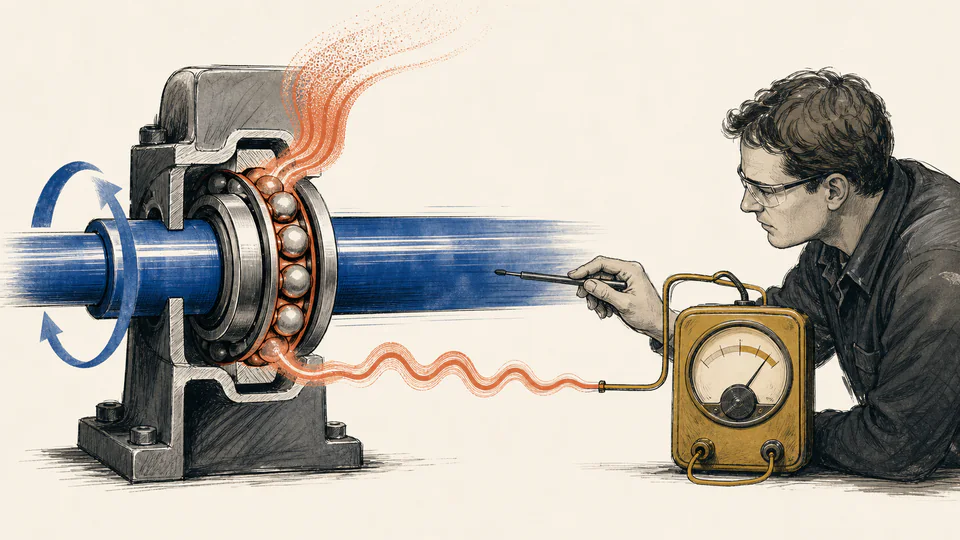
The entered equivalent coefficient reduces the bearing’s rolling, sliding, lubricant-churning, and seal behavior to one preliminary torque relationship. Torque is multiplied by angular speed to obtain watts; running hours then produce kWh and heat equivalent. This is intentionally simpler than bearing-manufacturer friction models that separate load-independent and load-dependent moments.
| Input / symbol | Engineering meaning and unit | Current value |
|---|---|---|
| equivalentLoadN | Equivalent bearing load (N) — Use the load basis associated with the chosen friction coefficient. | 9500 |
| frictionCoefficient | Equivalent friction coefficient — Dimensionless aggregate for this preliminary torque model. | 0.0018 |
| meanDiameterMm | Mean bearing diameter (mm) — Common screen uses the mean of bore and outside diameter. | 85 |
| speedRpm | Rotational speed (rpm) — Zero is allowed and produces zero speed-dependent loss. | 1800 |
| runtimeHours | Operating time (h) — Use loaded running hours, not total calendar hours. | 6000 |
| electricityRate | Energy rate (currency/kWh) — Optional planning rate in local currency units. | 0.14 |
Intermediate values remain unrounded until display formatting.
HOW TO USE THIS MODEL
BEARING FRICTION ENERGY FUNDAMENTALS
MODEL AND FORMULA
The entered equivalent coefficient reduces the bearing’s rolling, sliding, lubricant-churning, and seal behavior to one preliminary torque relationship. Torque is multiplied by angular speed to obtain watts; running hours then produce kWh and heat equivalent. This is intentionally simpler than bearing-manufacturer friction models that separate load-independent and load-dependent moments.
DEEPER ENGINEERING ANALYSIS
A constant μ model makes torque independent of speed. Real lubricant drag, grease channeling, and seal behavior can cause a nonlinear speed response, so extrapolating far beyond the calibration point is unsafe.
The calculated watts are a source term. Housing geometry, lubricant flow, ambient conditions, neighboring heat sources, and transient thermal mass determine the actual temperature rise.
A motor input difference includes gearbox, coupling, windage, seal, and electrical losses. Isolate bearing torque or perform a defensible baseline subtraction before fitting μeq.
WORKED DECISION CASES
Two bearing types carry similar load but use different seals and lubrication. The coefficient screen exposes whether the expected friction gap is large enough to justify a detailed manufacturer model and thermal test.
The calculated watt loss is small but runtime is nearly continuous. Energy cost may matter over a year even though local bearing temperature is governed mainly by environmental dust and lubrication practice.
TECHNICAL LANGUAGE
EVIDENCE AND DATA LINEAGE
Retain the bearing designation and internal design, load and preload, mean diameter definition, speed, lubricant type and viscosity at operating temperature, grease fill or oil flow, seal arrangement, run-in condition, coefficient source or torque-test record, housing temperature sensors, runtime basis, and calibration date. When the fitted coefficient comes from a motor-power subtraction, keep the full baseline-loss model and measurement uncertainty.
LIMITS AND EXCLUSIONS
RELIABLE SOURCES
FREQUENTLY ASKED QUESTIONS
No. Friction depends on bearing design, load, speed, lubricant viscosity and quantity, seals, temperature, and running condition. Use a documented coefficient for the intended boundary.
This model calculates mechanical power as torque times angular speed. It does not model heater power, static preload work, or transient starting energy.
Yes only when each bearing has its own defensible load, mean diameter, coefficient, and speed. Do not apply one bearing’s fitted coefficient to every location.
Mechanical friction loss ultimately becomes heat, but where it is rejected—bearing, oil, shaft, housing, or air—requires a thermal model.
Detailed models separate rolling, sliding, lubricant drag, and seal moments and account for viscosity and speed. The simple equivalent-coefficient model intentionally does not.
Not by itself. Cooling design needs the complete machine heat balance, lubricant flow and properties, transient behavior, ambient boundary, and a design margin.
IMPORTANT ENGINEERING NOTE
Use manufacturer calculation tools or a validated tribological and thermal model when friction affects maximum speed, lubricant selection, cooling capacity, fire risk, precision, or warranty. Confirm measured behavior under the real installation and operating cycle.
RELATED CALCULATORS
Use a separate model for the next boundary instead of folding it into this result.