EN

Engineering

Heat Exchanger Efficiency Calculator

Reconcile measured hot- and cold-side duties, quantify energy-balance mismatch, and compare transferred duty with the thermodynamic maximum to estimate heat-exchanger effectiveness.

MEASURED HEAT EXCHANGER PERFORMANCE

Reconcile both stream balances before calling performance efficient

This calculator helps commissioning engineers and energy analysts interpret measured exchanger temperatures and flow rates. It calculates heat released by the hot stream and heat gained by the cold stream, reports their mismatch, then divides the reconciled duty by Cmin times the inlet temperature span. The effectiveness result is only credible when mass flow, heat capacity, temperature timing, phase state, and heat-loss boundary are compatible.

Measured effectiveness
Reconciled duty
Hot-side duty
Cold-side duty
Energy-balance mismatch
Thermodynamic maximum

MEASURED HEAT EXCHANGER PERFORMANCE

Stream duty and effectiveness reconciliation

Accept an effectiveness trend only after the hot/cold imbalance is consistent with the test uncertainty and known ambient losses. A high effectiveness paired with a poor balance is a measurement warning, not proof of exceptional exchanger performance.

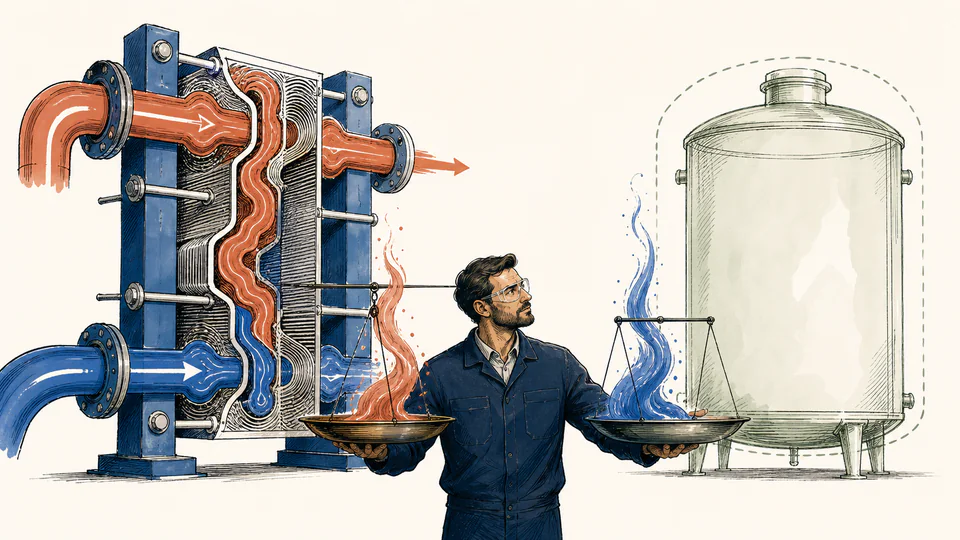
Editorial cutaway of two colored fluid paths exchanging heat through a plate wall while two separate energy ledgers are balanced by an engineer
The image keeps hot-side release, cold-side gain, and theoretical maximum as three distinct quantities that must reconcile before interpretation.
Stream duty and effectiveness reconciliationUnrounded calculation path
Live calculation ledger based on current inputs
Performance stageStream value AStream value BDerived quantityDuty / unit

CURRENT CALCULATION PROCESS

Formula, substitution, intermediate values, and reconciliation

Q_h = m_h c_ph(T_hi−T_ho); Q_c = m_c c_pc(T_co−T_ci); ε = [(Q_h+Q_c)/2] / [C_min(T_hi−T_ci)]

Separate first-law balances are calculated for the hot and cold streams. Their arithmetic mean is used only as a transparent reconciled test duty; the percentage mismatch remains visible. Effectiveness compares that reconciled duty with the maximum heat transfer permitted by the smaller heat-capacity rate and the inlet temperature difference.

Current default register: labels, meanings, units, and entered values
Input / symbolEngineering meaning and unitCurrent value
hotMassFlowKgSHot-side mass flow (kg/s) — Use synchronized mass flow at the test condition.3.2
hotCpKjKgKHot-side specific heat (kJ/kg·K) — Evaluate at a defensible mean temperature and composition.4.18
hotInCHot inlet temperature (°C) — Upstream of the exchanger test boundary.92
hotOutCHot outlet temperature (°C) — Synchronized with hot inlet and flow.63
coldMassFlowKgSCold-side mass flow (kg/s) — Use the same averaging interval as the hot side.4.1
coldCpKjKgKCold-side specific heat (kJ/kg·K) — Do not assume water properties for mixtures.4.18
coldInCCold inlet temperature (°C) — Measure at the actual exchanger inlet.24
coldOutCCold outlet temperature (°C) — Avoid sensor locations mixed with bypass flow.46.3

    Intermediate values remain unrounded until display formatting.

    HOW TO USE THIS MODEL

    Run a synchronized two-stream performance test

    1. Define the exchanger test boundary, including whether external heat loss, bypass, recirculation, and condensate are inside or outside the measurement.
    2. Collect hot and cold flow plus all four terminal temperatures over the same stable time interval; reject points collected during thermal storage or control-valve movement.
    3. Use fluid-specific heat capacities at the measured composition, pressure, and representative temperature; split the analysis if phase change occurs.
    4. Review hot and cold duties and their percentage mismatch before reading effectiveness; investigate sensor bias, flow calibration, or unmeasured heat loss when they disagree.
    5. Compare effectiveness only across tests with the same exchanger arrangement and capacity-rate basis, then inspect fouling, approach, and pressure-drop evidence separately.

    MEASURED HEAT EXCHANGER PERFORMANCE FUNDAMENTALS

    Performance quantities behind the effectiveness number

    Heat-capacity rate C
    Mass flow multiplied by specific heat, expressed in kW/K; it determines how much a stream temperature changes for a given duty.
    Cmin
    The smaller stream heat-capacity rate. It limits maximum possible sensible heat transfer for the entered inlet temperatures.
    Hot-side duty
    Energy rate inferred from hot-stream cooling. It includes every heat path inside the chosen hot-side test boundary.
    Cold-side duty
    Energy rate inferred from cold-stream heating. It should reconcile with hot-side duty after accounting for uncertainty and boundary losses.
    Effectiveness
    Actual or reconciled heat transfer divided by the maximum thermodynamically possible transfer for the same inlet state and capacity rates.
    Energy-balance mismatch
    Difference between stream duties relative to their mean; a data-quality indicator, not an efficiency penalty to conceal.

    MODEL AND FORMULA

    Combine first-law reconciliation with the effectiveness definition

    Q_h = m_h c_ph(T_hi−T_ho); Q_c = m_c c_pc(T_co−T_ci); ε = [(Q_h+Q_c)/2] / [C_min(T_hi−T_ci)]

    Separate first-law balances are calculated for the hot and cold streams. Their arithmetic mean is used only as a transparent reconciled test duty; the percentage mismatch remains visible. Effectiveness compares that reconciled duty with the maximum heat transfer permitted by the smaller heat-capacity rate and the inlet temperature difference.

    DEEPER ENGINEERING ANALYSIS

    Interpreting measured exchanger performance responsibly

    Sensor timing can imitate imbalance

    A metal exchanger stores energy while temperatures change. Unsynchronized readings during a transient make one stream appear to release more heat than the other receives even when sensors are individually accurate.

    Effectiveness is not the same as efficiency

    Effectiveness compares actual duty with an inlet-condition maximum. It does not include pump power, fan power, pressure-drop cost, or the value of delivered heat.

    Phase change needs a different enthalpy model

    Specific-heat times temperature change is appropriate for single-phase sensible duty. Condensation, evaporation, reaction, or significant property variation requires enthalpy differences.

    WORKED DECISION CASES

    Performance tests with different conclusions

    Post-cleaning baseline

    A plate exchanger is tested at matched flows before and after cleaning. Lower approach temperature and restored effectiveness matter only if duty balance and pressure-drop measurements remain comparable.

    Suspected bypass leakage

    Cold outlet temperature rises less than expected while hot duty remains high. A large stream imbalance prompts checks for mixing, bypass, sensor location, and unmeasured losses before blaming fouling.

    TECHNICAL LANGUAGE

    Heat-exchanger test terminology

    Terminal temperature
    One of the four inlet or outlet temperatures defining the exchanger test condition.
    Sensible heat
    Energy transfer that changes temperature without modeled phase change.
    Capacity-rate ratio
    Cmin divided by Cmax; a central parameter in effectiveness-NTU analysis.
    Approach temperature
    Small terminal temperature difference that indicates how closely one stream approaches the other inlet condition.
    Test boundary
    Declared physical boundary identifying which heat and flow paths are included.
    Steady state
    Condition where stored energy changes are small relative to transferred energy over the averaging interval.

    EVIDENCE AND DATA LINEAGE

    Measurement package needed for an auditable test

    Retain calibrated flow and temperature instrument IDs, locations, sample rate, averaging interval, process stabilization evidence, fluid composition and property source, pressure, valve and bypass positions, ambient condition, insulation state, fouling history, exchanger arrangement, uncertainty calculation, raw time series, excluded records, and the unrounded hot/cold/reconciled duties. Preserve which side, if any, the governing test code treats as authoritative.

    LIMITS AND EXCLUSIONS

    Conditions outside this sensible-duty model

    • The model assumes single-phase sensible heat with representative constant specific heat on each side.
    • It does not correct for ambient heat loss, shell heat storage, bypass, leakage, or mixing outside the declared measurements.
    • The arithmetic mean is a reconciliation convention, not a substitute for uncertainty analysis or a governing test-code rule.
    • Pump, fan, pressure-drop, exergy, utility-cost, and economic efficiency are excluded.
    • A transient test or unsynchronized measurements can invalidate the steady-state energy balance.

    RELIABLE SOURCES

    References for this page’s method and boundaries

    FREQUENTLY ASKED QUESTIONS

    Questions about effectiveness and balance

    Why average hot and cold duties?

    The mean is a transparent reconciled estimate when neither side is declared authoritative. It does not remove the mismatch; the mismatch remains a separate acceptance signal.

    What balance mismatch is acceptable?

    Use the project test code and propagated measurement uncertainty. The calculator does not impose a universal percentage because instrumentation and duty boundaries differ.

    Can effectiveness exceed 100%?

    A credible single-phase exchanger cannot transfer more than Cmin times the inlet temperature span. A result materially above 100% indicates incompatible inputs, property values, timing, or boundaries.

    Does higher effectiveness always mean lower operating cost?

    No. Higher effectiveness may require more area or pressure drop, and the calculation excludes pumps, fans, utilities, cleaning, and economic value.

    Can I use average water Cp for glycol?

    No. Use heat capacity for the actual concentration and temperature range; a wrong property can create both duty imbalance and biased effectiveness.

    What if one stream changes phase?

    Replace the sensible-heat calculation with a verified enthalpy balance and account for quality, pressure, superheat, subcooling, and condensate or vapor state.

    IMPORTANT ENGINEERING NOTE

    Do not certify exchanger performance from unmatched field readings

    Performance acceptance should follow the applicable test code, calibrated instrumentation plan, uncertainty analysis, stabilization criteria, and contractual boundary. Use a qualified thermal engineer for phase change, hazardous fluids, pressure equipment, guaranteed performance, or decisions with safety and commercial consequences.

    RELATED CALCULATORS

    Continue the engineering decision

    Use a separate model for the next boundary instead of folding it into this result.