Surface temperature is not fluid temperature
Insulation and wall resistance create gradients. Using bulk process temperature with an external coefficient can overstate loss when the actual outer surface is much cooler.
Engineering
Estimate ambient heat loss from an exchanger external surface, apply an entered insulation reduction, and reconcile gross exchanged duty with delivered process duty and period energy loss.
EXCHANGER AMBIENT HEAT LEAKAGE
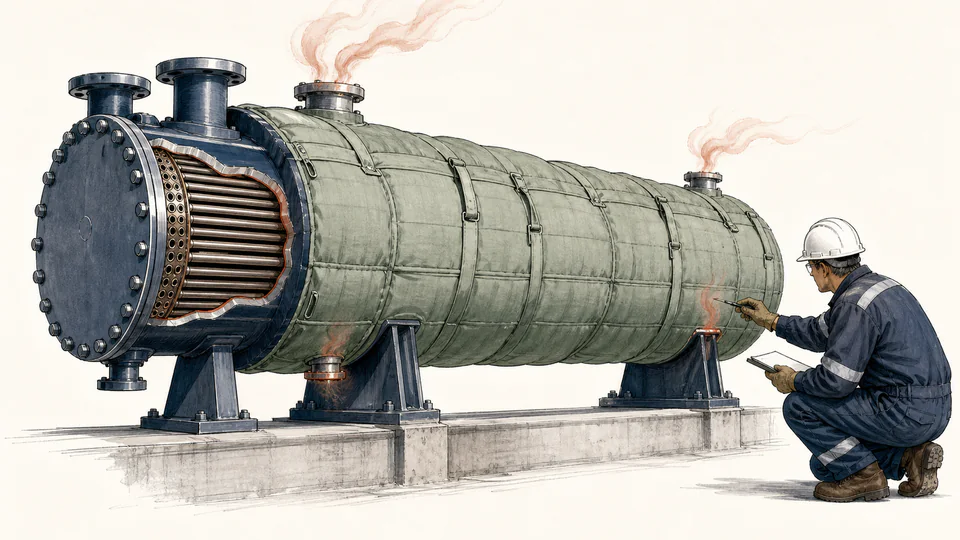
This calculator estimates steady heat leakage from an exchanger’s external surface to cooler ambient surroundings. It applies an external U-area-temperature-difference model, then reduces that uninsulated loss by an entered insulation effectiveness before reconciling delivered duty and period energy. It is intended for insulation and energy screening; the surface temperature and external coefficient must be measured or engineered for the actual orientation, airflow, and insulation condition.
EXCHANGER AMBIENT HEAT LEAKAGE
Use the result to prioritize insulation survey work and energy accounting. If calculated leakage is large relative to duty, verify thermal images, surface areas, air movement, radiation treatment, and uninsulated bridges before committing to a retrofit.
| Heat path | Boundary value A | Boundary value B | Calculated value | Unit / balance |
|---|
CURRENT CALCULATION PROCESS
Q_loss,0 = U_ext A_ext(T_surface−T_ambient)/1000; Q_loss = Q_loss,0(1−η_ins); Q_delivered = Q_gross−Q_loss
An entered aggregate external coefficient converts exposed area and mean temperature difference into an uninsulated steady loss. The insulation reduction is applied once to that heat path. Subtracting residual loss from gross exchanger duty produces delivered process duty, and multiplying by operating hours produces a screening energy quantity.
| Input / symbol | Engineering meaning and unit | Current value |
|---|---|---|
| grossDutyKw | Gross exchanged duty (kW) — Thermal duty inside the exchanger before modeled ambient leakage. | 480 |
| meanSurfaceTemperatureC | Mean external surface temperature (°C) — Area-weighted temperature at the external loss boundary. | 86 |
| ambientTemperatureC | Ambient temperature (°C) — Representative air or surrounding temperature at the same time. | 24 |
| externalU | External loss coefficient (W/m²·K) — Combined convection/radiation screen for the exposed geometry. | 9.5 |
| exposedAreaM2 | Exposed external area (m²) — Include shell, heads, channels, and uninsulated fittings as applicable. | 34 |
| insulationEfficiency | Insulation loss reduction (%) — 76% means residual loss is 24% of the uninsulated estimate. | 76 |
| operatingHours | Operating time (h) — Hours at a comparable surface and ambient condition. | 7200 |
Intermediate values remain unrounded until display formatting.
HOW TO USE THIS MODEL
EXCHANGER AMBIENT HEAT LEAKAGE FUNDAMENTALS
MODEL AND FORMULA
An entered aggregate external coefficient converts exposed area and mean temperature difference into an uninsulated steady loss. The insulation reduction is applied once to that heat path. Subtracting residual loss from gross exchanger duty produces delivered process duty, and multiplying by operating hours produces a screening energy quantity.
DEEPER ENGINEERING ANALYSIS
Insulation and wall resistance create gradients. Using bulk process temperature with an external coefficient can overstate loss when the actual outer surface is much cooler.
A dark hot shell in still air and reflective cladding in forced air have different combined coefficients. Record orientation, emissivity, air speed, and surroundings.
Flanges, valve bodies, channels, and manway covers may have high surface temperatures and weak insulation. Segmenting them can be more useful than refining the large shell average.
WORKED DECISION CASES
Thermography shows well-insulated shell sections but hot removable heads. Segmenting their area demonstrates that reusable covers may deliver more value than replacing intact shell insulation.
High wind raises external convection and process heat loss. The screening energy supports a seasonal operating review, while freeze protection and control stability remain separate requirements.
TECHNICAL LANGUAGE
EVIDENCE AND DATA LINEAGE
Retain equipment drawings and external area takeoff, insulation specification and condition survey, thermal images with emissivity and reflected-temperature settings, contact-probe checks, surface segmentation, ambient and wind measurements, orientation, external-coefficient method, operating duty and hours distribution, bare-component inventory, and the energy boundary. Re-survey after repair instead of assuming nameplate insulation performance.
LIMITS AND EXCLUSIONS
RELIABLE SOURCES
FREQUENTLY ASKED QUESTIONS
Not unless the external surface is effectively at that temperature and the method justifies it. Insulated outer surfaces can be far cooler than the process fluid.
No. It is the entered fractional loss reduction relative to a defined uninsulated case. Preserve how it was calculated or measured.
Yes only when the entered external coefficient deliberately combines convection and radiation for the actual surface and surroundings. Otherwise model the radiation term separately.
That result violates the declared duty balance and signals mismatched boundaries, units, coefficient, area, or temperatures.
Not without a representative load profile, calibrated field survey, weather and ambient distribution, insulation degradation, utility conversion, and uncertainty analysis.
Usually it saves energy, but some equipment relies on heat rejection for temperature control or freeze behavior. Review process control and material limits before insulating new surfaces.
IMPORTANT ENGINEERING NOTE
A qualified thermal and process engineer should validate surface segmentation, convection/radiation coefficients, insulation design, personnel protection, corrosion-under-insulation risk, fire requirements, process control, and savings uncertainty before authorizing work.
RELATED CALCULATORS
Use a separate model for the next boundary instead of folding it into this result.