Actual bore uncertainty
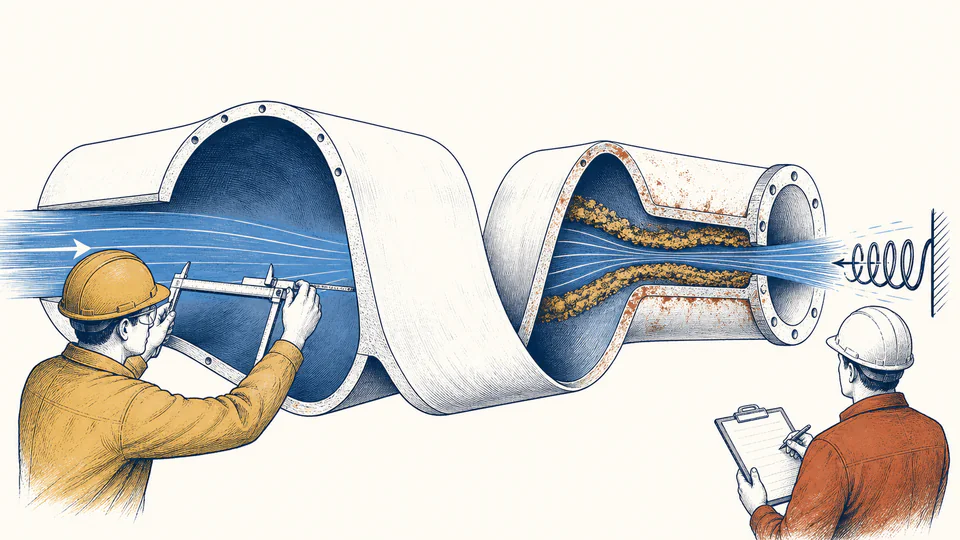
Schedule, lining, ovality, deposits, and inspection coverage determine effective diameter.
Engineering
Compare a reviewed pipe with changed internal diameter and roughness at fixed flow, quantifying velocity, pressure-drop, head-loss, and power changes.
PIPE HYDRAULIC SENSITIVITY
Head loss responds nonlinearly to diameter because smaller bore raises velocity and L/D together. This calculator holds flow, length, fluid, and fittings constant, then changes diameter and roughness explicitly. It reports both full cases instead of one untraceable sensitivity percentage.
PIPE HYDRAULIC SENSITIVITY
Use the comparison to rank inspection and design uncertainty. A severe plausible response can justify measurement or cleaning evaluation; it does not prove degradation exists.
| Case | Internal diameter (mm) | Roughness (mm) | Velocity (m/s) | Head loss (m) | Pressure drop (kPa) |
|---|
CURRENT CALCULATION PROCESS
For each case: v=Q/A; Re=rho v D/mu; hL=[f(L/D)+K]v^2/(2g); sensitivity=(changed-base)/base
Both cases recalculate velocity, Reynolds number, friction factor, and loss. The model avoids a fixed diameter-power shortcut.
| Input / symbol | Engineering meaning and unit | Current value |
|---|---|---|
| flowM3h | Fixed comparison flow (m3/h) — Same in both cases | 140 |
| baseDiameterMm | Base internal diameter (mm) — Reviewed reference bore | 200 |
| diameterChangePercent | Internal diameter change (%) — Negative for fouling or smaller bore | -5 |
| lengthM | Pipe length (m) — Held constant | 600 |
| baseRoughnessMm | Base absolute roughness (mm) — Reference wall condition | 0.045 |
| roughnessMultiplier | Changed roughness multiplier — Changed divided by base | 4 |
| density | Fluid density (kg/m3) — Held constant | 998 |
| dynamicViscosityMpaS | Dynamic viscosity (mPa*s) — Held constant | 1.002 |
| minorK | Unchanged minor-loss coefficient K — Same component basis | 8 |
Intermediate values remain unrounded until display formatting.
HOW TO USE THIS MODEL
PIPE HYDRAULIC SENSITIVITY FUNDAMENTALS
MODEL AND FORMULA
Both cases recalculate velocity, Reynolds number, friction factor, and loss. The model avoids a fixed diameter-power shortcut.
DEEPER ENGINEERING ANALYSIS
Schedule, lining, ovality, deposits, and inspection coverage determine effective diameter.
Published values may not represent aged, coated, biofouled, or blocked pipe.
A real fixed-speed pump may deliver less flow when resistance rises; actual operation needs the system intersection.
WORKED DECISION CASES
A plausible bore loss sharply raises required head, supporting targeted inspection and cleaning evaluation.
Alternative schedules change bore and recurring energy before pressure and lifecycle costs are considered.
TECHNICAL LANGUAGE
EVIDENCE AND DATA LINEAGE
Keep base model, bore and lining source, fouling evidence, roughness source, fluid condition, fixed-flow rationale, fittings, changed-case provenance, unrounded ledgers, and the decision informed.
LIMITS AND EXCLUSIONS
RELIABLE SOURCES
FREQUENTLY ASKED QUESTIONS
It isolates head needed to preserve service; actual flow may change and needs system analysis.
Yes within the model boundary when physically justified.
The calculator recalculates friction factor and minor losses.
No. Roughness acts through relative roughness and friction factor.
No. It contains no time or probability model.
Verify minimum velocity, control, capital, and service constraints.
RELATED CALCULATORS
Use these follow-on models to test a different boundary without hiding it inside this calculation.
IMPORTANT ENGINEERING NOTE
Final operating, inspection, cleaning, replacement, and energy decisions require verified condition data, full system behavior, integrity and lifecycle assessment, and qualified review.