A replacement can reverse savings
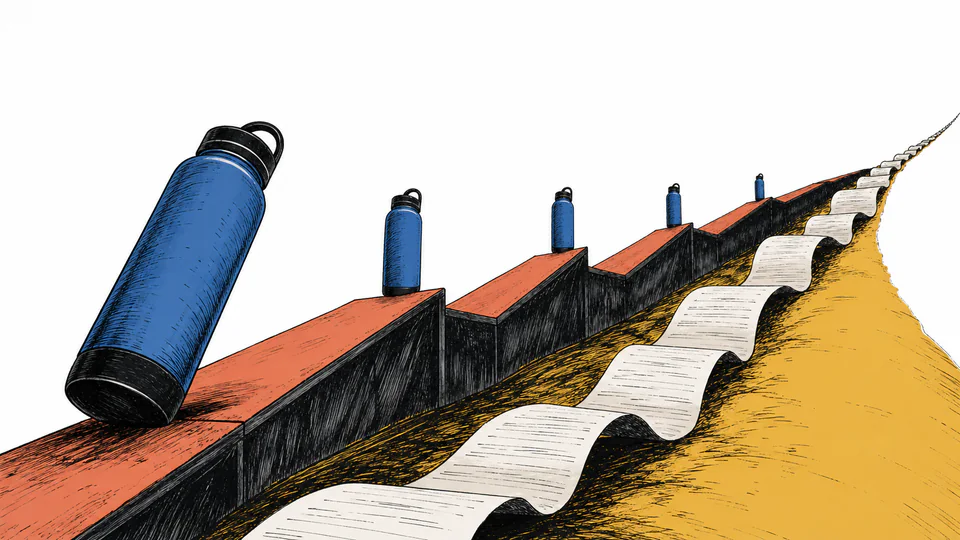
Reusable cost may temporarily cross below disposables and jump above again at the next replacement. Inspect the horizon total, not only the first crossing.
Practical household planning
Find the first use where a reusable system costs no more than disposables while honoring rated-life blocks, replacement purchases, cleaning, and a maximum horizon.
REUSABLE COST CROSSOVER
A straight-line break-even formula can fail when reusable items must be replaced in whole units. This calculator evaluates every whole use up to a chosen horizon, adding a replacement whenever rated capacity is crossed. It is for a buyer comparing one reusable system with a comparable disposable service; it reports no crossover when the entered horizon never reaches one.
REUSABLE COST CROSSOVER
A crossover near the maximum horizon is fragile: small changes in continued use, cleaning, or replacement price can erase it. “Not reached” means no whole-use crossover was found inside the entered search range.
| Cost layer | Count / use | Unit amount | Horizon amount |
|---|
CURRENT CALCULATION PROCESS
Cr(n)=P+A+max(0,ceil(n/L)−1)R+nc; Cd(n)=nd; n*=min{n∈[1,H]:Cr(n)≤Cd(n)}
For every whole use n through horizon H, calculate reusable cost with stepwise replacement blocks and compare it with linear disposable cost. The first use satisfying the inequality is the reported crossover.
| Symbol | Meaning | Unit | Default |
|---|---|---|---|
| n | Evaluated service count | uses | 1…1000 |
| P | Initial purchase | USD | 72 |
| A | Accessories | USD | 18 |
| L | Rated life | uses/item | 200 |
| R | Replacement cost | USD/item | 60 |
| c | Cleaning cost | USD/use | 0.09 |
| d | Disposable cost | USD/use | 0.45 |
| H | Search horizon | uses | 1000 |
Conversions and rounding: No percentage conversion is used. Evaluate integer uses in order, round replacement count upward by rated-life block, preserve monetary precision, and display cents after the search.
HOW TO USE
SUBJECT FUNDAMENTALS
MODEL AND FORMULA
For every whole use n through horizon H, calculate reusable cost with stepwise replacement blocks and compare it with linear disposable cost. The first use satisfying the inequality is the reported crossover.
DEEPER DECISION ANALYSIS
Reusable cost may temporarily cross below disposables and jump above again at the next replacement. Inspect the horizon total, not only the first crossing.
Break-even at 584 uses has no value if the product is abandoned at 300. Use a horizon supported by routine evidence.
Bundles, accessories, and future like-for-like units may have different prices. Keep them in separate inputs.
WORKED DECISION CASES
High repetition eventually absorbs opening and four replacement purchases; the first crossover appears late, so continued routine is essential.
When each reusable service costs more to operate than the disposable alternative, the search correctly reports no crossover in the horizon.
TECHNICAL LANGUAGE
EVIDENCE AND DATA LINEAGE
Keep receipts, accessories, rated-life documentation, item retirement records, cleaning measurements, disposable invoices, and a use log supporting the horizon. Re-run when a replacement occurs earlier than assumed or the household routine changes.
LIMITS AND EXCLUSIONS
RELIABLE SOURCES
FREQUENTLY ASKED QUESTIONS
Whole replacements create discontinuities that a single straight-line division cannot represent.
Yes. A later replacement jump can temporarily put reusable cost above disposables again.
The entered reusable path never becomes cheaper within the chosen horizon; extend only with credible continued-use evidence.
Add expected accessory replacement to replacement cost or use a more detailed model when timing differs.
Not necessarily. Match the service-count evidence and retirement condition, then treat warranty terms separately.
Only when no additional resource or consumable cost is attributable; document that boundary rather than assuming it.
IMPORTANT NOTE
Do not extend product use solely to reach a cost threshold. Follow care, inspection, and retirement instructions and obtain qualified guidance for safety-critical applications.