Horizon choice controls fixed-cost recovery
A short test period can penalize a durable purchase, while an implausibly long horizon can hide uncertainty about continued use.
Practical household planning
Compare reusable and disposable options across a common use horizon with replacements, cleaning, maintenance, accessories, and bulk discount kept explicit.
REUSABLE VERSUS DISPOSABLE COST
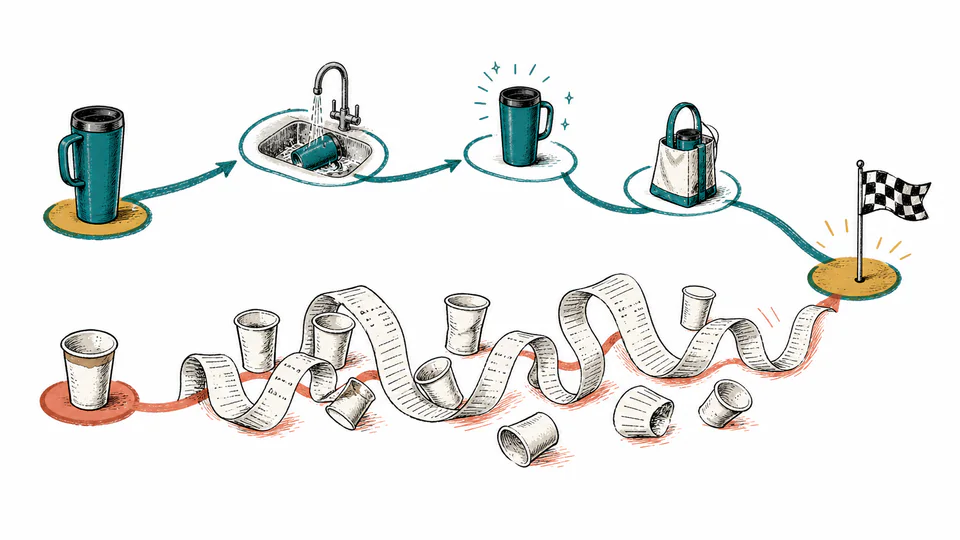
Sticker prices use different denominators: a reusable system is paid early, while disposables are purchased repeatedly. This calculator normalizes both choices to one expected-use horizon and respects whole reusable replacements. It is intended for a buyer with comparable products and documented operating assumptions; it does not declare that the lower cash cost has the lower environmental impact.
REUSABLE VERSUS DISPOSABLE COST
Choose from the total and per-use comparison only after confirming both products deliver the same service. A lower disposable total at 360 uses may reverse later; changing the horizon is a decision scenario, not a correction.
| Cost record | Count / uses | Unit basis | Extended cost |
|---|
CURRENT CALCULATION PROCESS
Cr = Pr + A + (ceil(U/L)−1)Pr + Uc + M; Cd = Ud(1−b); Δ = Cr−Cd
Count the whole reusable units needed to cover U uses at rated life L, charge the opening unit once, add replacements, cleaning, accessories, and maintenance, then compare with discounted disposable cost across exactly U uses.
| Symbol | Meaning | Unit | Default |
|---|---|---|---|
| Cr | Reusable horizon cost | USD | calculated |
| Pr | Reusable purchase price | USD/unit | 84 |
| U | Common use horizon | uses | 360 |
| L | Rated life | uses/unit | 500 |
| c | Cleaning cost | USD/use | 0.12 |
| Cd | Disposable horizon cost | USD | calculated |
| d | Disposable price | USD/use | 0.42 |
| b | Bulk discount | dimensionless | 5% = 0.05 |
Conversions and rounding: Convert bulk discount to 0.05 once. Round reusable unit count upward before costing replacements; keep monetary intermediates unrounded and display cents after comparison.
HOW TO USE
SUBJECT FUNDAMENTALS
MODEL AND FORMULA
Count the whole reusable units needed to cover U uses at rated life L, charge the opening unit once, add replacements, cleaning, accessories, and maintenance, then compare with discounted disposable cost across exactly U uses.
DEEPER DECISION ANALYSIS
A short test period can penalize a durable purchase, while an implausibly long horizon can hide uncertainty about continued use.
Cosmetic wear, hygiene retirement, loss, and mechanical failure are different endpoints. Use the endpoint that actually ends service.
Charging an entire dishwasher cycle to one item exaggerates cost; ignoring added cycles understates it. Allocate only attributable resource use.
WORKED DECISION CASES
Daily use spreads the opening cup and brush across many services; a measured wash allocation becomes the key sensitivity.
Low demand never recovers the durable purchase during the chosen horizon, so disposables remain cheaper despite a higher per-item shelf price.
TECHNICAL LANGUAGE
EVIDENCE AND DATA LINEAGE
Retain product dimensions, warranty or test-life evidence, receipts, tax and delivery, cleaning cycle measurements, maintenance history, bulk price terms, and the use log that defines U. Record loss separately from wear; a lost item should not be described as reaching rated life.
LIMITS AND EXCLUSIONS
RELIABLE SOURCES
FREQUENTLY ASKED QUESTIONS
Demand beyond available rated capacity requires another whole item; fractional purchasing would understate cash cost.
Add expected accessory replacement to maintenance when it occurs inside the horizon and is not already included.
Use it only if conditions match your care and retirement criteria; otherwise apply conservative observed life.
The reusable path costs more over this entered horizon; it says nothing by itself about another horizon or non-cash impacts.
Yes when purchase quantities create material leftovers; enter effective per-use price only when those leftovers have a documented use.
Convert both to the same service unit first, such as liters carried or portions served, before entering prices.
IMPORTANT NOTE
Use this page for a defined cash comparison. Follow manufacturer care and safety instructions and seek qualified advice for health-critical, food-contact, or regulated applications.