Reserve and cash timing differ
The model spreads expected replacement cost over the horizon. An actual failure can occur earlier, so the household still needs liquidity or a spare.
Practical household planning
Build a reusable-product lifecycle budget from initial inventory, setup, usage, cleaning cost, replacement rate, horizon, and available cash.
REUSABLE PRODUCT LIFECYCLE BUDGET
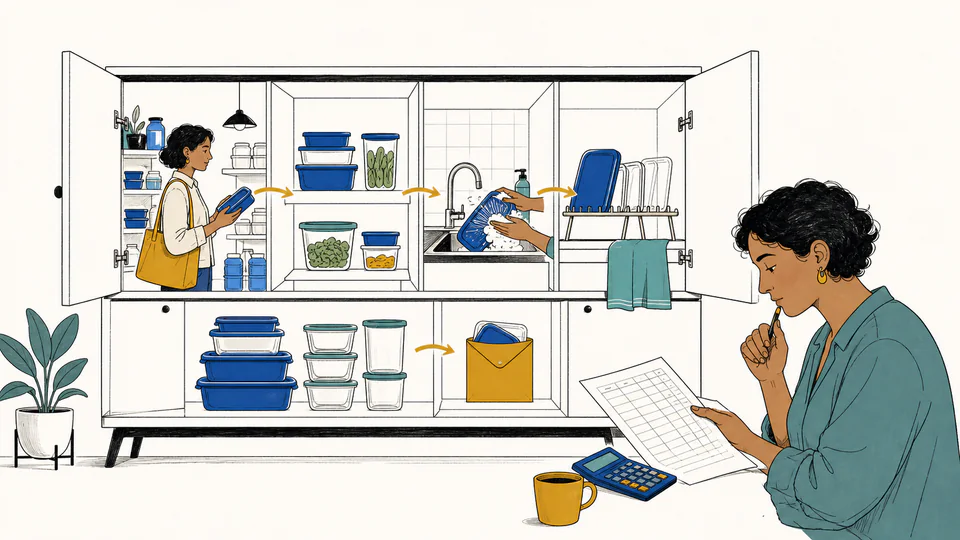
A reusable item creates a small operating system: enough inventory must be purchased, cleaned, maintained, and eventually replaced. This calculator is for households reserving cash for that system across a declared horizon. It separates the opening cart from cleaning operations and a proportional replacement reserve, so the available budget is compared with more than the shelf price.
REUSABLE PRODUCT LIFECYCLE BUDGET
A negative margin means the entered inventory, operations, and reserve exceed available cash. Reduce scope, improve evidence, change the horizon, or wait; do not erase cleaning or replacement simply to make the purchase appear affordable.
| Budget layer | Quantity / basis | Rate | Extended amount |
|---|
CURRENT CALCULATION PROCESS
B = qP + A + (u·52·m/12)c + q·ρ·m/12·Pᵣ; M = F − B
Extend the initial quantity q by price P, add setup A, convert weekly uses u into horizon uses, add cleaning c per use, and fund a proportional replacement reserve from annual rate ρ. Available funds F are compared only after every layer is included.
| Symbol | Meaning | Unit | Default |
|---|---|---|---|
| B | Modeled lifecycle budget | USD | calculated |
| q | Initial reusable units | items | 4 |
| P | Initial unit price | USD/item | 28 |
| A | Setup and accessories | USD | 35 |
| u | Expected uses per week | uses/week | 12 |
| m | Budget horizon | months | 12 |
| c | Cleaning cost | USD/use | 0.18 |
| ρ | Annual replacement rate | dimensionless | 25% = 0.25 |
| Pᵣ | Replacement unit price | USD/item | 28 |
| F | Available budget | USD | 300 |
Conversions and rounding: Convert months to years with m/12 and replacement percent to a decimal once. Convert weekly use to horizon use with 52m/12. Preserve fractional replacement equivalents as a reserve; round money only for display.
HOW TO USE
SUBJECT FUNDAMENTALS
MODEL AND FORMULA
Extend the initial quantity q by price P, add setup A, convert weekly uses u into horizon uses, add cleaning c per use, and fund a proportional replacement reserve from annual rate ρ. Available funds F are compared only after every layer is included.
DEEPER DECISION ANALYSIS
The model spreads expected replacement cost over the horizon. An actual failure can occur earlier, so the household still needs liquidity or a spare.
A small cleaning estimate becomes material at hundreds of uses. Measure cost per cycle and avoid entering a monthly total in a per-use field.
A proprietary filter, cartridge, or adapter may create future cost not visible in unit price. Include known setup and consumable dependencies explicitly.
WORKED DECISION CASES
A household buys enough containers for work lunches, includes labels and drying space, and budgets many low-cost washes. Replacement reserve reflects lids lost across a year.
A traveler expects few annual uses, so cleaning is immaterial but opening inventory dominates. The budget reveals that borrowing or using existing items may be better than a new system.
TECHNICAL LANGUAGE
EVIDENCE AND DATA LINEAGE
Keep receipts for initial units and accessories, a seven- or fourteen-day use log, local water and energy tariffs, detergent dose, cleaning batch size, warranty terms, and loss or breakage history. Date the replacement quote. If several items share one cleaning cycle, allocate the cycle cost by a documented capacity basis.
LIMITS AND EXCLUSIONS
RELIABLE SOURCES
FREQUENTLY ASKED QUESTIONS
The fraction is a cash-planning expectation across a group and horizon. Actual purchases remain whole and may occur sooner or later.
Include their marginal cost when cleaning uses them. Use local rates and the portion attributable to the entered cycle.
Only enter a rebate after eligibility and amount are confirmed; otherwise preserve it outside the available budget.
Exclude their acquisition price but include any new accessories, cleaning, maintenance, and expected replacement needed during this horizon.
No. This page tests affordability of the reusable system, not its cost relative to a disposable alternative.
Refresh when tariffs, usage, inventory count, replacement history, or supplier prices materially change.
IMPORTANT NOTE
This calculator is a household cash-planning aid. Follow product, hygiene, and safety instructions; verify local prices and resource costs; and do not rely on the result as environmental, tax, or financial advice.