Physics and mechanics
Lens Energy Calculator
Track optical pulse energy through a lens, convert transmitted energy to photon count, and estimate diffraction-limited Airy radius, disk-average fluence, and pulse-average intensity.
CURRENT MODEL
Define one optical pulse and the lens aperture
Laser lab students, optics technicians, and preliminary test planners checking pulse-energy accounting and ideal circular-aperture concentration.
Decision supportedEstimate transmitted energy and a best-case diffraction-scale focal average before choosing sensors, attenuation, optics, or a more complete beam-propagation model.
LIVE PULSE-ENERGY FLOW
Pulse energy from lens input to focal disk
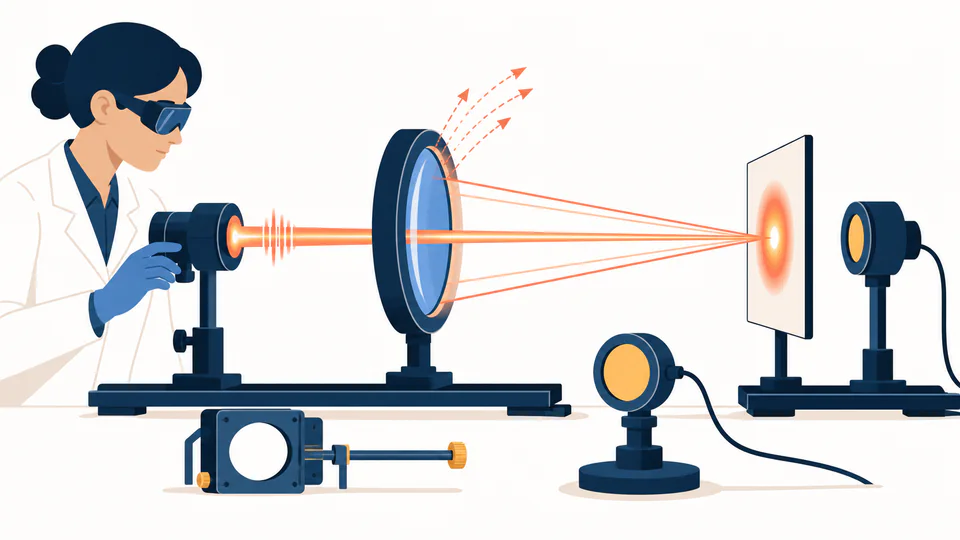
The live energy path partitions transmitted and lost energy, then scales the ideal first-minimum focal disk from wavelength, focal length, and filled aperture.
| Quantity | Equation | Current value | Unit |
|---|
How to use
Separate pulse accounting from focal concentration
- Enter energy arriving at the lens for one pulse, not laser average power.
- Enter vacuum wavelength used for both photon energy and diffraction scale.
- Enter focal length and the aperture diameter actually filled by the beam.
- Enter end-to-end pulse-energy transmission through the optic.
- Enter pulse duration only for pulse-average power and intensity; do not substitute repetition period.
- Compare transmitted plus lost energy with the input, then treat the focal values as ideal disk averages.
Pulse-energy fundamentals
Six concepts that keep joules, watts, and spot size distinct
- Pulse energy
- Joules contained in one optical pulse, independent of repetition rate.
- Passive transmission
- A lens can only pass a fraction of incident energy; it cannot amplify the pulse.
- Photon energy
- Each photon carries hc/lambda, so wavelength sets photon count for fixed joules.
- Airy first minimum
- A circular aperture sets an ideal radius 1.22 lambda f/D under diffraction-limited conditions.
- Fluence
- Energy per illuminated area, J/m^2, integrated over the pulse.
- Pulse-average intensity
- Disk-average fluence divided by pulse duration, not the spatial or temporal peak.
Calculation method
Conserve energy before estimating a diffraction disk
The model converts millijoules to joules and applies the entered transmission to obtain energy after the lens. Dividing by hc/lambda gives a photon-count equivalent while preserving total energy accounting.
Separately, it estimates the first-minimum radius for a uniformly filled circular aperture. Transmitted energy divided by that disk area gives a declared area average; dividing once more by pulse duration gives a pulse-time average.
Beam fill factor
The illuminated diameter, not the clear mechanical diameter, controls ideal diffraction. Underfilling enlarges the spot.
Gaussian beams
A Gaussian waist uses beam-quality and input-waist relations, not a uniform Airy-disk average. Do not equate this disk average with Gaussian peak fluence.
Damage evaluation
Damage thresholds depend on material, coating, pulse duration, wavelength, repetition history, defects, beam profile, and test protocol.
Aberration budget
Defocus and aberrations spread energy beyond the ideal disk, usually lowering central average while possibly creating local hot structures.
Detailed calculation process
Symbols, current substitution, intermediate quantities, and reconciliation
E_out = eta E_in; E_ph = hc/lambda; r_A = 1.22 lambda f/D; F_avg = E_out/(pi r_A^2)Energy conservation, photon count, and diffraction geometry retain full precision. Scientific notation is used only for displayed microscopic and large-count values.
| Symbol | Meaning | Default | Unit |
|---|---|---|---|
| E_in | Incident energy per pulse | 2 | mJ |
| eta | Lens energy transmission | 90 | % |
| lambda | Vacuum wavelength | 532 | nm |
| f | Focal length | 100 | mm |
| D | Filled circular aperture | 10 | mm |
| tau | Pulse duration | 10 | ns |
| r_A | First-minimum radius | calculated | m |
Waiting for valid inputs.
Interpretation
Treat focal outputs as ideal averages, not maxima
Transmitted energy and untransmitted energy form the primary conservation result. Photon count is an equivalent count at one wavelength. Airy radius, disk-average fluence, and disk-average intensity are idealized concentration indicators; none is a measured peak or safety limit.
Evidence and measurement
Retain pulse and aperture provenance
Record energy-meter calibration and location, wavelength spectrum, pulse-duration definition, temporal trace, beam diameter definition, aperture fill, focal-length reference, coating transmission, polarization, beam-quality factor, focus method, and shot-to-shot statistics. Preserve attenuation used during measurement.
Scope and limitations
What this pulse estimate does not certify
- Gaussian waist, M-squared beam quality, or measured encircled energy
- Spatial or temporal peak fluence and intensity
- Aberration, defocus, aperture clipping, scatter, or nonlinear propagation
- Coating or substrate laser-induced damage threshold
- Thermal accumulation across repeated pulses
- Laser class, eye exposure, protective eyewear, or safe procedure
A monochromatic pulse crosses a passive lens with scalar energy transmission and a uniformly filled circular aperture. The focal estimate uses the Airy first-minimum radius and averages energy over that disk; it is not a peak Gaussian or damage-threshold result.
Key terminology
Lens pulse-energy glossary
- Pulse energy
- Time integral of optical power over one pulse.
- Transmission
- Ratio of energy after the lens to incident pulse energy.
- Photon energy
- Discrete electromagnetic energy hc/lambda at one wavelength.
- Airy pattern
- Ideal circular-aperture diffraction pattern with a central lobe and rings.
- Fluence
- Pulse-integrated energy per area.
- Pulse-average power
- Pulse energy divided by pulse duration.
- Clear aperture
- Usable optical diameter; the filled diameter may be smaller.
- Beam quality
- Measure of departure from ideal diffraction-limited propagation.
Practical cases
Two pulse decisions with different missing evidence
Fluorescence excitation screen
A 2 mJ green pulse through a 90% lens is translated into transmitted joules and an ideal focal scale. The team then replaces the disk estimate with measured beam profile before selecting a sample exposure.
Zero-energy interlock state
With pulse energy set to zero, all energy and photon outputs fall to zero while the geometric Airy radius remains defined. This separates an optical geometry setting from an active emission state.
Important note
Never use the ideal disk average as a damage guarantee
Real peaks and defects can exceed the average. Retain measured beam and pulse evidence and use qualified laser-safety and optics-damage review for any exposure or high-energy decision.
Frequently asked questions
Does a lens increase optical energy?
No. A passive lens transmits part of the incident pulse and loses the rest to reflection, absorption, scattering, or clipping. It concentrates surviving energy spatially.
What does lens energy mean here?
It means pulse-energy accounting through the optic plus an ideal focal-area estimate. It does not mean mechanical energy stored in the lens or photon energy changed by refraction.
Is the Airy disk the actual laser spot?
Only for a diffraction-limited, uniformly filled circular aperture with suitable aberration control. Beam quality, truncation, aberrations, defocus, and alignment generally enlarge or reshape the spot.
Is disk-average fluence a peak damage value?
No. It spreads transmitted energy uniformly over the first-minimum disk as a declared average. Real spatial and temporal peaks can be substantially higher.
Why does photon count depend on wavelength?
Each photon carries hc/lambda. At the same transmitted joules, longer wavelength means lower photon energy and therefore more photons.
Can I enter zero pulse energy?
Yes. It represents a no-pulse boundary: output energy, photons, fluence, and power become zero while geometry remains defined.
Authority and follow-on work
Reliable sources and related calculators
- OpenStax College Physics — Rayleigh CriterionSupports the 1.22 lambda/D circular-aperture angular scale used for focal radius.
- RP Photonics — Pulse EnergyDistinguishes optical pulse energy from peak and average power.
- NIST — SI defining constantsSupports exact h and c values used for photon energy.
Related calculators
Continue with a distinct optics question without silently changing the model boundary.