Physics and mechanics
Lens Rate Calculator
Convert pulse energy and repetition rate into lens input, transmitted, absorbed, and residual-loss power plus transmitted photon throughput.
CURRENT MODEL
Define the repetitive pulse train and lens fractions
Laser test technicians, optics students, thermal-screening engineers, and instrument planners translating a repetitive pulse specification into per-second energy flow.
Decision supportedScreen delivered optical power and lens heat load from a pulse train while keeping per-pulse energy, repetition rate, and wavelength-dependent photon throughput distinct.
LIVE ENERGY-RATE LEDGER
One-second pulse-train energy channels
The live stream scales input, transmitted, absorbed, and other-loss rates from current pulse energy and repetition frequency rather than using decorative samples.
| Quantity | Equation | Current value | Unit |
|---|
How to use
Translate pulses into watts without inventing a peak
- Enter incident energy carried by each pulse at the lens plane.
- Enter pulse repetition rate in kilohertz; zero represents a stopped train.
- Enter wavelength for photon-throughput conversion.
- Enter transmitted and absorbed fractions measured for this lens and wavelength.
- Review the automatically assigned residual fraction as reflection, scatter, clipping, and other loss.
- Reconcile all one-second output channels to input average power before using the absorbed watts in a thermal study.
Rate fundamentals
Six distinctions behind a pulse-train power budget
- Energy per pulse
- Joules in one event; it does not describe delivery per second alone.
- Repetition rate
- Pulses per second, converted from kHz to Hz before multiplying energy.
- Average power
- One-second energy throughput E_p f_rep, measured in J/s or W.
- Absorbed power
- Average optical energy converted within the lens and available as a thermal load.
- Other loss
- Remaining fraction after transmission and absorption; it is not automatically deposited in the lens.
- Photon rate
- Transmitted watts divided by hc/lambda, distinct from optical frequency.
Calculation method
Build a one-second energy ledger from individual pulses
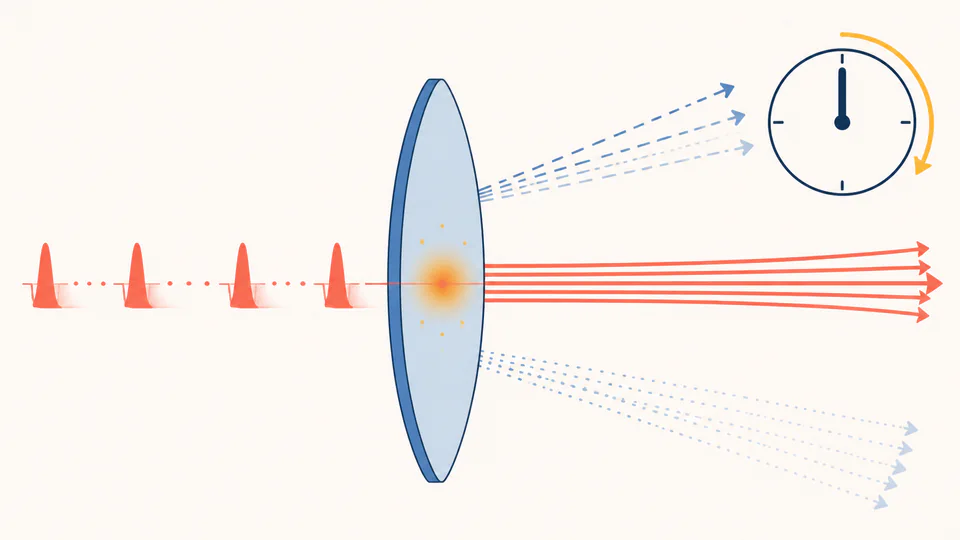
The model converts pulse energy to joules and repetition frequency to pulses per second. Their product is input average power. Transmission and absorption then allocate two explicit channels, while 1 - T - A closes the remaining-loss fraction.
For a one-second check, watts equal joules transferred during that interval. Dividing transmitted watts by photon energy produces photon throughput without changing the optical power total.
Peak-power boundary
Peak power requires pulse duration and temporal shape. Two lasers with equal pulse energy and rate can have radically different peaks.
Thermal response
Absorbed average watts are an input to a thermal model, not a temperature. Mount conductance, material, geometry, convection, and transient timing remain necessary.
Fraction provenance
Catalog transmission may omit clipping, contamination, incidence angle, or the user's spectrum. Measure the assembled optical path when delivery matters.
Pulse variability
This model assumes identical pulses and spacing. Bursts, missing pulses, energy jitter, and warm-up drift need time-resolved statistics.
Detailed calculation process
Symbols, current substitution, intermediate quantities, and reconciliation
P_in = E_p f_rep; P_trans = T P_in; P_abs = A P_in; photon rate = P_trans/(hc/lambda)Each per-second channel is calculated from unrounded fractions. The residual is evaluated before display formatting to preserve the energy-rate check.
| Symbol | Meaning | Default | Unit |
|---|---|---|---|
| E_p | Incident energy per pulse | 0.5 | mJ |
| f_rep | Pulse repetition rate | 20 | kHz |
| lambda | Vacuum wavelength | 1064 | nm |
| T | Transmitted fraction | 92 | % |
| A | Absorbed fraction | 3 | % |
| P_trans | Transmitted average energy rate | calculated | W |
| Ndot | Transmitted photon throughput | calculated | photons/s |
Waiting for valid inputs.
Interpretation
Use delivered and absorbed watts for different decisions
Transmitted average power is the optical throughput available downstream. Absorbed power is the starting thermal load inside the lens. Other loss closes energy accounting but may be reflected or scattered elsewhere. Photon rate describes quanta per second, not beam speed.
Evidence and measurement
Preserve both per-pulse and per-second evidence
Record pulse-energy meter location and calibration, repetition counter trace, wavelength spectrum, transmission and absorption method, optic temperature and cleanliness, aperture clipping, polarization, duty cycle, burst structure, and sample duration. Keep means, variation, and maximum observed values.
Scope and limitations
What this lens rate does not certify
- Peak power, pulse duration, temporal shape, or nonlinear effects
- Lens temperature, thermal lensing, stress, or cooling requirement
- Time-varying burst patterns, jitter, warm-up, or missing pulses
- Beam size, focal intensity, damage threshold, or downstream exposure
- Detailed reflection, scatter direction, clipping destination, or enclosure heating
- Laser classification or operating safety controls
Rate means average energy flow across a stationary lens under a repetitive pulse train. Pulse energy and fractions are constant from pulse to pulse; no duty-cycle peak waveform, thermal transient, group velocity, focal motion, or detector response is modeled.
Key terminology
Repetitive-laser glossary
- Repetition rate
- Number of pulses emitted per second.
- Average power
- Energy transferred per unit time over many pulse periods.
- Peak power
- Maximum instantaneous power within a pulse, not calculated here.
- Transmission
- Fraction of incident energy continuing beyond the lens.
- Absorption
- Fraction converted into internal material energy.
- Photon throughput
- Number of transmitted photons per second at one wavelength.
- Duty cycle
- Fraction of time an emission is active, needed for some waveform models.
- Thermal lensing
- Optical-power change caused by temperature-dependent index and stress.
Practical cases
Two rate screens with different consequences
Scanning-laser delivery
A 0.5 mJ, 20 kHz source delivers 10 W to a lens. At 92% transmission, 9.2 W continues; that helps size downstream monitoring, while pulse duration remains necessary for peak exposure.
Stopped-train maintenance state
Setting repetition rate to zero drives all average-power channels to zero without erasing the configured pulse energy. The state clarifies that no ongoing energy flow exists while settings may remain armed.
Important note
Average absorbed power is not a safe lens temperature
Feed absorbed watts into a validated thermal model and retain time-resolved laser evidence. Qualified optics and laser-safety review remain necessary before operating or selecting hardware.
Frequently asked questions
What does rate mean on this page?
It is optical energy per unit time: pulse energy multiplied by pulses per second. It is not propagation speed, image rate, focal movement, or peak power.
How is average power different from peak power?
Average power spreads pulse energy across the entire pulse interval. Peak power requires pulse duration and temporal shape, neither of which is part of this rate model.
Why separate absorption from other loss?
Absorption directly loads the lens thermally. Reflection, scatter, and clipping can remove delivered light without depositing all of that energy in the optic.
Does wavelength change average optical power?
Not for fixed pulse energy and repetition rate. Wavelength changes energy per photon, so it changes photon throughput at the same watts.
What does zero repetition rate represent?
A stopped pulse train. Average input, transmitted, absorbed, and other-loss power all become zero even if the configured energy per pulse remains nonzero.
Can absorbed watts be used as a lens temperature rise?
Not by itself. Temperature requires geometry, material properties, mount conductance, convection, radiation, pulse timing, and a transient or steady thermal model.
Authority and follow-on work
Reliable sources and related calculators
- RP Photonics — Pulse EnergyExplains pulse energy and its relation to average power and repetition rate.
- NIST SP 330 Appendix 1Defines the watt as joule per second for the page's strict rate interpretation.
- NIST — SI defining constantsSupports exact h and c used for photon throughput.
Related calculators
Continue with a distinct optics question without silently changing the model boundary.