Physics and mechanics
Lens Scenario Calculator
Compare two signed focal lengths for one object and sensor, including focus position, magnification, image height, sensor utilization, clipping, and target framing error.
CURRENT MODEL
Enter the declared physical case
Camera, projection, and laboratory teams screening two lens configurations before ray tracing or physical setup.
Decision supportedChoose the configuration that produces a finite image, fits the active sensor height, and comes closest to a declared image-height target.
LIVE PHYSICAL ANALYSIS
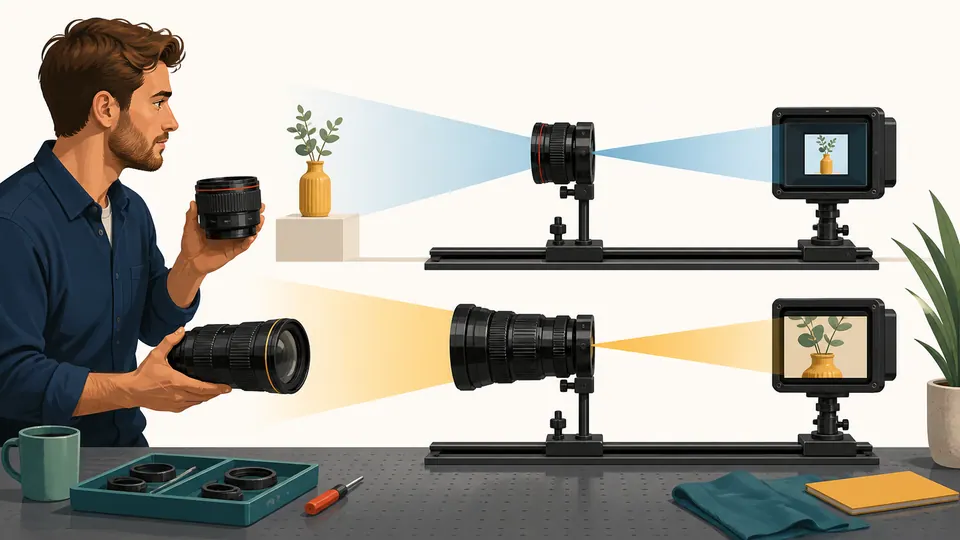
Two lens benches against one sensor boundary
The live comparison shows signed image placement and how much of the sensor height each scenario consumes.
| Scenario | Focal length (mm) | Image distance (mm) | Magnification | Image height (mm) | Sensor utilization | Fits? | Target error (mm) |
|---|
How to use
Compare two lenses against one framing brief
- Measure the same real-object distance and transverse object height for both configurations.
- Enter the sensor active height, not the package or diagonal dimension.
- Choose a target image height that leaves any required framing margin.
- Enter signed focal lengths A and B at the relevant wavelength and focus state.
- Require finite focus and sensor fit before comparing target-height error.
- Check focus-plane shift and unresolved aperture or aberration constraints before selecting a lens.
Scenario fundamentals
Five quantities that separate framing from focus
- Shared object geometry
- Both lenses see the same distance and size so focal length is the controlled scenario difference.
- Signed focus plane
- Positive image distance is physically accessible behind the lens; negative distance is virtual.
- Image height
- Magnification translates object height into the sensor-plane transverse requirement.
- Sensor utilization
- Absolute image height divided by active sensor height supplies the fit boundary.
- Target error
- The absolute difference from desired image height ranks only configurations that already focus and fit.
Calculation method
Apply validity and fit before preference
Each lens independently solves its signed image distance and magnification. The model then converts image height to sensor utilization and rejects collimated or clipping candidates from recommendation.
Among remaining candidates, the smaller absolute target-height error wins. The reported focus shift exposes a mechanical consequence that a framing-only comparison would miss.
Fit is one dimensional
A height fit does not guarantee width, diagonal, aspect-ratio, or chief-ray acceptance. Preserve the sensor orientation and object extent used by the comparison.
Focal length changes two constraints
A longer positive focal length usually enlarges the image while moving the focus plane. Mechanical travel and framing therefore cannot be optimized independently.
Virtual-image disqualification
A mathematically finite virtual image may have a useful magnification, but a rear sensor cannot capture it without an additional optical element.
Detailed calculation process
Symbols, current substitution, intermediate quantities, and reconciliation
d_i=f d_o/(d_o-f); h_i=-(d_i/d_o)h_o; U=|h_i|/H_sensorFit and recommendation use unrounded image heights; values are formatted afterward.
| Symbol | Meaning | Default | Unit |
|---|---|---|---|
| d_o | Shared object distance | 1000 | mm |
| h_o | Shared object height | 200 | mm |
| H_s | Sensor active height | 24 | mm |
| H_t | Target image height | 20 | mm |
| f_A,f_B | Scenario focal lengths | 50,85 | mm |
| U | Sensor utilization | calculated | dimensionless |
Waiting for valid inputs.
Evidence to retain
Freeze the comparison brief
Save object dimensions and distance reference, sensor active area and orientation, desired framing margin, lens focal length at wavelength, focus-travel limits, mount spacing, aperture, distortion specification, and the method used to define acceptable image coverage.
Scope and limitations
What the two-lens screen does not decide
- No sensor width, aspect ratio, diagonal, pixel sampling, or circle of confusion
- No field of view from finite sensor width or chief-ray angle
- No aberration, distortion, vignetting, aperture, diffraction, or MTF comparison
- No working-distance envelope or moving object
- No thick-lens or compound principal-plane offsets
- No procurement, safety, or optical-quality approval
Both scenarios use the same real object, one-dimensional sensor height, ideal thin paraxial lenses, and distances measured from each principal plane.
Key terminology
Lens-selection glossary
- Active sensor height
- The photosensitive dimension available to receive the image.
- Framing margin
- Unused sensor space reserved around the desired image.
- Focus shift
- The difference between the two finite image-plane positions.
- Clipping
- An image-height requirement that exceeds the modeled sensor boundary.
- Target error
- Absolute deviation between modeled and desired image height.
- Working distance
- The physical object-to-reference distance maintained by the setup.
Practical cases
Two choices with different failure modes
Machine-vision retrofit
A fixed camera compares two lenses for a 200 mm part at one metre. The longer lens approaches the target coverage but requires a sensor shift that the existing mount must be checked to provide.
Projection replacement
A replacement lens creates a real image but exceeds the available panel height. The alternative is slightly farther from target yet fits, so it proceeds to distortion and aperture testing.
Important note
Framing fit is only the first selection gate
Confirm focus travel, two-dimensional field coverage, wavelength, aperture, aberration, distortion, MTF, environmental limits, and mount compatibility before choosing hardware.
Frequently asked questions
Why compare image height instead of focal length alone?
Focal length affects framing through object distance. Image height and sensor utilization expose the actual one-dimensional fit consequence.
What happens if one focal length equals object distance?
That scenario sends collimated output in the ideal model and has no finite sensor plane, so it cannot satisfy the framing rule.
Can a virtual image fit a physical sensor?
No. A negative image distance describes a virtual image on the object side; the numeric height is informative but it cannot be directly recorded on a rear sensor.
Does a 100% height utilization guarantee no clipping?
Only in the modeled dimension. Sensor width, aspect ratio, chief-ray angle, distortion, mount vignetting, and object extent remain outside scope.
Why can the recommended lens require a large focus shift?
A focal-length change alters the conjugate image distance. A framing benefit may demand sensor or lens repositioning that the hardware cannot provide.
Is the closest target always the best lens?
No. The rule first requires finite focus and sensor fit, but working distance, aberration, aperture, resolution, and mechanical constraints can override it.
Authority and follow-on work
Reliable sources and related calculators
- OpenStax College Physics 2e - Image Formation by LensesThin-lens and magnification relations.
- OpenStax University Physics - Thin LensesLens choice and real-image interpretation.
- NIST Guide to the SILength-unit traceability.
Related calculators
Continue with a distinct physical question without silently changing this page's model boundary.