Physics and engineering
Magnetic Force Trajectory Calculator
Solve a nonrelativistic charged particle's helical radius, period, phase, pitch, position, and velocity in a uniform magnetic field.
CURRENT MODEL
Define one particle and elapsed uniform-field flight
Physics students, beamline learners, and laboratory teams estimating ideal particle paths before numerical field-map tracking.
Decision supportedEstimate whether a charged particle's ideal radius, pitch, and elapsed-time position fit a uniform-field region.
PHYSICAL CONTEXT
The modeled decision in context
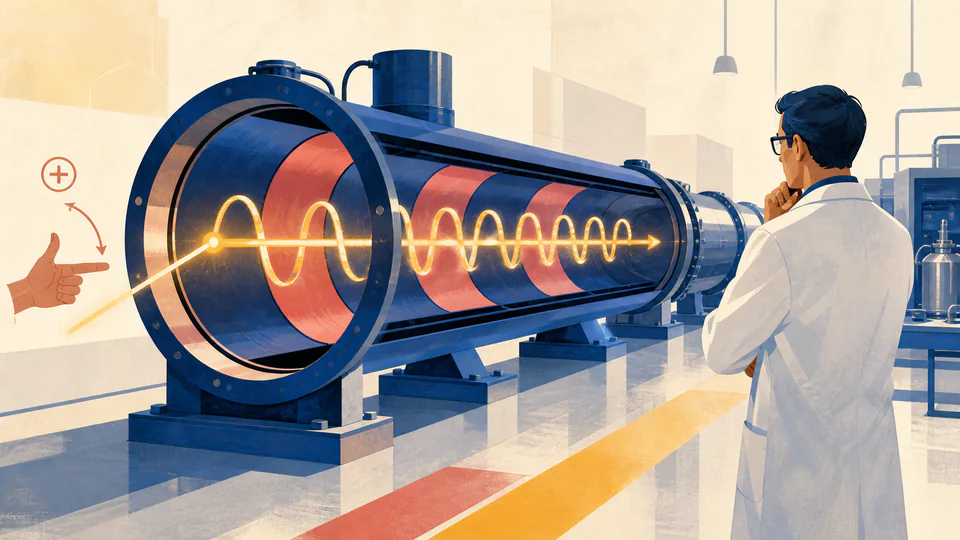
This static editorial scene clarifies the apparatus and evidence boundary; all current numeric detail remains in the exact ledger below.
| Quantity | Symbol or equation | Current value | Unit |
|---|
How to use
Set a nonrelativistic particle trajectory
- Enter signed charge in elementary-charge multiples.
- Enter particle mass in unified atomic mass units.
- Use initial speed below the stated nonrelativistic limit.
- Measure velocity angle from the +B direction.
- Enter positive uniform field and elapsed time.
- Review radius, pitch, signed turns, position, and speed check together.
Trajectory fundamentals
Six facts behind a magnetic helix
- Perpendicular component
- Creates circular gyromotion.
- Parallel component
- Advances uniformly along field.
- Charge sign
- Reverses rotation handedness.
- Gyroradius
- Scales with momentum perpendicular to field.
- Cyclotron period
- Is independent of speed in the nonrelativistic uniform model.
- No magnetic work
- Ideal magnetic force preserves speed.
Calculation method
Decompose velocity before integrating position
The page converts charge, mass, field, speed, and time to SI, splits velocity by pitch angle, then uses signed angular frequency to integrate transverse coordinates and parallel drift.
Handedness evidence
Signed turns and coordinates preserve charge sign; taking absolute charge too early would erase a measurable trajectory distinction.
Relativistic boundary
Above the page limit, momentum gains a gamma factor and both radius and frequency need a relativistic treatment.
Field-map departure
Real fringe fields can change pitch and guiding centre, requiring stepwise Lorentz integration rather than a closed helix.
Detailed calculation process
Symbols, conversions, substitution, intermediate results, and reconciliation
v_perp=v sin(alpha); omega=qB/m; r=m v_perp/(|q|B); T=2pi/|omega|SI constants, phase, and coordinates retain full precision; nonrelativistic validity and aligned-path state are evaluated before formatting.
| Symbol | Meaning | Default | Unit |
|---|---|---|---|
| q | Signed particle charge | +1 | e |
| m | Particle mass | 1.007276466621 | u |
| v | Initial speed | 100 | km/s |
| alpha | Angle from +B | 60 | deg |
| B | Uniform field | 50 | mT |
| t | Elapsed time | 2 | microseconds |
Waiting for valid inputs.
Interpretation
Read radius, pitch, and phase as one path
Radius describes transverse confinement, pitch gives axial distance per turn, and signed phase locates the particle at the entered time. A zero radius can mean a valid field-aligned path.
Evidence and measurement
Preserve initial conditions and field definition
Record particle species and charge state, mass source, velocity distribution, pitch-angle datum, field-map region, entry coordinates, timing reference, vacuum quality, detector resolution, uncertainty, and relativistic screening.
Scope and limitations
What the ideal helix excludes
- Electric fields and E cross B drift
- Field gradients and magnetic mirrors
- Collisions and material energy loss
- Radiation loss and space charge
- Relativistic momentum
- Beamline safety and acceptance
Uniform magnetic field along +z, no electric field, no collisions or radiation loss, and speed below 0.1c. Charge sign controls handedness.
Key terminology
Trajectory glossary
- Pitch angle
- Angle between velocity and magnetic field.
- Gyroradius
- Radius of transverse circular motion.
- Cyclotron period
- Time for one ideal revolution.
- Helix pitch
- Axial advance per turn.
- Guiding centre
- Centre around which transverse motion circles.
- Charge state
- Signed number of elementary charges.
Practical cases
Two distinct path regimes
Proton-like helical flight
The default case completes about 1.525 signed turns while advancing 100 mm along +z.
Field-aligned injection
At zero pitch angle radius collapses to zero and the particle travels straight, a valid boundary rather than an error.
Important note
Uniform-field tracking is a screening model
Use a verified field map and relativistic numerical integrator for real beam transport or exposure decisions.
Frequently asked questions
Why does the magnetic field not change particle speed?
The Lorentz magnetic force is perpendicular to velocity, so it changes direction while doing no work in this ideal model.
What does negative charge change?
It reverses the sign of angular frequency and therefore the helix handedness, while radius and period magnitudes remain unchanged.
Why is there a helical pitch?
The perpendicular velocity circles around the field while the parallel component continues uniformly along it.
What happens at zero pitch angle?
Perpendicular speed and radius are zero, so the particle travels straight along the field without gyromotion.
Why reject speeds at 0.1c?
The formulas use nonrelativistic momentum. At higher speed, relativistic gamma changes radius and angular frequency materially.
Can this track a particle through a real magnet fringe?
No. Field gradients, fringe regions, electric fields, scattering, and material interactions require numerical integration through a field map.
Authority and follow-on work
Reliable sources and related calculators
- OpenStax — Motion of a Charged Particle in a Magnetic FieldSupports radius, period, speed conservation, and helical decomposition.
- NIST — 2022 CODATA ConstantsProvides elementary charge and atomic mass constants.
- OpenStax — Magnetic Fields and ForceSupports Lorentz-force direction and right-hand-rule interpretation.