Physics and engineering
Mirror Equilibrium Calculator
Balance radiation-pressure torque on an opaque reflective mirror against a linear torsional spring and report the static angular deflection.
CURRENT MODEL
Define the beam load and torsional restraint
Precision optomechanics teams, teaching laboratories, and instrument designers estimating beam-induced mirror deflection before detailed structural analysis.
Decision supportedEstimate whether radiation torque produces a tolerable small-angle mirror offset for the entered beam, reflectance, lever arm, and suspension stiffness.
LIVE STATIC BALANCE
Radiation and restoring torque balance
The live balance responds to current beam power, lever arm, reflectance, incidence, and calculated angular deflection.
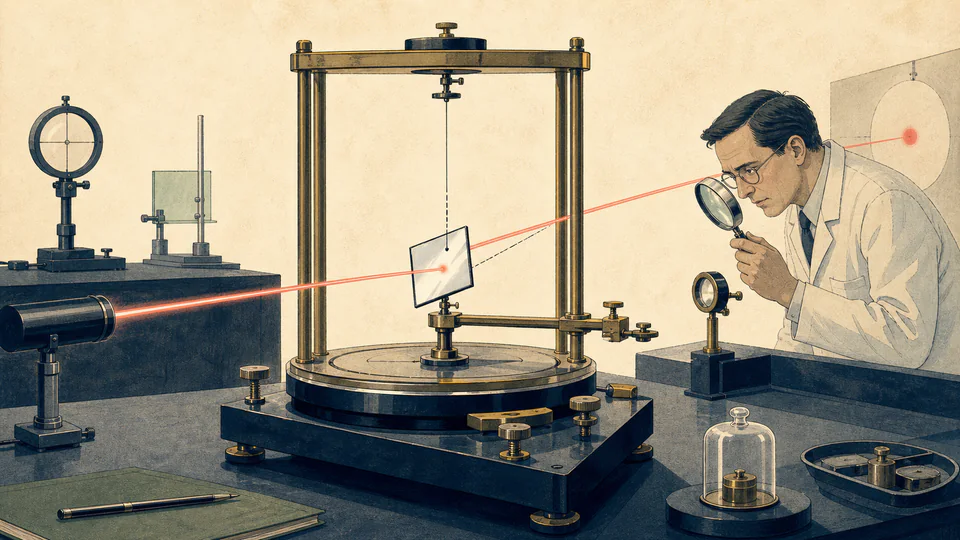
| Quantity | Symbol or equation | Current value | Unit |
|---|
How to use
Convert a beam load into a small-angle static offset
- Enter optical power actually incident on the mirror, after upstream loss.
- Use power reflectance at the operating wavelength; the opaque model treats the remainder as absorbed.
- Measure incidence from the surface normal, not from the mirror plane.
- Enter the perpendicular pivot-to-spot lever arm rather than a diagonal mounting distance.
- Use torsional stiffness in microN m per radian from calibration or a verified mechanical model.
- Check the small-angle state and torque residual before using the deflection in pointing analysis.
Radiation-balance fundamentals
Six mechanisms separate force from angular equilibrium
- Photon momentum
- Optical power carries momentum flux P/c even when the beam has negligible rest mass.
- Absorption transfer
- Absorbed power transfers its incident normal momentum once.
- Reflection transfer
- Reflected normal momentum reverses, contributing twice its reflected fraction.
- Lever arm
- A normal force creates torsional torque only when its line of action misses the pivot.
- Restoring stiffness
- A linear torsion spring generates opposing torque proportional to angular displacement.
- Static equilibrium
- Net torque is zero after the mirror has settled; transient inertia and damping are omitted.
Calculation method
Resolve normal momentum before balancing torque
For an opaque surface, absorptance A=1-R. The normal momentum coefficient becomes A+2R=1+R. Multiplying by incident power, cos(alpha), and 1/c gives normal radiation force.
The perpendicular lever arm converts force to torque. Dividing by torsional stiffness solves the static angle. Reapplying stiffness to that angle provides an independent restoring-torque reconciliation.
Pointing amplification
A mirror rotation changes reflected-ray direction by roughly twice the mechanical angle, so a few microradians can matter over a long optical path.
Thermal coupling
Absorbed power can heat coatings, shift the pivot, or alter stiffness. That slow drift is separate from the direct photon-momentum torque solved here.
Closed-loop operation
An actuator or servo can supply additional restoring torque. Add its calibrated stiffness or control law only through a model that preserves sign and bandwidth.
Detailed calculation process
Symbols, current substitution, intermediate quantities, and reconciliation
F_n = (1 + R)P cos(alpha)/c; tau_rad = F_n l; theta_eq = tau_rad/kappaMomentum, force, torque, and angle remain unrounded through the balance. The 0.05 rad small-angle flag uses the unrounded result.
| Symbol | Meaning | Default | Unit |
|---|---|---|---|
| P | Incident optical power | 10 | W |
| R | Power reflectance | 0.95 | dimensionless |
| alpha | Incidence from surface normal | 10 | deg |
| l | Perpendicular beam lever arm | 20 | mm |
| kappa | Torsional stiffness | 50 | microN m/rad |
| theta | Static equilibrium angle | calculated | microrad |
Waiting for valid inputs.
Interpretation
Separate optical force, mechanical torque, and pointing impact
Normal force alone does not predict rotation; lever arm and stiffness determine angular response. A zero-power or centred-beam case is a genuine zero-load equilibrium. A large reported angle is a model warning because incidence, lever arm, and spring law may then change with position.
Evidence and measurement
Keep beam and suspension evidence on the same time basis
Record laser power calibration, wavelength, beam profile and spot centroid, reflectance and transmission evidence, incidence convention, pivot datum, lever-arm uncertainty, stiffness calibration range, preload, ambient pressure, temperature, damping, and settling criterion.
Scope and limitations
What the static torsion model leaves outside
- Transient acceleration, resonance, damping, and control-loop dynamics
- Mirror flexure, mount compliance, backlash, or friction
- Beam-profile torque distribution and spot motion during rotation
- Transmission through a partially transparent optic
- Thermal deformation and stiffness drift from absorbed power
- Laser safety, structural certification, or pointing acceptance
Static mechanical equilibrium of a rigid opaque mirror on a linear torsion spring. Incidence is measured from the surface normal; transmission is neglected and absorptance is 1-R. The beam spot and lever arm remain fixed while the small angle is solved.
Key terminology
Optomechanical equilibrium glossary
- Radiation pressure
- Force per area caused by electromagnetic momentum transfer.
- Power reflectance
- Fraction of incident optical power reflected by the mirror.
- Moment arm
- Perpendicular distance between pivot and force line.
- Torsional stiffness
- Restoring torque produced per radian of rotation.
- Static deflection
- Settled angle where applied and restoring torques balance.
- Arcsecond
- Angular unit equal to 1/3600 degree.
Practical cases
Two mirror systems with different controlling risks
Suspended metrology mirror
The default 10 W beam and 20 mm offset produce 1.281136 nN m torque and 25.622728 microrad deflection. That result feeds a separate reflected-beam pointing budget.
Centred cavity optic
Moving the beam centroid onto the torsional pivot drives lever arm to zero. Direct radiation torque vanishes, but absorbed-power deformation still needs thermal analysis.
Important note
Small force does not automatically mean negligible system error
Use calibrated beam and suspension inputs. Verify angular sensitivity, dynamics, thermal drift, and safety with the actual optomechanical assembly before acceptance.
Frequently asked questions
What does equilibrium mean on this page?
It is mechanical torque equilibrium: radiation torque equals the opposing torsion-spring torque. It is not optical focus, thermal balance, or electrostatic equilibrium.
Why is the force coefficient 1 + R?
For an opaque mirror, the absorbed fraction transfers one incident momentum unit and the reflected fraction reverses its normal momentum, adding a second reflected contribution. Together A + 2R = 1 + R.
Why does force decrease with incidence angle?
The model reports the surface-normal force. The incident momentum flux projected onto the normal contains cos(alpha), with alpha measured from the normal.
Does a centred beam produce mirror rotation?
Not in this torsional model. A zero perpendicular lever arm produces force but zero torque and therefore zero angular deflection.
Why flag angles above 0.05 rad?
The page holds lever arm and incidence fixed and assumes linear restoring torque. Larger rotations can change both geometry and suspension response, so a coupled nonlinear solution is needed.
Does absorbed power affect equilibrium thermally?
Not here. Absorbed power is reported for evidence, but thermal expansion, coating deformation, and temperature-dependent stiffness require a thermal-structural model.
Authority and follow-on work
Reliable sources and related calculators
- NASA Technical Reports Server — Radiation Pressure on MirrorsSupports radiation momentum transfer and the 2P/c reflecting-mirror limit.
- OpenStax University Physics — Linear Momentum and Radiation PressureExplains electromagnetic momentum flux and pressure on absorbing and reflecting surfaces.
- NIST CODATA — Speed of LightProvides the exact SI speed of light used in the force calculation.
Related calculators
Continue with a distinct physics question without silently changing the model boundary.