PH

Physics calculator

Momentum Rate Calculator

Calculate initial and final momentum, signed momentum change, impulse, and average force over a defined time interval from constant mass and measured velocities.

Finite-interval momentum change

What net impulse and average force are required to produce the measured signed velocity change over this exact interval?

Turn a before-and-after velocity record into signed momentum change, impulse, and average net force. The time interval is explicit, and the force result is an interval average rather than a peak impact load.

Designed for: For lab impacts, sports motion, braking tests, and preliminary force estimates where mass is constant over the measured interval.

Average net force -
Impulse -
Momentum change -
Initial momentum -
Final momentum -
Average-force direction -

LIVE MODEL OUTPUT

Impulse-momentum ledger

Before, after, difference, interval average, and signed direction from the current measurements.
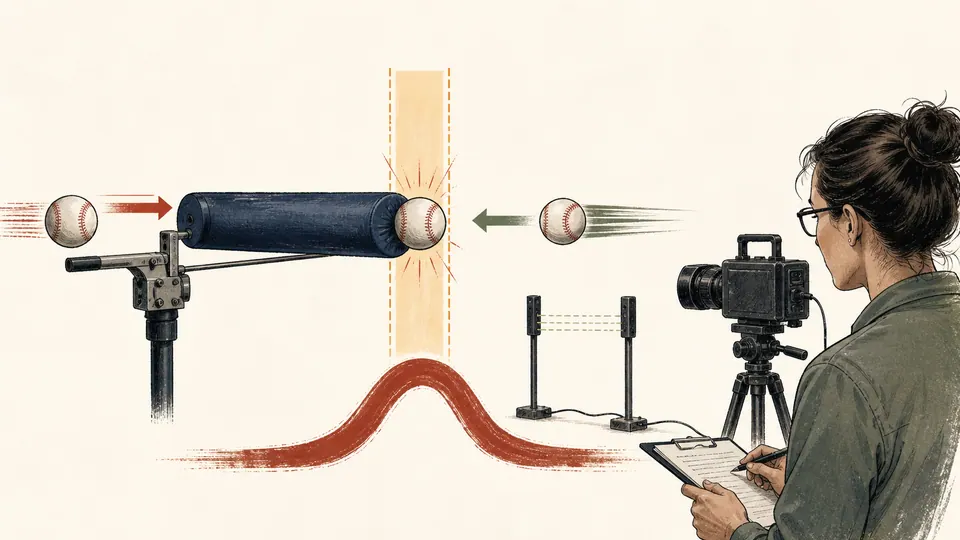
Current visualization updates with every valid input change.
Editorial illustration of a sports scientist timing a ball reversal while a short force pulse and before-after arrows are marked.
A sharp reversal can create a large momentum change even when the object mass is small.
Impulse-momentum ledgerExact values from the current model state
Before, after, difference, interval average, and signed direction from the current measurements.
QuantityEquationValueSI unit or direction

CURRENT CALCULATION PROCESS

Formula, units, substitution, intermediate quantities, and check

p_i = m x v_i; p_f = m x v_f; Delta p = p_f - p_i; J = Delta p; F_avg = Delta p / Delta t

Mass, both velocities, and the interval are converted to SI. The page subtracts signed momenta in final-minus-initial order. Dividing by the full interval gives average net force; multiplying that average by the same interval must recover impulse.

Symbols, meanings, units, and defaults for this page model
SymbolMeaningUnitDefault
mConstant object masskg0.145
v_iInitial signed velocitym/s-40
v_fFinal signed velocitym/s50
Delta tMeasured intervals0.005
Delta pFinal minus initial momentumkg*m/sderived
JNet impulseN*sderived
F_avgAverage net forceNderived

Conversions and rounding: 1 g = 0.001 kg; 1 lb = 0.45359237 kg; 1 km/h = 1/3.6 m/s; 1 mph = 0.44704 m/s; 1 ms = 0.001 s. The sign is preserved through every conversion.

    HOW TO USE

    Build an interval-average force record

    1. Define the positive direction before recording both velocities.
    2. Use the same velocity unit and reference frame for the initial and final measurements.
    3. Enter the actual interaction interval, not the video frame period unless they are the same.
    4. Read Delta p and impulse as signed equivalents, then distinguish average force from peak force.
    5. Confirm the area check F_avg x Delta t = J before exporting the record.

    SUBJECT FUNDAMENTALS

    Impulse and momentum-rate fundamentals

    Net force changes momentum
    For a finite interval, the average net force is Delta p divided by elapsed time.
    Impulse equals momentum change
    The integral of net force over time equals p_f - p_i; a constant rectangle with height F_avg has the same area.
    Reversal magnifies Delta p
    Changing from negative to positive velocity subtracts a negative initial momentum, so magnitudes add.
    Average is not peak
    Different force-time shapes can have the same impulse and average while reaching very different maximum forces.
    The interval boundary matters
    Starting or ending the clock too early can include unrelated forces or miss part of the interaction.
    External net force is implied
    Internal contact forces within a larger chosen system can cancel; system definition affects which force the result represents.

    RESULT INTERPRETATION

    Interpret the current force record

    Signed impulse

    Its sign tells the direction of net momentum transfer under the declared axis.

    Average force

    This is the constant force that would deliver the same impulse over the same interval.

    Zero result

    Zero Delta p means zero net impulse for the selected object, not necessarily absence of individual forces.

    DEEPER ANALYSIS

    Three measurement decisions behind F_avg

    Choose the system boundary

    For a ball alone, bat contact and gravity are external. For ball plus bat, their mutual contact is internal. State what object the mass and momenta describe.

    Separate impulse from force shape

    Delta p constrains area under F(t), not rise time or peak. Equipment strength and injury analysis need a force-time trace or validated pulse model.

    Use signed subtraction

    Delta p = p_f - p_i. Replacing signed velocities with speeds can turn a reversal into a small difference instead of the correct large change.

    WORKED CASES

    Worked impulse cases

    Baseball direction reversal

    For m = 0.145 kg, v_i = -40 m/s, v_f = +50 m/s, and Delta t = 5 ms, Delta p = 13.05 N*s and F_avg = 2,610 N in the positive direction.

    Vehicle coasting at unchanged speed

    If initial and final signed velocity are equal, Delta p, impulse, and average net force are zero even though individual engine, drag, and rolling forces may be nonzero and balanced.

    ASSUMPTIONS

    Rate-model assumptions

    • Constant mass over the interval.
    • Initial and final velocities refer to the same object and inertial frame.
    • The entered interval covers the intended interaction window.
    • The result is net average force, not a particular contact-force component.
    • Relativistic effects are negligible.

    TECHNICAL LANGUAGE

    Impulse and rate terms

    Momentum change
    Final signed momentum minus initial signed momentum.
    Impulse
    The time integral of net force; equal to Delta p.
    Average net force
    Impulse divided by the chosen elapsed time.
    Force-time area
    The signed area under F(t), measured in N*s.
    Interaction interval
    The start-to-end time window over which momentum change is assigned.
    Peak force
    The largest instantaneous force, which cannot be recovered from average force alone.

    EVIDENCE AND DATA LINEAGE

    Evidence to retain for an average-force result

    Keep the system boundary, axis direction, mass source, calibrated timestamps, before-and-after velocity measurements, frame rate or sensor bandwidth, interval-selection rule, and exported table. For impact work, retain the raw force or motion trace because an average cannot reconstruct the peak.

    LIMITS AND EXCLUSIONS

    Limits of the finite-interval result

    • Does not calculate peak force or force-pulse shape.
    • Assumes constant mass; rockets, leaks, and accretion need a variable-mass balance.
    • Measurement uncertainty and sensor filtering are not propagated.
    • The result is net force on the chosen object, not automatically one named contact force.
    • Very short intervals require instrumentation with adequate sampling rate and synchronized endpoints.

    RELIABLE SOURCES

    Primary references and stated use

    FREQUENTLY ASKED QUESTIONS

    Questions about average force and impulse

    Why is the force so large for a millisecond interval?

    The same Delta p divided by a shorter time gives a larger average force. Verify that the interval really spans the complete interaction.

    Can this calculator find peak impact force?

    No. Impulse and duration determine an average, but many force-time curves with different peaks have the same area.

    Why does a reversal add velocity magnitudes?

    Because Delta v = v_f - v_i; subtracting a negative initial velocity increases the signed change.

    Is impulse always positive?

    No. Its sign follows Delta p and the declared axis. Magnitude alone discards direction.

    What if initial and final velocities match?

    Net impulse and average net force are zero for the interval, though individual forces may have acted and canceled.

    Should gravity be subtracted?

    Only if you need a specific contact-force impulse rather than net impulse. This page reports net force implied by the object momentum change.

    IMPORTANT NOTE

    Impact and safety note

    Average force is not a peak-load rating. Do not use it alone for protective equipment, structural impact, injury, crash, or machinery certification; those decisions require suitable transient measurements and qualified analysis.