Magnitude
|p| measures the amount of one-dimensional momentum but discards direction.
Physics calculator
Solve linear momentum, mass, or signed velocity with explicit SI conversion, one-dimensional direction conventions, validation, substitution, and reverse checking.
One-dimensional linear momentum
Solve any one variable in p = m x v while preserving the sign of the chosen axis. Inputs can be entered in common mass, velocity, and momentum units; the calculation is normalized to SI before the requested value is returned.
Designed for: For mechanics homework, experiment logs, collision setup checks, and engineering estimates that need unit conversion and direction made explicit.
LIVE MODEL OUTPUT
Entered values, conversion results, and the signed one-dimensional relationship.
| Quantity | Input or equation | Canonical value | Canonical unit |
|---|
CURRENT CALCULATION PROCESS
The solver converts the two active known quantities to SI. Mass remains positive, while velocity and momentum carry the sign of the declared axis. It rearranges only the selected equation and then multiplies solved mass and velocity to reverse-check momentum.
| Symbol | Meaning | Unit | Default |
|---|---|---|---|
| p | Signed linear momentum | kg*m/s | 18,000 |
| m | Positive mass | kg | 1,500 |
| v | Signed velocity | m/s | 12 |
| u_p | Selected momentum unit | varies | kg*m/s |
| u_m | Selected mass unit | varies | kg |
| u_v | Selected velocity unit | varies | m/s |
Conversions and rounding: 1 g = 0.001 kg; 1 lb = 0.45359237 kg; 1 km/h = 1/3.6 m/s; 1 mph = 0.44704 m/s; 1 lb*ft/s = 0.138254954376 kg*m/s. N*s and kg*m/s are numerically equal in SI.
HOW TO USE
SUBJECT FUNDAMENTALS
RESULT INTERPRETATION
|p| measures the amount of one-dimensional momentum but discards direction.
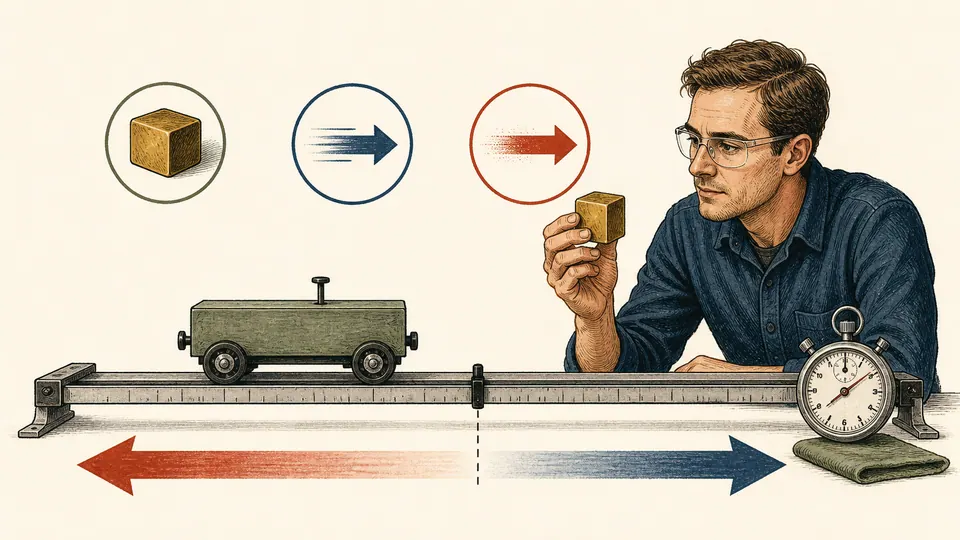
Positive and negative are coordinate labels. They are meaningful only when the axis is documented.
A positive result is necessary but does not validate whether the point-particle or constant-mass assumption fits the system.
DEEPER ANALYSIS
m = p/v must be positive. Opposite signs indicate inconsistent axis conventions, not a negative physical mass.
A pound entered here is a mass conversion to kilograms. Do not substitute pound-force or mix feet and meters without the selected unit conversion.
Speed alone is nonnegative. A signed collision or recoil problem needs velocity so opposite directions do not collapse into the same momentum.
WORKED CASES
A 1,500 kg car moving at +12 m/s has p = +18,000 kg*m/s. Reversing the lane direction to -12 m/s changes the sign but not the magnitude.
If a 0.020 kg object has measured momentum -3.0 N*s, v = p/m gives -150 m/s. The negative result reports direction; it does not mean a negative speed.
ASSUMPTIONS
TECHNICAL LANGUAGE
EVIDENCE AND DATA LINEAGE
Preserve the solve target, original numbers and units, axis sketch, reference frame, mass basis, timing or velocity measurement method, and exported canonical table. This prevents a later reader from treating lb as force or dropping a negative direction.
LIMITS AND EXCLUSIONS
RELIABLE SOURCES
FREQUENTLY ASKED QUESTIONS
Your velocity is negative along the chosen axis. Positive mass preserves that sign in p = m x v.
No. If p/v is negative, the entered signs are inconsistent for a positive-mass object.
They are dimensionally and numerically equivalent in SI, though N*s usually emphasizes impulse and kg*m/s emphasizes momentum.
It documents the selected output unit and default scenario; the runtime excludes its entered value and reports the calculated replacement.
Yes. Each is independently converted to SI before multiplication, and the canonical table exposes the conversions.
Only to the specified object and velocity at that instant. Collision conservation requires all relevant objects and external impulse.
IMPORTANT NOTE
This solver is for classical, one-dimensional momentum arithmetic. Validate the frame, units, mass constancy, and vector components before using it in safety, ballistics, crash, or equipment decisions.