Physics and optics
Photon Energy Calculator
Calculate single-photon energy, transmitted pulse energy, delivered photon count and pulse peak power from wavelength, pulse energy, transmission and duration.
CURRENT PHOTON MODEL
Enter the physical assumptions
For laser pulse planning, optics labs and detector-budget checks where one photon and the whole pulse must be kept distinct.
CURRENT CALCULATION DETAIL
Photon pulse energy ledger
Inputs, intermediate values and final checks are regenerated from one current calculation state.
| Quantity | Formula path | Current value | Interpretation |
|---|
CURRENT CALCULATION PROCESS
Formula, substitution, intermediate steps and final check
E_photon = hc/lambda; N_delivered = (E_pulse x T)/E_photon; P_peak = E_delivered/delta t.
Convert entered units to SI, apply transmission to the pulse, divide by single-photon energy, then divide delivered energy by duration for rectangular-equivalent peak power.
Waiting for valid inputs.
MODEL EXPLANATION
A pulse has two energy scales
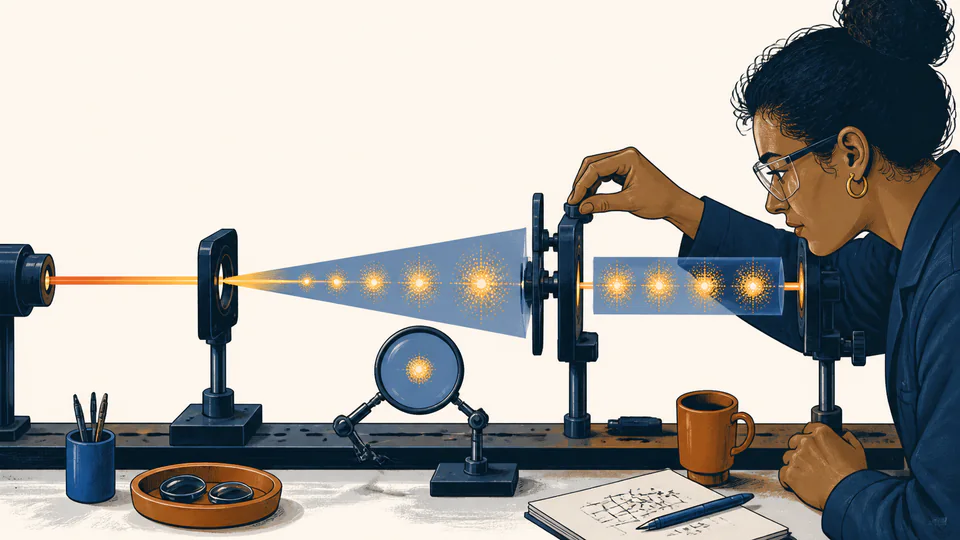
The Planck relation describes one photon, while a joulemeter describes the complete pulse. Dividing pulse energy by hc/lambda connects them.
A passive attenuator reduces expected photon count. It does not make each surviving photon weaker.
SYMBOLS AND VARIABLES
Read the formula before using the result
| Symbol | Unit or range | Meaning |
|---|---|---|
| h | 6.62607015 x 10^-34 J s | exact Planck constant |
| c | 299792458 m/s | exact vacuum light speed |
| lambda | m | vacuum wavelength |
| T | 0 to 1 | path transmission |
| delta t | s | pulse duration |
WORKED EXAMPLE
Default 532 nm pulse, line by line
- Convert 532 nm to 5.32 x 10^-7 m.
- Compute hc/lambda for one green photon.
- Convert 250 microJ to joules and multiply by 0.72.
- Divide delivered joules by joules per photon; divide again by 10 ns for peak power.
PHYSICS FOUNDATIONS
What this result represents
- Photon count is a macroscopic expectation, not an individual event record.
- Peak power can be high while average power is modest; repetition rate is needed for average power.
- Use source vacuum wavelength for photon energy even when spatial wavelength changes inside a material.
DEEPER ANALYSIS
Loss, bandwidth and pulse shape
- One transmission value compresses reflection, absorption, clipping and coupling losses.
- A broadband pulse requires spectral integration when center wavelength is insufficient.
- E/delta t is rectangular-equivalent; other temporal shapes require a shape factor.
REAL-WORLD CASE
Case: photons delivered to a fluorescent sample
A lab measures 250 microJ before filters and estimates 72% delivery at 532 nm.
Delivered photons support exposure bookkeeping, but fluorescence also depends on absorption, geometry and bleaching.
Keeping emitted and delivered energy separate lets a later transmission measurement be substituted cleanly.
TERMS
Photon-model vocabulary
- Pulse energy
- Time-integrated energy in one optical pulse.
- Transmission
- Delivered divided by incident optical energy.
- Photon fluence
- Photon count per area; beam area is outside this model.
- Peak power
- Pulse-scale power, not repetition-average power.
LIMITS AND DISCLAIMER
Where this model stops
- Assumes one vacuum wavelength.
- Treats transmission as linear and wavelength-independent.
- Does not model beam area, pulse shape, repetition rate or detector response.
- Use calibrated instruments and laser-safety procedures for real exposure decisions.
This educational calculator supports transparent estimation. It does not replace calibrated measurements, instrument specifications, safety controls or expert review.
Frequently asked questions
Does lower wavelength mean more photons for the same pulse energy?
No. Shorter-wavelength photons carry more energy, so the same pulse contains fewer.
Should transmission change photon energy?
No for passive loss; it changes delivered pulse energy and expected count.
Is peak power average power?
No. Average power also needs repetition rate.
Why is photon count not an integer?
It is an expectation derived from measured macroscopic energy.
Can I use wavelength inside glass?
Use vacuum wavelength or source frequency for photon energy.
What usually dominates uncertainty?
Pulse-energy calibration and path transmission often dominate.
SOURCES