Physics and optics
Photon Rate Calculator
Convert wavelength and optical power into source photon rate, transmitted arrival rate, detected count rate, gate counts and ideal shot noise.
CURRENT PHOTON MODEL
Enter the physical assumptions
For continuous-light experiments and detector budgets that follow photons from source power through path loss and quantum efficiency.
CURRENT CALCULATION DETAIL
Photon arrival and detection ledger
Inputs, intermediate values and final checks are regenerated from one current calculation state.
| Quantity | Formula path | Current value | Interpretation |
|---|
CURRENT CALCULATION PROCESS
Formula, substitution, intermediate steps and final check
R_source = P/(hc/lambda); R_detected = R_source x T x QE; mu = R_detected x gate.
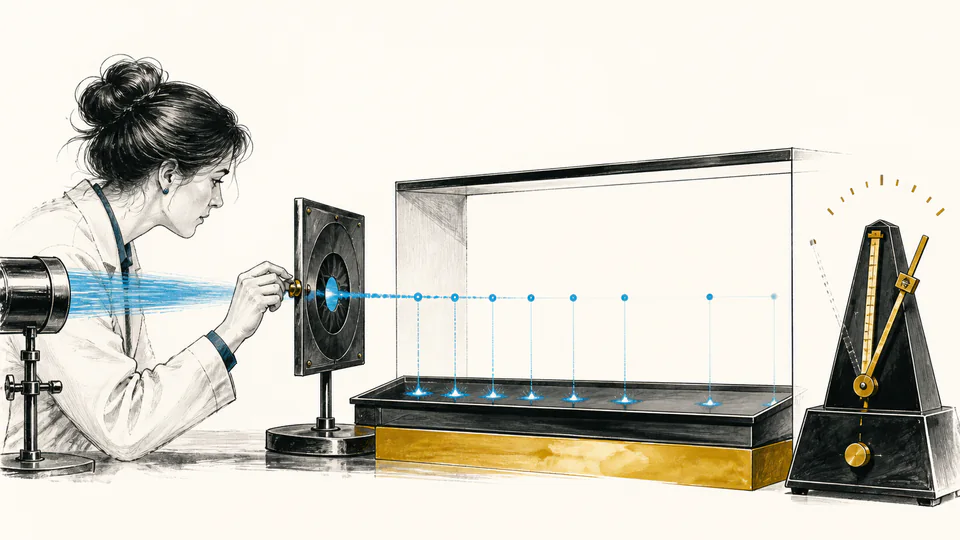
Power is joules per second. Dividing by joules per photon yields photon rate; transmission and quantum efficiency are then applied as separate probabilities.
Waiting for valid inputs.
MODEL EXPLANATION
Keep arrival and count rate separate
Transmission predicts photons reaching the detector; quantum efficiency predicts incident photons becoming registered events.
Improving optical coupling and changing detector technology act on different links in the chain.
SYMBOLS AND VARIABLES
Read the formula before using the result
| Symbol | Unit or range | Meaning |
|---|---|---|
| P | W | source optical power |
| E | J/photon | single-photon energy |
| R | s^-1 | event rate |
| QE | 0 to 1 | quantum efficiency |
| mu | counts | expected gate events |
WORKED EXAMPLE
Default red-source count budget
- Find one 650 nm photon energy.
- Divide 2.5 mW by that energy.
- Apply 80% transmission and 65% efficiency.
- Multiply by 10 ms and use sqrt(mu) for ideal Poisson noise.
PHYSICS FOUNDATIONS
Mean counts are not guaranteed counts
- The model predicts a long-run mean; individual gates fluctuate.
- For independent events, ideal sigma is sqrt(mu) and relative noise falls as 1/sqrt(mu).
- Dark counts, read noise, dead time and saturation are not included.
DEEPER ANALYSIS
When the linear chain breaks
- At high rates, detector dead time makes counts sublinear.
- Technical intensity noise may exceed photon shot noise.
- Quantum efficiency can vary with wavelength, temperature and bias.
REAL-WORLD CASE
Case: choosing a detector gate
A timing experiment needs sufficient counts without saturating electronics.
The model supplies the ideal mean and shot-noise floor for comparison with detector limits.
Changing gate time scales expected counts but leaves the source and detected rates unchanged.
TERMS
Photon-model vocabulary
- Photon rate
- Expected photons crossing a plane each second.
- Count rate
- Registered detector events each second.
- Quantum efficiency
- Probability an incident photon registers.
- Shot noise
- Fluctuation from discrete independent events.
LIMITS AND DISCLAIMER
Where this model stops
- Assumes steady monochromatic power.
- Uses linear independent transmission and efficiency.
- Ignores dead time, dark counts, gain noise and saturation.
- Treat shot noise as a lower-bound model.
This educational calculator supports transparent estimation. It does not replace calibrated measurements, instrument specifications, safety controls or expert review.
Frequently asked questions
Why divide power by photon energy?
Joules per second divided by joules per photon gives photons per second.
Is efficiency the same as transmission?
No; they describe arrival and registration separately.
Does a longer gate increase shot noise?
Absolute sigma grows, while relative noise falls.
Can detected rate exceed photon rate?
Not in this one-event-per-photon model.
What if the detector saturates?
Use a detector-specific dead-time or saturation model.
Why is wavelength needed?
Equal power at different wavelengths contains different photon rates.
SOURCES