Physics and optics
Photon Graph Calculator
Build a numerical wavelength sweep showing photon energy and photon rate at fixed power, with endpoint changes and reciprocal-law checks.
CURRENT PHOTON MODEL
Enter the physical assumptions
For students and optical planners who need a reproducible numeric sweep rather than a decorative chart.
CURRENT CALCULATION DETAIL
Wavelength sweep ledger
Inputs, intermediate values and final checks are regenerated from one current calculation state.
| Quantity | Formula path | Current value | Interpretation |
|---|
CURRENT CALCULATION PROCESS
Formula, substitution, intermediate steps and final check
E(lambda)=hc/lambda; R(lambda)=P/E(lambda)=P lambda/(hc).
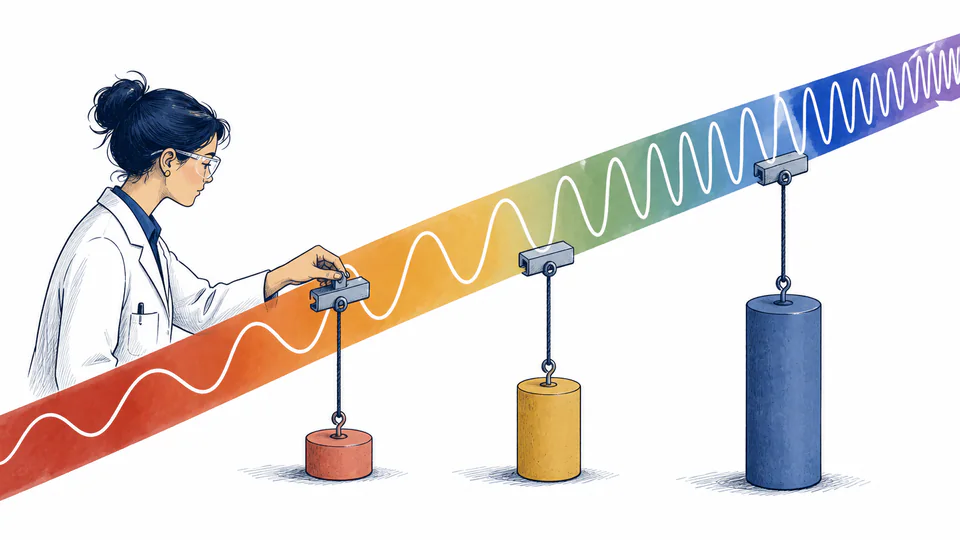
Generate explicit wavelength rows. At fixed power, energy falls inversely with wavelength while photon rate rises directly with wavelength.
Waiting for valid inputs.
MODEL EXPLANATION
Why the numeric sweep matters
A curve can hide sampling and rounded endpoints; the ledger exposes every evaluated point.
At fixed power, E is proportional to 1/lambda and R is proportional to lambda.
SYMBOLS AND VARIABLES
Read the formula before using the result
| Symbol | Unit or range | Meaning |
|---|---|---|
| lambda | nm then m | sweep wavelength |
| P | W | fixed power |
| E(lambda) | J or eV | energy per photon |
| R(lambda) | photons/s | rate at fixed power |
WORKED EXAMPLE
Default visible-range sweep
- Generate 400 through 700 nm in 50 nm increments.
- Calculate hc/lambda and convert to eV at each row.
- Divide 1 mW by each photon energy.
- Compare endpoint ratios with wavelength ratios.
PHYSICS FOUNDATIONS
Read endpoints before the middle
- E_start/E_end should equal lambda_end/lambda_start.
- R_end/R_start should equal lambda_end/lambda_start.
- If the interval is not divisible by the step, the final included row stays below the entered end.
DEEPER ANALYSIS
Sampling and interpretation
- Smaller steps add rows but do not improve the physical relation.
- This model holds power fixed, not photon rate.
- Real spectra have bandwidth; each row here is monochromatic.
REAL-WORLD CASE
Case: equal-power visible sources
A lab compares equal-power sources across the visible band.
The red source has more photons per second than the blue source at the same wattage.
Detector counts still require wavelength-specific throughput and efficiency.
TERMS
Photon-model vocabulary
- Sweep
- Ordered calculations over changing input.
- Sampling step
- Wavelength gap between rows.
- Endpoint ratio
- Dimensionless first-to-last check.
- Monochromatic point
- Ideal single-wavelength comparison.
LIMITS AND DISCLAIMER
Where this model stops
- Produces a numeric sweep table, not a standalone interactive visualization.
- Assumes vacuum wavelength and constant power.
- Does not model detector efficiency, bandwidth or dispersion.
- Limited to 41 rows for readable export.
This educational calculator supports transparent estimation. It does not replace calibrated measurements, instrument specifications, safety controls or expert review.
Frequently asked questions
Why can the last row be below the entered end?
The sweep uses whole steps from the start.
Why does rate rise toward red?
Longer-wavelength photons carry less energy.
Does a smaller step improve accuracy?
It increases density, not model accuracy.
Can this predict detector counts?
Only after adding wavelength-dependent path and detector response.
Is this a spectrum simulation?
No, it is a deterministic fixed-power sweep.
What is the fastest check?
Compare energy and rate ratios with endpoint wavelength ratios.
SOURCES