Physics and optics
Photon Scenario Calculator
Compare two wavelength, power, transmission and detector-efficiency scenarios using detected rate, gate count, ratio and signed difference.
CURRENT PHOTON MODEL
Enter the physical assumptions
For side-by-side optical choices where power alone cannot identify the stronger detector signal.
CURRENT CALCULATION DETAIL
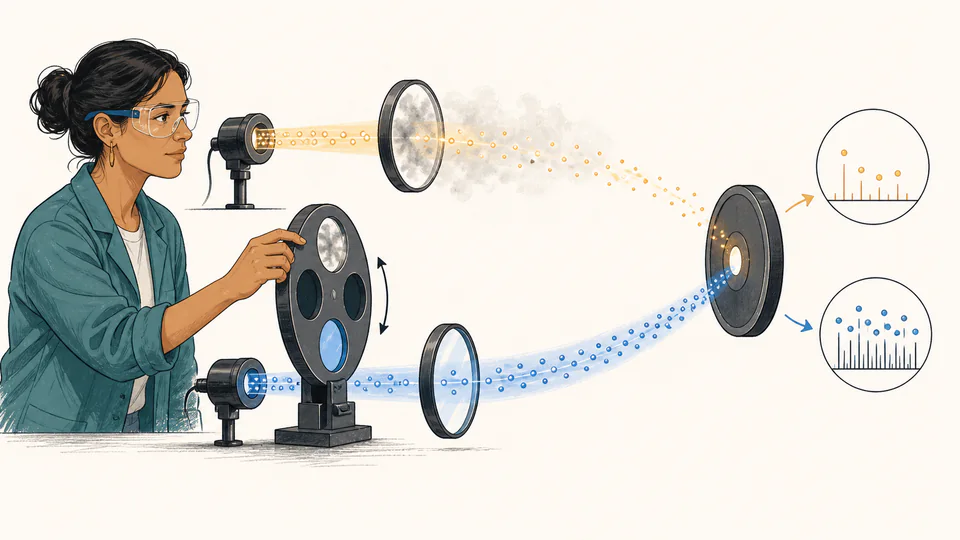
Two-path photon comparison
Inputs, intermediate values and final checks are regenerated from one current calculation state.
| Quantity | Formula path | Current value | Interpretation |
|---|
CURRENT CALCULATION PROCESS
Formula, substitution, intermediate steps and final check
mu_i=[P_i/(hc/lambda_i)] x T_i x QE_i x gate; comparison=mu_B/mu_A.
Evaluate each path independently through the same physical chain before comparing counts.
Waiting for valid inputs.
MODEL EXPLANATION
Compare complete chains
Wavelength changes photons per watt, transmission changes arrivals, and efficiency changes registrations.
A shared gate makes the ratio independent of gate duration while absolute counts still scale.
SYMBOLS AND VARIABLES
Read the formula before using the result
| Symbol | Unit or range | Meaning |
|---|---|---|
| i | A or B | scenario index |
| P_i | W | source power |
| T_i | 0 to 1 | transmission |
| QE_i | 0 to 1 | efficiency |
| mu_i | counts | expected gate count |
WORKED EXAMPLE
Default blue-versus-infrared paths
- Convert each wavelength to photon energy.
- Divide each power by its photon energy.
- Apply each path's transmission and efficiency.
- Multiply both rates by 5 ms, then compute B/A and B-A.
PHYSICS FOUNDATIONS
Ratios reveal tradeoffs
- Long wavelength gives more photons per watt, but detector response varies independently.
- A ratio above one favors B only for expected registered counts.
- Equal count does not imply equal resolution, penetration or safety.
DEEPER ANALYSIS
Sensitivity and uncertainty
- Transmission and efficiency enter multiplicatively.
- Near-zero A makes B/A unstable; inspect signed difference too.
- Real comparisons may require noise, bandwidth, area and saturation.
REAL-WORLD CASE
Case: choosing an emitter-sensor pair
A prototype compares a blue emitter with modest throughput and an infrared emitter with a better sensor match.
The count comparison informs selection, while target reflectance and ambient background remain separate.
The ledger makes later supplier-specification changes auditable.
TERMS
Photon-model vocabulary
- Scenario
- One complete source-path-detector set.
- Throughput
- Fraction reaching the detector.
- Count ratio
- Expected B divided by A.
- Signed difference
- B count minus A count.
LIMITS AND DISCLAIMER
Where this model stops
- Compares mean counts without uncertainty intervals.
- Assumes linear one-event-per-photon response.
- Omits reflectance, area, noise and saturation.
- Use measured wavelength-specific inputs where possible.
This educational calculator supports transparent estimation. It does not replace calibrated measurements, instrument specifications, safety controls or expert review.
Frequently asked questions
Why can lower-power B win?
Wavelength, transmission and efficiency can outweigh power.
Does gate time affect B/A?
Not when the same gate applies to both.
What if A is nearly zero?
Use the difference and inspect assumptions; the ratio is unstable.
Can this compare detector models?
Yes with wavelength-specific efficiencies and a common optical reference plane.
Does larger count always mean better?
No; noise, bandwidth, safety and cost also matter.
Why separate transmission and efficiency?
They represent different physical links and remedies.
SOURCES