Physics and engineering
Photon Solver Calculator
Solve vacuum wavelength, frequency, photon energy, momentum, and spectroscopic wavenumber from one known single-photon quantity.
CURRENT MODEL
Translate one known photon quantity into equivalent forms
Physics students, spectroscopy users, and optical engineers translating one monochromatic vacuum photon quantity into equivalent forms.
Decision supportedConvert a known wavelength, frequency, energy, or momentum into a consistent single-photon record before instrument or experiment planning.
PHYSICAL CONTEXT
The modeled decision in context
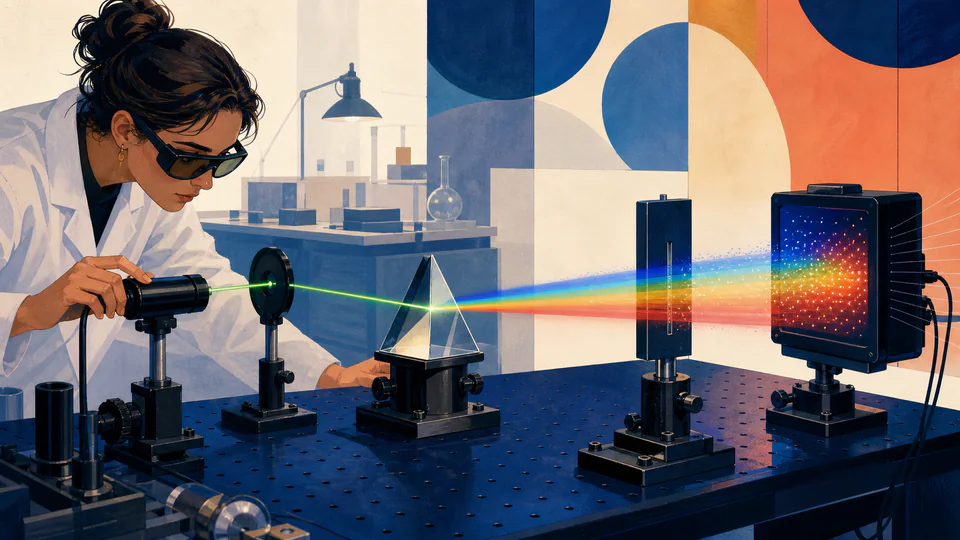
This static editorial scene clarifies the apparatus and evidence boundary; all current numeric detail remains in the exact ledger below.
| Quantity | Symbol or equation | Current value | Unit |
|---|
How to use
Solve one monochromatic vacuum photon record
- Select whether the known value is wavelength, frequency, photon energy, or momentum.
- Enter the value in the unit stated by that selection.
- Confirm that a vacuum wavelength is intended rather than a wavelength measured inside a material.
- Review all equivalent photon quantities rather than converting a displayed rounded result again.
- Use wavenumber only with the stated reciprocal-centimetre convention.
- Preserve source bandwidth and photon-count evidence separately when planning an experiment.
Photon fundamentals
Six distinctions behind the conversion
- Vacuum wavelength
- The spatial period associated with frequency at the exact speed of light c.
- Frequency
- The oscillation rate, which remains continuous across a stationary material interface.
- Single-photon energy
- Planck's relation E=h f assigns energy to one photon, not to an entire pulse.
- Photon momentum
- A zero-rest-mass photon still carries momentum p=E/c.
- Wavenumber
- Spectroscopic reciprocal wavelength, reported here in cm^-1.
- Monochromatic assumption
- One value represents one spectral component rather than a finite bandwidth.
Calculation method
Normalize to vacuum wavelength, then derive every equivalent
The solver converts the selected input to metres, derives frequency with c/lambda, applies Planck's relation for joules and electronvolts, calculates momentum from h/lambda, and converts reciprocal metres to reciprocal centimetres. Exact SI constants are retained through the full chain.
Vacuum versus material wavelength
Frequency does not change at a stationary interface, but wavelength becomes lambda/n in a material. A material wavelength therefore needs a wavelength- and condition-specific refractive index before this vacuum solver can be used.
Bandwidth changes the question
A central wavelength does not preserve the energy distribution of a broadband, chirped, or asymmetric source. Convert the measured spectrum bin by bin when spectral width affects detector response or dose.
Single photon versus beam or pulse
Beam power needs photon flux, and pulse energy needs photon count. Neither can be inferred from one photon's wavelength without an independently measured rate, duration, or count.
Detailed calculation process
Symbols, conversions, substitution, intermediate results, and reconciliation
c=lambda f; E=h f=h c/lambda; p=h/lambda=E/c; sigma=1/lambdaExact SI constants are used and all derived quantities retain full precision. Scientific notation is applied only in display strings.
| Symbol | Meaning | Default or exact value | Unit |
|---|---|---|---|
| lambda | Vacuum wavelength | 532 | nm |
| f | Photon frequency | Derived | THz |
| E | Single-photon energy | Derived | J and eV |
| p | Photon momentum | Derived | kg m/s |
| c | Speed of light in vacuum | 299,792,458 | m/s |
| h | Planck constant | 6.62607015e-34 | J s |
| e | Elementary charge used for eV conversion | 1.602176634e-19 | C |
| sigma | Spectroscopic wavenumber | Derived | cm^-1 |
Waiting for valid inputs.
Interpretation
Equivalent values describe the same ideal photon
A shorter vacuum wavelength means higher frequency, energy, momentum, and wavenumber. These are equivalent descriptions of one monochromatic photon, not separate additive results and not a statement of source brightness.
Evidence and measurement
Retain the spectral context with the number
Record the instrument, calibration date, air-to-vacuum correction, material refractive index when applicable, line centre method, bandwidth or linewidth, uncertainty, source mode, pulse duration, repetition rate, and whether the value is measured or nominal.
Scope and limitations
What this single-photon solver excludes
- Dispersion and wavelength inside matter
- Broadband spectral integration
- Photon count, flux, beam power, and pulse energy
- Doppler, gravitational, and relativistic shifts
- Polarization and quantum state statistics
- Detector efficiency, exposure limits, and laser safety
One photon in vacuum with a positive finite monochromatic quantity. Material wavelength, spectral bandwidth, pulse energy, and photon count are outside scope.
Key terminology
Photon conversion glossary
- Vacuum wavelength
- Distance per cycle when light propagates at c.
- Frequency
- Cycles per second, measured in hertz.
- Electronvolt
- Energy gained by one elementary charge across one volt.
- Photon momentum
- Momentum h/lambda carried by one photon.
- Wavenumber
- Reciprocal wavelength, commonly cm^-1 in spectroscopy.
- Linewidth
- Finite spectral spread around a line centre.
Practical cases
Two different ways to specify one photon
532 nm green source
The default corresponds to about 563.52 THz, 2.33053 eV, and 1.24550e-27 kg m/s per photon. Total laser power still requires photon flux.
1 eV photon input
Entering 1 eV gives about 1239.84 nm in vacuum, in the near-infrared. A broadband source centred there still needs its full spectrum for detector or heating analysis.
Important note
Equivalent photon quantities do not establish exposure safety
Laser and optical safety depend on power, pulse structure, beam geometry, wavelength, access conditions, and applicable exposure standards; one-photon energy alone is insufficient.
Frequently asked questions
Are these wavelength values in vacuum?
Yes. Material wavelength is shorter by refractive index while frequency remains continuous across a stationary interface.
Why is photon energy proportional to frequency?
Planck's relation E=hf assigns higher energy to higher-frequency photons, equivalently shorter vacuum wavelengths.
Is photon momentum zero because its rest mass is zero?
No. A photon has momentum p=E/c=h/lambda despite zero rest mass.
Does the solver calculate pulse energy?
No. Multiply single-photon energy by photon count only when count and losses are independently known.
Can I enter a wavelength measured in glass?
Not directly. Convert it to vacuum wavelength using the material refractive index at the relevant frequency and conditions.
Does one result represent a broadband source?
No. Broadband light requires a spectrum; using only a central wavelength can hide bandwidth and asymmetric energy distribution.
Authority and follow-on work
Reliable sources and related calculators
- OpenStax University Physics — Chapter 6 Key EquationsSupports E=hf=hc/lambda and p=h/lambda.
- NIST — 2022 CODATA ConstantsProvides exact c, h, and elementary charge values.
- NIST Atomic Spectroscopy IntroductionExplains equivalent vacuum frequency, wavelength, wavenumber, and energy descriptions.