Physics and mechanics
Sound Wave Energy Calculator
Convert RMS acoustic pressure into intensity, transmitted power, and total sound energy across a stated area and exposure time.
CURRENT MODEL
Define the plane-wave pressure, medium, aperture, and duration
Acoustics students, laboratory technicians, enclosure designers, and educators who need an energy budget from a plane-wave pressure measurement.
Decision supportedEstimate how much acoustic energy crosses a known area during a known interval, while keeping pressure, intensity, power, and energy as distinct quantities.
LIVE ENERGY FLOW
From pressure amplitude to accumulated energy
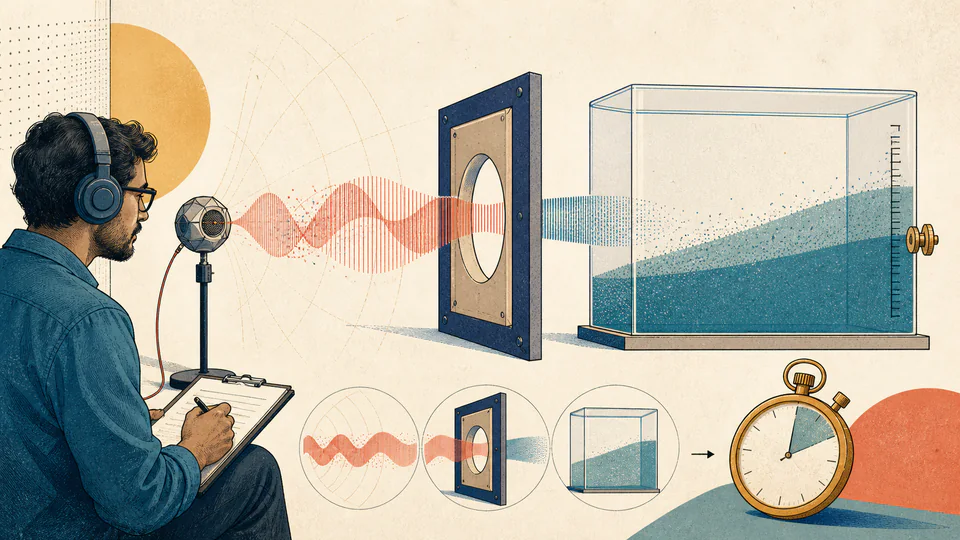
The live flow strip carries the current pressure through medium impedance, area, and time so watts per square metre, watts, and joules remain distinct.
| Quantity | Equation | Current value | Unit |
|---|
How to use
Build an energy estimate without confusing rate and total
- Enter RMS acoustic pressure in pascals after removing static atmospheric pressure.
- Enter medium density and sound speed for the same temperature, pressure, and composition.
- Define the projected area perpendicular to propagation rather than an arbitrary enclosure area.
- Enter the duration over which average power is assumed steady; zero duration is allowed as a boundary check.
- Read intensity first, then power through the aperture, then accumulated energy.
- Use IAt as the independent reconciliation and retain the field assumptions with the exported values.
Acoustic energy fundamentals
Six quantities that must keep their own units
- RMS pressure
- The effective sinusoidal pressure amplitude used for time-average power calculations.
- Characteristic impedance
- Z = rho c links plane-wave pressure to particle velocity.
- Intensity
- Average acoustic power crossing each square metre, measured in W/m2.
- Power
- The rate of energy crossing the declared aperture, measured in watts.
- Energy
- Power accumulated over time, measured in joules.
- Energy density
- Average acoustic energy stored per unit volume for the idealized traveling wave.
Calculation method
Use impedance to move from pressure to flow
The model first forms characteristic impedance rho c. For a progressive plane wave, RMS pressure divided by impedance gives RMS particle velocity, and p_rms squared divided by impedance gives average intensity.
Multiplying by a perpendicular area converts intensity to acoustic power. Multiplying that power by duration converts a rate into total transmitted energy; duration never appears in the intensity calculation.
RMS versus peak
For a sinusoid, peak pressure is sqrt(2) times RMS pressure. Entering a peak value as RMS doubles the predicted average intensity and every downstream power or energy result.
Area orientation
Only the component of area normal to propagation intercepts the idealized flux. Oblique or curved surfaces require a surface integral of the local intensity vector.
Reactive fields
Near sources or in standing waves, pressure and particle velocity can be out of phase. Pressure magnitude alone then does not establish net energy flow.
Time variability
If pressure changes during the interval, integrate instantaneous or short-time average power. A single steady RMS value cannot represent duty cycle or impulsive events without evidence.
Detailed calculation process
Symbols, current substitution, intermediate quantities, and reconciliation
Z = rho c; I = p_rms^2/Z; P = I A; E = P tThe model retains full SI precision. Small powers and energies use adaptive significant figures so a physically valid low-level result is not rounded to zero.
| Symbol | Meaning | Default | Unit |
|---|---|---|---|
| p_rms | RMS acoustic pressure | 2 | Pa |
| rho | Medium density | 1.204 | kg/m3 |
| c | Sound speed | 343 | m/s |
| A | Perpendicular intercepted area | 0.5 | m2 |
| t | Exposure duration | 60 | s |
| I | Average sound intensity | calculated | W/m2 |
| P, E | Acoustic power and accumulated energy | calculated | W, J |
Waiting for valid inputs.
Interpretation
Trace every unit change through the ledger
A small joule result can still correspond to substantial sound pressure because acoustic power is often much smaller than electrical source power. Conversely, extending duration increases energy linearly but does not change intensity or power while the steady condition holds.
Evidence and measurement
Preserve amplitude convention, geometry, and exposure window
Retain microphone calibration, bandwidth and weighting, whether pressure is RMS or peak, background subtraction, medium conditions, aperture dimensions and orientation, and the time history supporting a steady average. Record reflections and source distance when plane-wave validity matters.
Scope and limitations
What the plane-wave energy budget excludes
- Diffuse, standing, evanescent, or strongly reactive acoustic fields
- Nonuniform pressure over the selected area
- Oblique incidence and vector intensity integration
- Broadband phase relations and frequency-dependent impedance
- Source electrical consumption or transducer efficiency
- Occupational dose, hearing safety, and regulatory compliance
A progressive plane wave travels through a uniform medium, RMS pressure and particle velocity are in phase, the entered area is normal to propagation, and reflections or standing-wave effects are negligible.
Key terminology
Acoustic energy glossary
- RMS
- Root mean square, the effective amplitude for average sinusoidal power.
- Acoustic pressure
- Dynamic pressure variation around ambient pressure.
- Particle velocity
- Oscillatory medium velocity associated with the sound wave.
- Impedance
- Ratio of acoustic pressure to particle velocity in the progressive plane wave.
- Intensity
- Directional acoustic power flow per unit area.
- Acoustic power
- Rate at which sound energy crosses the declared area.
- Acoustic energy
- Time integral of acoustic power.
- Reactive field
- A field with stored oscillatory energy and potentially little net outward flow.
Practical cases
Two energy budgets with different constraints
Transmission through a test aperture
A lab measures nearly uniform RMS pressure in a plane-wave tube and knows the sample opening area. The calculator estimates energy incident during a 60-second run; transmission loss still requires the downstream measurement.
Short ultrasonic pulse train
A technician substitutes a verified equivalent steady RMS pressure and total active duration to screen energy delivered to a small target. Pulse shape, focusing, cavitation, and tissue or material response require separate analysis.
Important note
Pressure alone is not always net acoustic energy flow
Use this result only where progressive plane-wave assumptions are defensible. Exposure limits and process effects depend on spectrum, duty cycle, geometry, calibration, and standards beyond this calculation.
Frequently asked questions
Why does this calculator ask for RMS pressure?
For a sinusoid, RMS pressure gives the time-average intensity directly through I = p_rms^2/(rho c). Peak pressure would require a conversion before the same average-power relation can be used.
Is acoustic energy the same as sound intensity?
No. Intensity is power per area in W/m2, power is the rate crossing the stated area in W, and energy is that power accumulated over the entered duration in J.
Can I use a sound-level meter reading in dB directly?
Not directly. Convert the level to RMS pressure using its reference, weighting, bandwidth, and calibration context, then enter pressure in pascals.
What does zero duration mean?
It produces zero accumulated energy while intensity and instantaneous average power remain defined. This is a useful boundary check, not a finite exposure estimate.
Why can reflected rooms give a misleading answer?
Pressure and net energy flow are not necessarily in phase in standing or diffuse fields. A single pressure reading can therefore overstate or understate the power crossing a particular surface.
Does this result represent electrical energy consumed by a loudspeaker?
No. It is acoustic energy crossing the modeled area. Electrical input, transducer efficiency, directivity, and losses require separate measurements or models.
Authority and follow-on work
Reliable sources and related calculators
- MIT OCW — Chapter 13 AcousticsSupports plane-wave impedance, pressure, particle velocity, and average intensity relations.
- NIOSH — Occupational Noise ExposureDefines sound pressure, intensity, power, and decibel quantities in practical noise measurement.
- NIST Guide to the SISupports SI units for pressure, power, energy, area, and time.
Related calculators
Continue with a distinct physics question without silently changing the model boundary.