Physics and mechanics
Sound Wave Trajectory Calculator
Track the leading and trailing edges of a finite-duration sound burst across distance, including propagation delay, pulse length, carrier cycles, and envelope attenuation.
CURRENT MODEL
Enter the declared physical case
Acoustics students, test engineers, ultrasonic technicians, and audio-system planners timing a direct finite sound event between source and receiver.
Decision supportedDetermine when a burst occupies each location and whether the receiver window, acquisition gate, or path length captures the full event.
LIVE PHYSICAL ANALYSIS
Leading and trailing edges across distance
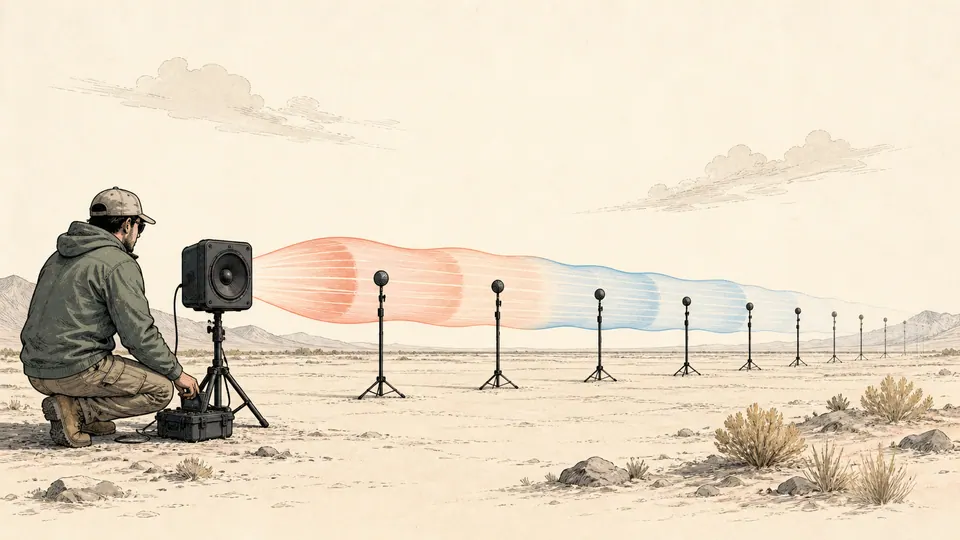
The live distance-time band separates source start time, propagation delay, and burst duration instead of drawing a phase snapshot.
| Distance (m) | Leading arrival (ms) | Trailing departure (ms) | Envelope pressure (Pa RMS) |
|---|
How to use
Define a finite burst and a direct receiver path
- Choose the constant sound speed for the actual medium and environmental state.
- Enter the carrier frequency and the source-envelope duration as separate quantities.
- Set the direct path length and the clock time when the leading edge leaves the source.
- Enter a reference RMS envelope pressure and a defensible amplitude-level attenuation rate.
- Read the leading arrival and trailing departure as the receiver acquisition window.
- Inspect the eleven-position trajectory and verify that trailing minus leading time remains the declared burst duration.
Trajectory fundamentals
Five physical meanings that keep the timing model honest
- Envelope edge
- The start or end boundary of a finite sound event, distinct from an individual carrier crest.
- Propagation delay
- Path length divided by wave speed, added to the source clock time for every received feature.
- Pulse length
- The spatial distance between leading and trailing edges, equal to sound speed times burst duration.
- Carrier cycles
- Frequency times duration; a burst need not contain an integer number of cycles.
- Envelope attenuation
- A declared amplitude-level decay applied along the path without changing arrival timing in this model.
Calculation method
Move both envelope edges with the same speed
The leading edge at position x arrives at t0 + x/c. The trailing edge leaves the source tau seconds later and therefore arrives at t0 + x/c + tau. Their parallel distance-time lines enclose the interval when the burst occupies each receiver position.
Wavelength and cycle count describe the carrier inside the envelope. The model separately applies an exponential amplitude ratio implied by the entered dB-per-meter loss, so timing and magnitude assumptions remain visible.
Group versus phase motion
The envelope transports the identifiable event while carrier phase advances within it. They share one speed only because the declared medium is nondispersive.
Acquisition-gate design
A gate opening before the leading arrival mostly records background; a gate closing before the trailing edge truncates energy and distorts spectral estimates. Add trigger and sensor uncertainty outside this ideal timing.
Multipath separation
Each reflection has another path length and loss. If its arrival overlaps the direct burst, the received pressure must be superposed with phase and bandwidth information rather than appended as a second scalar row.
Detailed calculation process
Symbols, current substitution, intermediate quantities, and reconciliation
t_lead(x) = t0 + x/c; t_trail(x) = t_lead + tau; L_pulse = c tauTime and pressure are calculated at full precision. The table samples eleven equally spaced receiver positions; displayed values are rounded after arrival and attenuation calculations.
| Symbol | Meaning | Default | Unit |
|---|---|---|---|
| c | Constant sound speed | 343 | m/s |
| f | Carrier frequency | 1000 | Hz |
| tau | Burst-envelope duration | 20 | ms |
| x_R | Direct receiver path | 20 | m |
| t0 | Leading-edge source time | 5 | ms |
| a | Envelope attenuation | 0.02 | dB/m |
Waiting for valid inputs.
Evidence to retain
Preserve clocks, paths, and bandwidth
Record source trigger definition, clock synchronization and uncertainty, source and receiver coordinates, direct-path survey, medium temperature and composition, sound-speed source, carrier center frequency and bandwidth, burst window shape, transducer response, attenuation provenance, and any detected reflected arrivals.
Scope and limitations
Where the straight trajectory ends
- No temperature gradient, wind, refraction, dispersion, or frequency-dependent group delay
- No reflection, diffraction, scattering, or path superposition
- No source or receiver motion and therefore no Doppler shift
- No transducer ring-up, ring-down, phase response, or acquisition latency
- No inverse-square spreading unless already represented by the chosen attenuation input
- No claim that air particles travel from source to receiver
Trajectory means the distance-time path of a finite burst envelope, not the motion of air particles and not a ray bent by gradients. The model uses constant sound speed, one direct path, constant dB-per-meter envelope attenuation, and no reflections or dispersion.
Key terminology
Tone-burst trajectory glossary
- Leading edge
- The first boundary of the emitted envelope used to define arrival time.
- Trailing edge
- The final boundary of the finite envelope, delayed from the leading edge by the burst duration.
- Group velocity
- The speed of an envelope or information-bearing modulation in a dispersive analysis.
- Phase velocity
- The speed of a constant carrier phase such as a crest.
- Propagation path
- The physical source-to-receiver route whose length determines delay.
- Acquisition gate
- The measurement time window chosen to capture a desired arrival and reject others.
Practical cases
Two timing problems with different scales
Warehouse alarm latency
A commissioning team sends a 20 ms test burst to a microphone 20 m away. The predicted direct arrival defines a narrow inspection window, while later peaks in the recording are retained as room reflections rather than folded into the direct path.
Ultrasonic material test
A technician substitutes the specimen's longitudinal sound speed, a microsecond burst, and millimeter path. The same edge equations size the gate, but dispersion, couplant layers, and transducer ring-down must be handled in the instrument procedure.
Important note
Arrival prediction is not a substitute for timing calibration
When synchronization or defect location matters, calibrate cable, trigger, transducer, and acquisition delays with a reference path. This calculator isolates ideal propagation time and cannot identify undocumented instrument latency.
Frequently asked questions
What does trajectory mean for a sound wave?
Here it means the distance-time locus of a finite burst envelope. It does not mean that an air parcel travels from the source to the receiver; local particles oscillate around equilibrium.
Why does the burst duration stay constant at every receiver?
The model assumes one nondispersive path with constant sound speed. Frequency-dependent group delay, reflections, and bandwidth-limited transducers can broaden or reshape a real pulse.
Is the propagation delay based on phase velocity or group velocity?
For the nondispersive medium assumed here they are equal. In a dispersive medium, envelope arrival should use group velocity while carrier phase uses phase velocity.
Why is frequency included if arrival time is distance divided by speed?
Frequency determines wavelength and how many carrier cycles fit inside the envelope. It does not change travel time in the declared constant-speed model.
Does the pressure model include inverse-square spreading?
No. The entered dB-per-meter term is an explicit envelope-loss model. Add spreading only if it belongs to the measured or specified attenuation convention; do not double-count it.
Can I use the calculator for echoes?
Use each reflected path length as a separate event and retain its reflection loss. This page reports one direct path and does not superpose overlapping arrivals or phases.
Authority and follow-on work
Reliable sources and related calculators
- Penn State Graduate Program in Acoustics: Math of SoundShows direct-pulse arrival time t = d/c and amplitude dependence on path length.
- University of Maryland Speed of Sound Using PulsesUses pulse time shift and microphone displacement to demonstrate speed = distance/time.
- NIOSH Industrial Noise Control ManualProvides the physical distinctions among sound pressure, propagation regions, and distance behavior.
Related calculators
Continue with a distinct physical question without silently changing this page's model boundary.