Engineered rail and blocking
The allowable is documented for the exact cabinet bank and substrate, installation is inspected, and contents assumptions match use. The screen supports record review.
Home & Construction
Keep cabinet weight, expected contents, the planning factor, and a documented installed-system allowable distinct before reporting a screening margin.
WALL CABINET LOAD SCREEN
The page calculates service load from cabinet self-weight and expected contents, applies one explicit planning factor, and compares that demand only with an allowable supplied for the complete installed mounting system.
EDITORIAL FIELD GUIDE
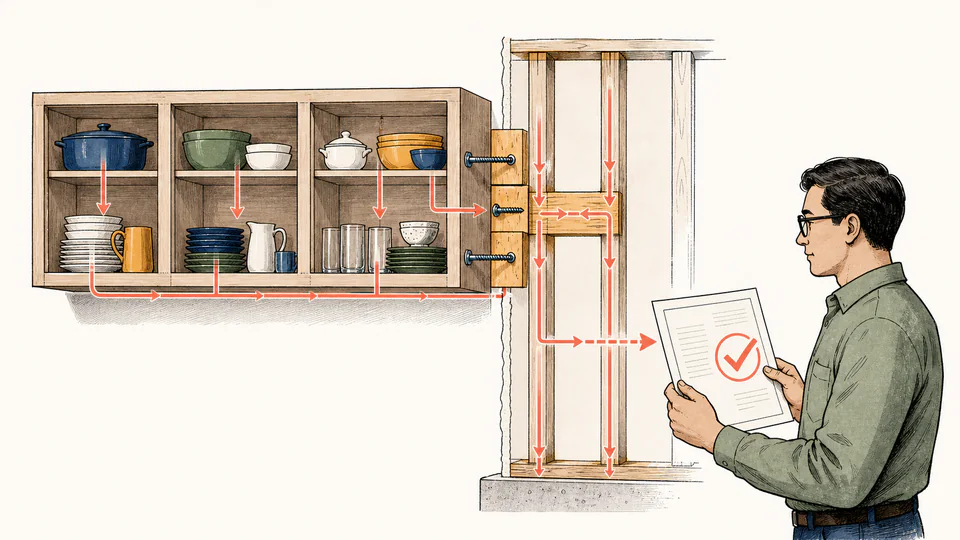
The mounting-path illustration shows why cabinet boxes, rails, blocking, fasteners, and wall support cannot be screened independently. The ledger carries service load through the planning factor before comparing it with the declared complete-system allowable.
| Load layer | Per cabinet | Cabinet count | Aggregate load | Planning treatment | Decision use |
|---|
How to use
Load-path fundamentals
Calculation method
Cabinet self-weight and contents each multiply by cabinet count. Their sum is service load. The planning factor applies once to that service load. The resulting demand is divided by the entered complete-system allowable, while margin is allowable minus demand.
Allowable provenance
Cabinet performance standards contain defined test arrangements and purposes. An individual test value does not establish an allowable for unknown blocking, fasteners, wall material, installation, eccentricity, damage, or field geometry. Use project-specific manufacturer or engineering documentation.
Load distribution
Cabinet rails and screws may not share load evenly. Edge distance, stud position, slots, shims, gaps, cabinet stiffness, door operation, and overturning can concentrate demand. This page deliberately avoids calculating a per-fastener acceptance value.
Use and occupancy
Dishes, appliances, files, chemicals, and supplies have different densities and loading patterns. Consider adjustable shelves, impact, people pulling on doors, maintenance, and foreseeable misuse in the qualified review. A low default contents estimate is not a safe limit.
Detailed calculation process
The current result cards and load-path ledger above provide the final reconciliation.
Result interpretation
Within the entered allowable means only that factored arithmetic demand does not exceed the external value supplied by the user. The status is invalid if that allowable does not apply to the exact cabinet bank, substrate, anchorage, installation, use, and governing load combinations.
Decision analysis
If utilization is high, do not reduce the factor to force a pass. Confirm cabinet and contents weights, obtain the actual mounting design, improve blocking or anchorage through qualified design, redistribute contents, restrict use, or select a verified system with appropriate capacity.
Evidence and data lineage
Keep cabinet manufacturer, model, dimensions, self-weight, shelf and contents assumptions, cabinet-bank layout, mounting rail, fastener type and size, quantity and location, wall construction, stud or blocking material, edge distances, shims, installation instructions, installer, inspection, tested or engineered allowable source, planning factor rationale, seismic or special loads, damage, alterations, and use restrictions.
Limits and exclusions
Key terminology
Worked decision cases
The allowable is documented for the exact cabinet bank and substrate, installation is inspected, and contents assumptions match use. The screen supports record review.
No complete-system allowable exists. Entering a guessed value would produce a meaningless status; qualified investigation is required before loading.
Authoritative basis
Do not load wall cabinets from this calculator alone. A qualified person must verify the cabinet, wall, blocking, anchors, load path, instructions, and intended use, and the installation must follow approved documentation.
Cabinet safety depends on the complete cabinet-to-structure path, not a generic screw value.
No. A standard test value has a defined test purpose and does not automatically represent field service capacity.
Real stiffness, geometry, gaps, and installation can create unequal load sharing.
Wall cabinets normally require their own load path; include only loads that the verified system is designed to support.
The entered demand exceeds the entered allowable and the plan requires qualified correction, not rounding or assumption changes.
No. It is conditional on the accuracy and applicability of every input and does not replace design or inspection.