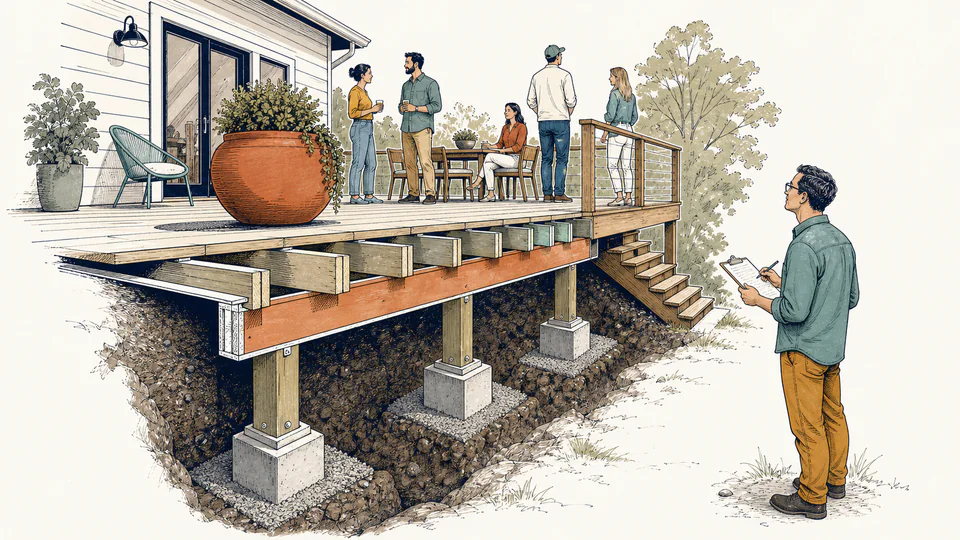
Uniform gathering load
People are distributed across the deck. The aggregate screen records a live-load basis, while joist and beam design still depends on spans and tributary widths.
Home & Construction
Keep entered load assumptions and the verified allowable distinct; the page does not derive joist, beam, post, connection, or footing capacity.
DECK LOAD-BASIS SCREEN
The page totals dead, live, and additional concentrated loads before one explicit planning factor. Capacity is not derived; the entered whole-system allowable must come from qualified project evidence.
PROJECT DECISION ILLUSTRATION
Trace deck area, tributary load, and declared concentrated demand to the preliminary load record; the ledger reports demand only and does not claim member, connection, or foundation capacity.
| Load layer | Quantity | Entered intensity / factor | Calculated load | Basis | Decision role |
|---|
How to use
Deck load fundamentals
Calculation method
Deck area multiplies dead and live intensities separately. The additional concentrated-load allowance is added afterward because it is not spread by the calculator. Their service-load sum is multiplied by the entered planning factor and compared with the entered whole-system allowable.
Load-path boundary
Members respond to tributary area, span, continuity, load position, connection behavior, and support conditions. Average demand per post is only a reconciliation check. It must not replace reactions, beam analysis, post stability, connection design, or soil-bearing verification.
Concentrated-load discipline
A hot tub, planter, masonry feature, storage cluster, or crowd can create local effects that a whole-system total hides. Keep the object, footprint, filled weight, location, support framing, and load combination with the project record.
Allowable compatibility
Do not compare service demand with a nominal ultimate capacity or a single component test. Confirm whether the entered value includes the same dead, live, snow, occupancy, duration, safety, and load-combination basis. A planning factor is not a substitute for code combinations.
Detailed calculation process
The current result cards and ledger above provide the final reconciliation.
Result interpretation
A nonnegative margin means only that the declared aggregate demand does not exceed the entered aggregate allowable. It does not verify member capacities, deflection, vibration, local effects, lateral resistance, connections, ledger attachment, footing bearing, soil, decay, or construction quality.
Decision analysis
If utilization is high, confirm loads, concentrated items, load combinations, and the external capacity record with the responsible professional. Do not reduce live load, erase a feature, average reactions, or raise the allowable merely to obtain a favorable card.
Evidence and data lineage
Keep permit set, framing plan, deck geometry, material schedule, dead-load takeoff, governing live and snow loads, concentrated-item specifications and locations, load combinations, engineering calculations, member and connector schedules, ledger details, lateral-load details, footing dimensions, soil-bearing basis, inspection records, alterations, deterioration observations, calculation version, and exact unrounded inputs and outputs.
Limits and exclusions
Key terminology
Worked decision cases
People are distributed across the deck. The aggregate screen records a live-load basis, while joist and beam design still depends on spans and tributary widths.
A similar total is concentrated over a smaller footprint near selected supports. The whole-deck result may look unchanged, but local framing, reactions, vibration, and footing demand require a dedicated engineered check.
Authoritative basis
Use project-specific calculations from a licensed professional and approvals from the authority having jurisdiction. This page records an entered load basis; it cannot determine whether a deck is safe or adequate.
Real reactions depend on geometry, spans, continuity, support locations, and load placement rather than equal division.
No. Beam design requires span, tributary width, material properties, load combinations, deflection, connections, and code rules.
Use the governing project load combinations; do not substitute one value without qualified code review.
You may record its documented filled weight, but placement and local structural design still require professional analysis.
It is an explicit user-entered multiplier for a documented planning purpose, not a code safety factor or capacity generator.
No. It means only that one entered aggregate demand is below one entered aggregate comparison value.