Large open shell
Long uninterrupted walls may support the entered high production rates. A larger crew can reduce productive days, provided lifts, material flow, and inspection zones scale with it.
Home & Construction
Keep productive crew time distinct from compound drying and inspection waits so added labor is not credited with shortening chemical or administrative holds.
DRYWALL READY-FOR-PAINT PLAN
Wall and ceiling area drive the labor phases. Coat count and drying time create elapsed waits that a larger crew cannot erase; the ledger keeps those clocks separate before reporting the ready-for-paint day.
EDITORIAL FIELD GUIDE
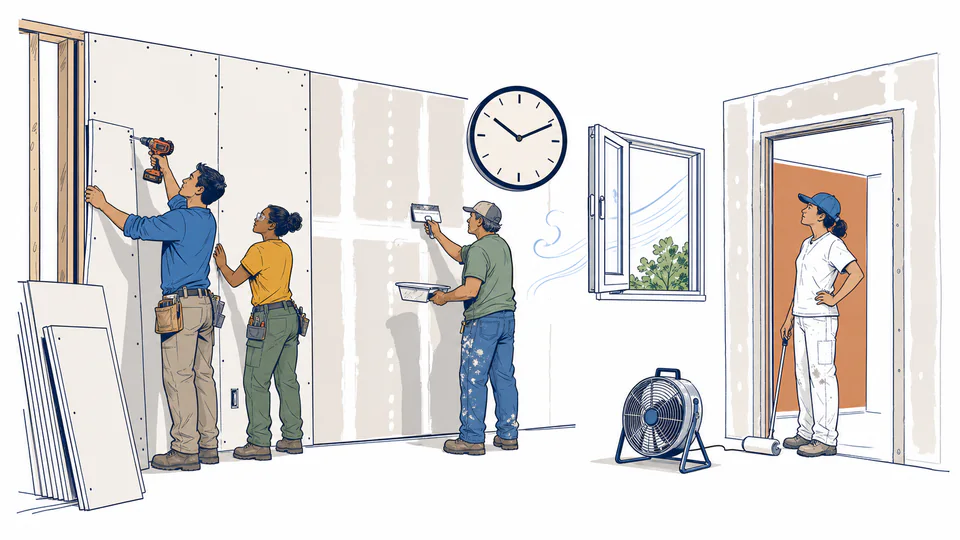
The illustration is explanatory, not a graph and not a source of numeric results. Current values are reconciled only in the result cards and exact table below.
| Phase | Quantity basis | Labor-hours | Crew-days | Elapsed wait | Release condition |
|---|
How to use
Drywall schedule fundamentals
Calculation method
Hanging uses total board area divided by hanging productivity. Finishing multiplies that area by coat count before division by per-coat productivity. Sanding uses its own rate. The sum becomes productive crew-days; drying and inspection remain elapsed days added after the labor conversion.
Finish-level boundary
A Level 4 residential finish, a Level 5 critical-lighting finish, a fire-taping scope, and a temporary partition are not interchangeable. Record the finish requirement, board type, corner treatment, and inspection criteria behind the entered coat count.
Drying conditions
Compound type, thickness, temperature, humidity, ventilation, substrate moisture, and successive coat timing determine drying. Use the manufacturer’s conditions or observed project evidence rather than assuming every coat dries overnight.
Crew scaling
The arithmetic assumes entered labor productivity remains valid at the selected crew size. Congestion, scaffold limits, lift access, room fragmentation, tool availability, and trade handoffs can cap useful crew growth; drying remains unchanged.
Detailed calculation process
The current result cards and phase ledger above provide the final reconciliation.
Result interpretation
The result assumes phases are sequential and the entered rates represent total labor-hours. It does not mean the room is occupied, inspected for every code requirement, trimmed, primed, or free from touch-up. Define the receiving trade’s acceptance criteria before using the date.
Decision analysis
If productive crew-days dominate, labor planning may matter. If drying and inspection dominate, extra hangers will not proportionally advance paint release. Run documented alternatives for compound type, ventilation, work zones, and crew composition rather than applying a blanket acceleration factor.
Evidence and data lineage
Keep drawings and takeoff revision, wall and ceiling area, board type, finish level, coat system, corner and bead scope, crew composition, productivity source, work hours, temperature and humidity records, ventilation plan, compound technical data, inspection requirements, and accepted rework with the schedule.
Limits and exclusions
Key terminology
Worked decision cases
Long uninterrupted walls may support the entered high production rates. A larger crew can reduce productive days, provided lifts, material flow, and inspection zones scale with it.
Small rooms, protection, daily cleanup, restricted hours, and isolated drying conditions can make elapsed access and cure time more important than nominal square-foot rates.
Authoritative basis
Confirm the schedule with the finishing system manufacturer, project specification, site superintendent, and receiving trade. Do not compress drying or inspection holds merely to reach a target date.
Drying is elapsed dependency time, not productive labor. A worker can leave the room, but the next coat still waits for the required condition.
Yes, but this page uses a conservative sequential scope. Model separate zones if work fronts genuinely overlap.
No. The formula divides labor-hours, but congestion, access, tools, and handoffs may reduce actual productivity.
It is the entered planning handoff after finishing, drying, sanding, and declared holds—not proof of primer or finish acceptance.
Only if the recorded method supports it. Base coats, fill coats, skim coats, and touch-up can have different productivity.
No. Crew-days describe productive capacity; weekends, restricted hours, and explicit no-work days need separate schedule treatment.