Fire-taping utility room
Board and fastener quantities may be similar to a finished room, while coat count and compound demand are much lower under the accepted finish requirement.
Home & Construction
Keep boards, fasteners, tape, and compound on their own measured or specified consumption bases instead of multiplying one generic waste factor through every item.
DRYWALL MULTI-MATERIAL TAKEOFF
Net wall and ceiling areas determine whole sheets with the entered board allowance. Fasteners follow installed area, tape follows an entered per-sheet joint proxy, and compound follows area, finish coats, and container size.
EDITORIAL FIELD GUIDE
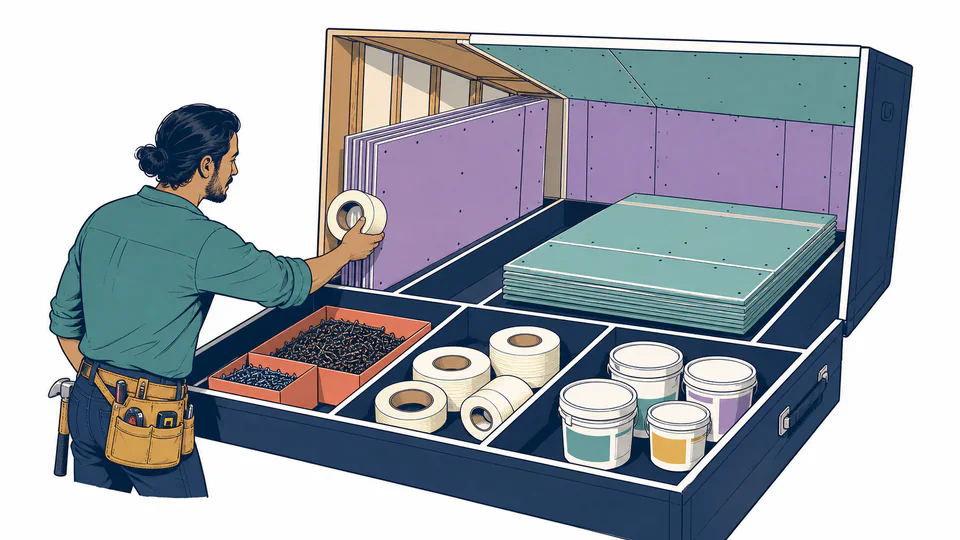
The illustration is explanatory, not a graph and not a source of numeric results. Current values are reconciled only in the result cards and exact table below.
| Material family | Demand basis | Unrounded demand | Package yield | Order quantity | Boundary |
|---|
How to use
Takeoff fundamentals
Calculation method
Wall and ceiling sheets apply the entered board allowance and round separately. Screws follow net installed area without board waste. Tape follows the declared joint proxy and roll yield. Compound follows net area, finish-coat count, consumption rate, and container weight.
Fastener basis
Screws per square foot are only a compact input. Board thickness, framing material and spacing, ceiling versus wall, adhesive use, edge and field spacing, fire or sound assembly, and code requirements must support it.
Finishing basis
Room geometry, sheet orientation, butt joints, corners, beads, repairs, skim coating, tool losses, premixed water content, and finish level change consumption. Preserve the estimator or manufacturer basis for both proxies.
Mixed assemblies
Do not blend standard wall board, Type X ceilings, wet-area board, shaftliner, impact panels, double layers, or different finish levels into one average. Separate them, then consolidate compatible purchase units.
Detailed calculation process
The current result cards and purchase-family ledger above provide the final reconciliation.
Result interpretation
The page does not claim that 1.25 screws/ft², 16 ft of tape per sheet, or 12 lb/1,000 ft²/coat is universal. Those are explicit planning inputs whose product, layout, and specification sources must travel with the result.
Decision analysis
Record unopened returns, usable remnants, discarded compound, actual screws, damaged sheets, and extra coats. Compare actual consumption with each entered driver instead of adjusting one blanket waste percentage.
Evidence and data lineage
Keep takeoff areas, board type, layer, thickness, sheet dimensions, allowance rationale, framing spacing, fastener schedule, adhesive assumption, joint layout, finish level, tape product and roll length, compound product, consumption source, coat count, container weight, package quantities, and actual field variance.
Limits and exclusions
Key terminology
Worked decision cases
Board and fastener quantities may be similar to a finished room, while coat count and compound demand are much lower under the accepted finish requirement.
A higher finish level or skim coat can raise compound and labor substantially without changing the board area. Keep the finish input independent.
Authoritative basis
Verify product-specific yields and the governing assembly before purchase. This page keeps assumptions visible; it does not create an approved material schedule.
Screws attach installed area; unused or discarded board should not automatically create installed fastener demand.
It is an entered proxy for planning. A panel layout or measured joint schedule is more accurate.
The entered rate may reflect normal finishing around bead, but bead quantity itself is not calculated.
They are summed for the headline but rounded separately because orientation and product may differ.
Convert the screw result to the selected carton size and add only a documented loss or contingency rule.
Only if the entered compound rate and coat count explicitly represent that specification and method.