Repeat rectangular production
Consistent sizes and coil-fed fabrication may support measured high yield and credible remnant reuse.
Home & Construction
Avoid one unexplained waste percentage by showing which added area serves seams, layout scrap, fittings, and credible reuse.
DUCT FABRICATION ALLOWANCE
Straight rectangular and round surface are combined with fitting-equivalent area. Seam and scrap additions are shown before documented offcut recovery.
SUBJECT DECISION ILLUSTRATION
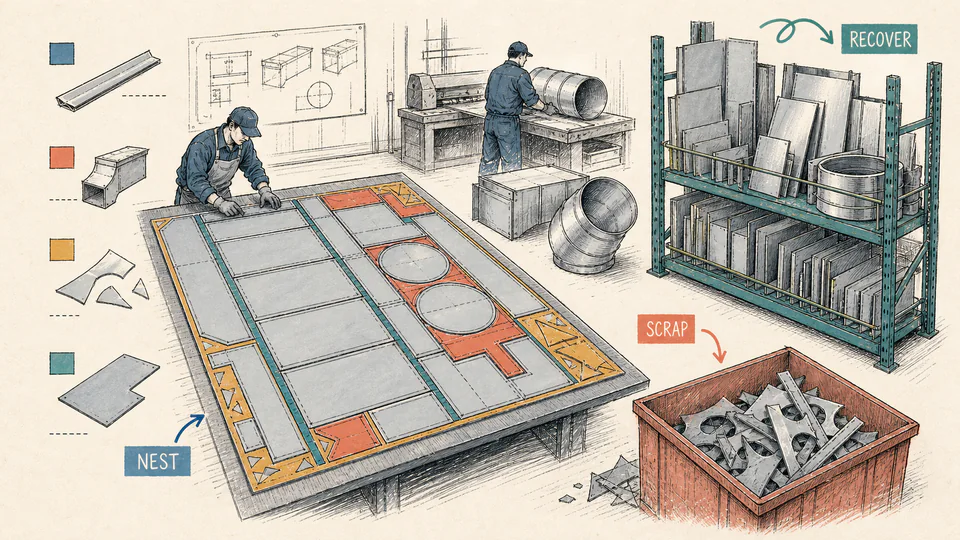
The illustration explains the professional setting without pretending to be a data chart. The ledger below preserves the entered values and calculation path.
| Area layer | Declared basis | Addition / recovery rule | Area before rounding | Current area | Evidence required |
|---|
How to use
Allowance fundamentals
Calculation method
Net fabricated area combines straight surface and fitting-equivalent area. Seam and base scrap percentages are applied to that common net basis. Offcut recovery is applied only to the added seam and scrap pool, preventing a recovery credit from erasing required duct skin.
Nesting boundary
Coil width, sheet dimensions, gauge segregation, Pittsburgh or other seams, reinforcement, fitting development, part rotation, CNC capability, grain or coating direction, and minimum remnants determine real nesting yield.
Recovery boundary
Retain gauge, material, coating, dimensions, condition, traceability, storage, and assigned future part. An optimistic universal recovery percentage can understate purchasing.
Fitting depth
Elbows, transitions, offsets, branches, taps, plenums, caps, access pieces, and reinforcements do not share one simple multiplier. Replace the entered equivalent area with shop software or detailed development when procurement matters.
Detailed calculation process
The current cards and area ledger provide the live reconciliation.
Result interpretation
The final percentage summarizes the entered seam, scrap, and recovery evidence. Preserve the component areas so another estimator can challenge the assumptions and replace them with actual nesting results.
Decision analysis
Do not pool recovery across galvanized steel, stainless steel, aluminum, different gauges, coatings, liner requirements, or incompatible jobs. Run separate calculations when the stock pools cannot substitute.
Evidence and data lineage
Keep drawing/model revision, duct sizes and lengths, fitting development report, material, gauge, coating, joint and seam system, stock/coil dimensions, nesting report, shop scrap history, remnant inventory, recovery assignments, purchasing minimums, estimator, date, and unrounded area ledger.
Limits and exclusions
Key terminology
Worked decision cases
Consistent sizes and coil-fed fabrication may support measured high yield and credible remnant reuse.
Mixed gauges, many transitions, and small quantities can reduce nesting efficiency and make broad recovery credits unreliable.
Authoritative basis
This page documents entered fabrication allowances. Shop development, nesting, purchasing, material control, and the governing duct construction specification determine actual sheet requirements.
Fittings consume real developed sheet and belong in the net fabricated basis.
No. Recovery is limited to the added seam and scrap pool and cannot remove required net skin.
No. It becomes part of the fabricated duct; it is an order addition, not necessarily discarded material.
Fittings are useful product, while scrap is stock not assigned to the represented fabrication.
Only with evidence; different stock pools and pattern mixes should usually be calculated separately.
No. It reports area; sheet, coil, package, and supplier rounding require a procurement model.