Clear attic top-up
Minimal removal and good access make material and installation the major layers. Bag rounding and label coverage dominate the estimate.
Home & Construction
Price the thermal material separately from access, removal, and air-sealing scope so an apparently low material rate does not hide the work needed for a durable assembly.
INSULATION SCOPE COST
The calculator rounds product to whole bags using the coverage entered for the selected R-value. Labor, removal, air sealing, and equipment remain visible cost layers before one declared contingency is applied.
EDITORIAL FIELD GUIDE
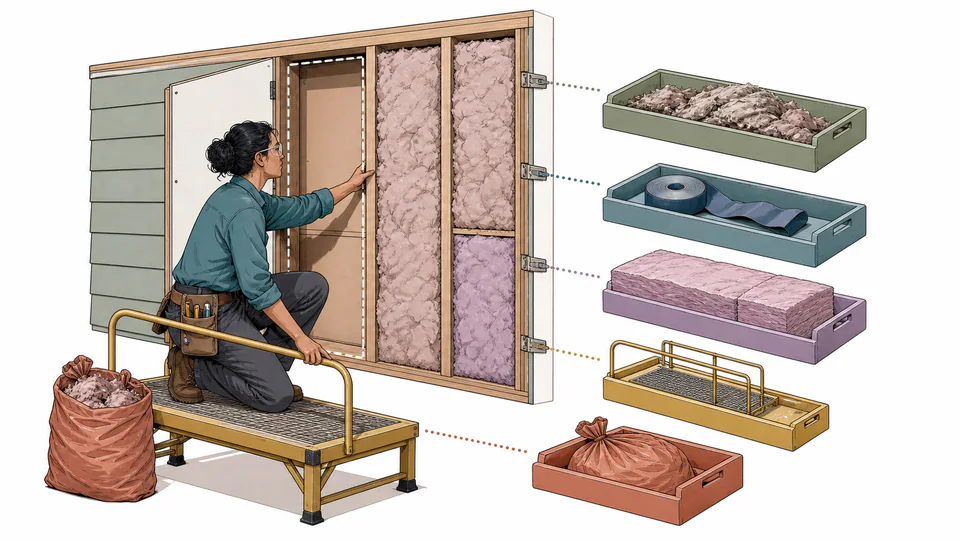
The illustration is explanatory, not a graph and not a source of numeric results. Current values are reconciled only in the result cards and exact table below.
| Cost layer | Quantity basis | Rate or yield | Base amount | Contingency treatment | Included amount |
|---|
How to use
Cost fundamentals
Calculation method
Whole bags equal area divided by coverage per bag, rounded upward. Bag count times current unit price gives material. Installation and removal use their own measured areas and rates. Air sealing and equipment remain explicit lump sums; contingency applies once to their combined base.
Coverage basis
A bag may cover very different square footage at different depths, densities, and R-values. Do not use a package headline from another target, and do not convert batt, blown, and spray products through one generic yield.
Assembly scope
Air leakage, moisture, ventilation, combustion safety, recessed fixtures, blocking, access, wiring, and pest damage can control the work. Price investigation and correction where required rather than hiding it in a material multiplier.
Cost normalization
The denominator is the area receiving new insulation. A project with extensive removal and air sealing will have a higher normalized cost than a clear open attic even when the material rate is identical; that difference can be informative rather than an error.
Detailed calculation process
The current result cards and cost ledger above provide the final reconciliation.
Result interpretation
The result assumes every bag delivers the entered label coverage and the measured area is correct. Settling, density, depth, obstructions, inaccessible bays, compression, gaps, and installer technique are not proven by the invoice.
Decision analysis
Separate material, installation, removal, air sealing, equipment, and contingency in every quote. A lower price may simply omit removal, access, baffles, ventilation protection, safety testing, or verification rather than offer an equivalent method.
Evidence and data lineage
Keep zone measurements, climate and code target, product manufacturer and SKU, declared R-value and coverage, unit-price date, labor scope, removal quantity, disposal method, air-sealing checklist, equipment and access assumptions, ventilation and combustion-safety review, contingency rationale, rebates, taxes, and excluded work.
Limits and exclusions
Key terminology
Worked decision cases
Minimal removal and good access make material and installation the major layers. Bag rounding and label coverage dominate the estimate.
Access, removal, air sealing, protection, and verification can exceed product cost. A simple $/ft² material comparison would be misleading.
Authoritative basis
Confirm assembly safety, moisture control, ventilation, product coverage, and complete contractor scope before relying on the estimate.
The same bag covers different areas at different installed depths and densities.
Only the explicit air-sealing allowance you enter; verify the actual leakage paths and work scope.
Some zones may retain suitable existing material while others require removal and disposal.
No rebate is modeled. Apply project-specific incentives after confirming eligibility and timing.
No. It normalizes project cost only; savings require an energy and building-system analysis.
Yes only by entering each product’s actual coverage and equivalent complete scope, then considering performance and constructability separately.