Well-documented loose-fill attic
Zone measurements, bag chart, bag count, and depth markers reconcile; the nominal coverage result supports the field evidence.
Home & Construction
Retain each zone and the product label coverage for the chosen thermal target; nominal square footage does not prove installed quality.
INSULATION ZONE COVERAGE
Each zone remains in the evidence trail. Exclusions are deducted once, one declared allowance is applied, and product coverage must correspond to the selected material and R-value before the page compares required and available bags.
EDITORIAL FIELD GUIDE
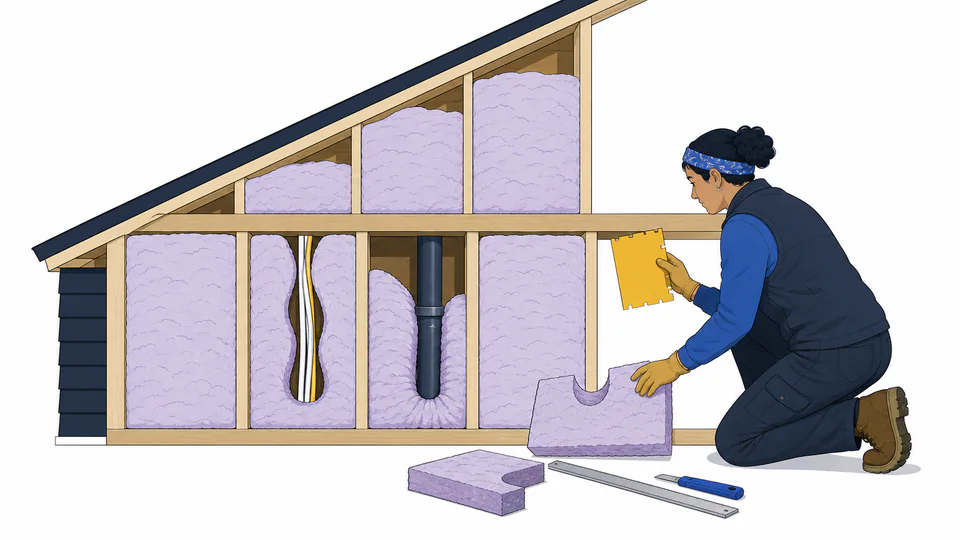
The illustration is explanatory, not a graph and not a source of numeric results. Current values are reconciled only in the result cards and exact table below.
| Zone or step | Measured area | Deduction / allowance | Required coverage | Available coverage | Balance / status |
|---|
How to use
Coverage fundamentals
Calculation method
The model sums positive zone records, subtracts the entered exclusion, applies one percentage to the remaining net area, and divides by the product coverage per bag before rounding upward. Available bags use the same coverage basis so the reported balance is comparable.
Product-label boundary
Loose-fill bag charts, batt package areas, board dimensions, and spray yields are not interchangeable. For many products, higher R-value or greater depth means less area per package. Record the exact line from the current product data.
Installation-quality boundary
Gaps, compression, low density, uneven depth, voids around wiring and pipes, wind washing, thermal bridges, moisture, and missing air control can reduce performance even when the nominal bag count matches the arithmetic.
Zone evidence
Separate flat attic, sloped ceiling, kneewall, rim joist, floor, wall, and access-platform zones when their product, depth, density, or installation method differs. Run another calculation rather than averaging unlike assemblies.
Detailed calculation process
The current result cards and zone ledger above provide the final reconciliation.
Result interpretation
“Nominal coverage available” means the entered bags multiply to at least the required order area. It does not mean the installed assembly reaches the target R-value or is free of gaps, compression, moisture, air leakage, or thermal bridging.
Decision analysis
A shortfall calls for additional compatible product or a revised measured scope. A large surplus may indicate conservative allowance, package rounding, an incorrect label yield, or omitted zones. Reconcile it before reducing the order.
Evidence and data lineage
Keep measured zone identifiers, dimensions, exclusions and their purpose, assembly type, climate or code target, product manufacturer and SKU, R-value, depth and density target, coverage chart revision, allowance rationale, bags installed, bag labels, depth markers, coverage photos, gaps and compression inspection, baffles, dams, air-sealing evidence, and accepted corrections.
Limits and exclusions
Key terminology
Worked decision cases
Zone measurements, bag chart, bag count, and depth markers reconcile; the nominal coverage result supports the field evidence.
Package area may be sufficient, but poor cuts around pipes and wiring create gaps and compression. Material quantity cannot substitute for inspection.
Authoritative basis
Confirm the product’s coverage at the specified target and inspect depth, density, fit, gaps, compression, moisture, air control, and ventilation before accepting the work.
Separate records expose omitted areas and preserve the takeoff for field reconciliation.
Only if the product coverage and takeoff method are defined that way; framing also creates thermal bridges rather than disappearing from the assembly.
Higher targets commonly require more installed material per square foot, reducing package coverage.
No. Material must be installed to the required fit, depth, and density in each zone.
Use separate calculations when coverage basis, target, depth, density, or installation method differs.
Verify measurements and label yield, then treat the remainder according to package return, contingency, and field-quality needs.