Installed loose-fill
A large volume at low density can produce a modest average psf when spread across the full ceiling area.
Home & Construction
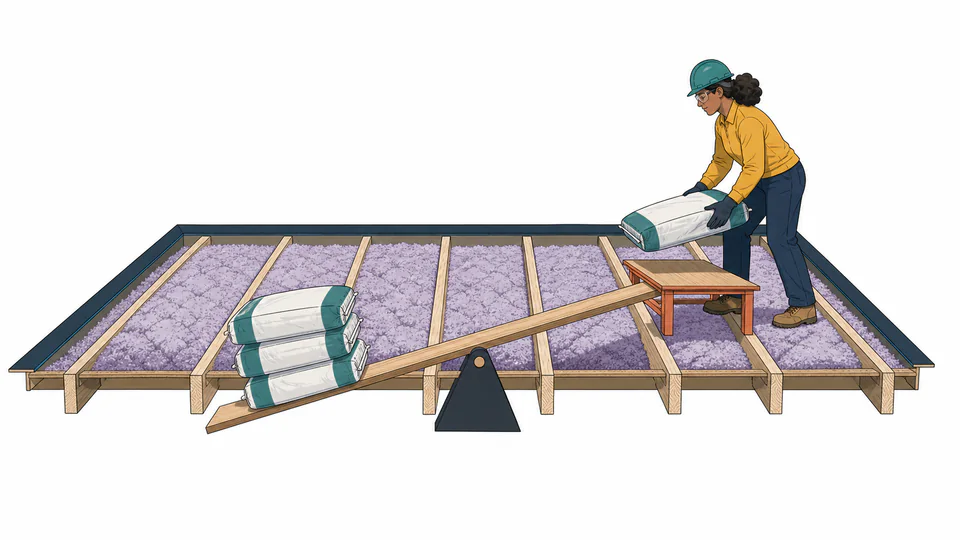
Keep the distributed installed material and the temporary staged delivery separate because equal total weight can create very different local demands.
INSULATION LOAD PATH SCREEN
Installed weight spreads across the entered area and derives directly from density and depth. Unopened bags occupy a much smaller staging footprint, so their local pounds per square foot are reported separately.
EDITORIAL FIELD GUIDE
The illustration is explanatory, not a graph and not a source of numeric results. Current values are reconciled only in the result cards and exact table below.
| Load state | Area or volume | Density / unit weight | Total weight | Average psf | Use boundary |
|---|
How to use
Load fundamentals
Calculation method
Installed volume equals area times depth converted from inches to feet. Volume times in-place density gives total installed weight, and dividing by area gives installed psf. Staged weight equals bag count times bag weight; dividing by the measured footprint gives staged psf.
Density evidence
Installed density can depend on settling, netted dense-pack procedure, thickness, substrate, and product. Do not substitute packaged density or a value from another material. Use manufacturer instructions, specifications, or verified field records.
Staging geometry
Platforms, joists, sleepers, wheels, and workers transfer temporary loads through smaller contact areas. The model’s average staging psf is a screening demand; it does not resolve actual point loads or the supporting framing.
Existing load context
Ceiling finishes, framing self-weight, storage, ductwork, equipment, people, tools, old insulation, moisture, and access platforms may already load the assembly. The page does not subtract capacity or combine those demands.
Detailed calculation process
The current result cards and load ledger above provide the final reconciliation.
Result interpretation
Installed psf describes only the entered insulation average. Staged psf describes only the bag stack average. Neither result states allowable floor, ceiling, joist, truss, platform, or access-path capacity, and neither includes workers or equipment.
Decision analysis
Possible controls include smaller deliveries, ground-level feeding, approved platforms, distributing bags only over reviewed supports, and limiting bags in the work zone. Any change must preserve safe access and be approved for the actual structure.
Evidence and data lineage
Keep product and SKU, installed method, specified depth and density, measured area, existing material, package weight, maximum staged bags, stack dimensions, platform or dunnage, support orientation, delivery route, worker and equipment loads, floor or ceiling construction, structural review, and approved staging location.
Limits and exclusions
Key terminology
Worked decision cases
A large volume at low density can produce a modest average psf when spread across the full ceiling area.
The same future material occupies a small temporary footprint before installation, producing a much higher local average that deserves a separate plan.
Authoritative basis
Do not place bags, workers, carts, or equipment on an unverified ceiling, attic path, platform, or framing system. Obtain competent structural review.
One square foot at that depth has a volume equal to depth in feet; multiplying by pcf gives pounds per square foot.
No. Use in-place density for the installed method; compressed packaging density is different.
The bag weight is concentrated over a much smaller footprint than the installed area.
No. It compares two demands only and contains no structural capacity.
Yes in the real load review, along with equipment and contact areas; this page does not model them.
Only after the actual load path and platform are reviewed; location alone does not prove capacity.